
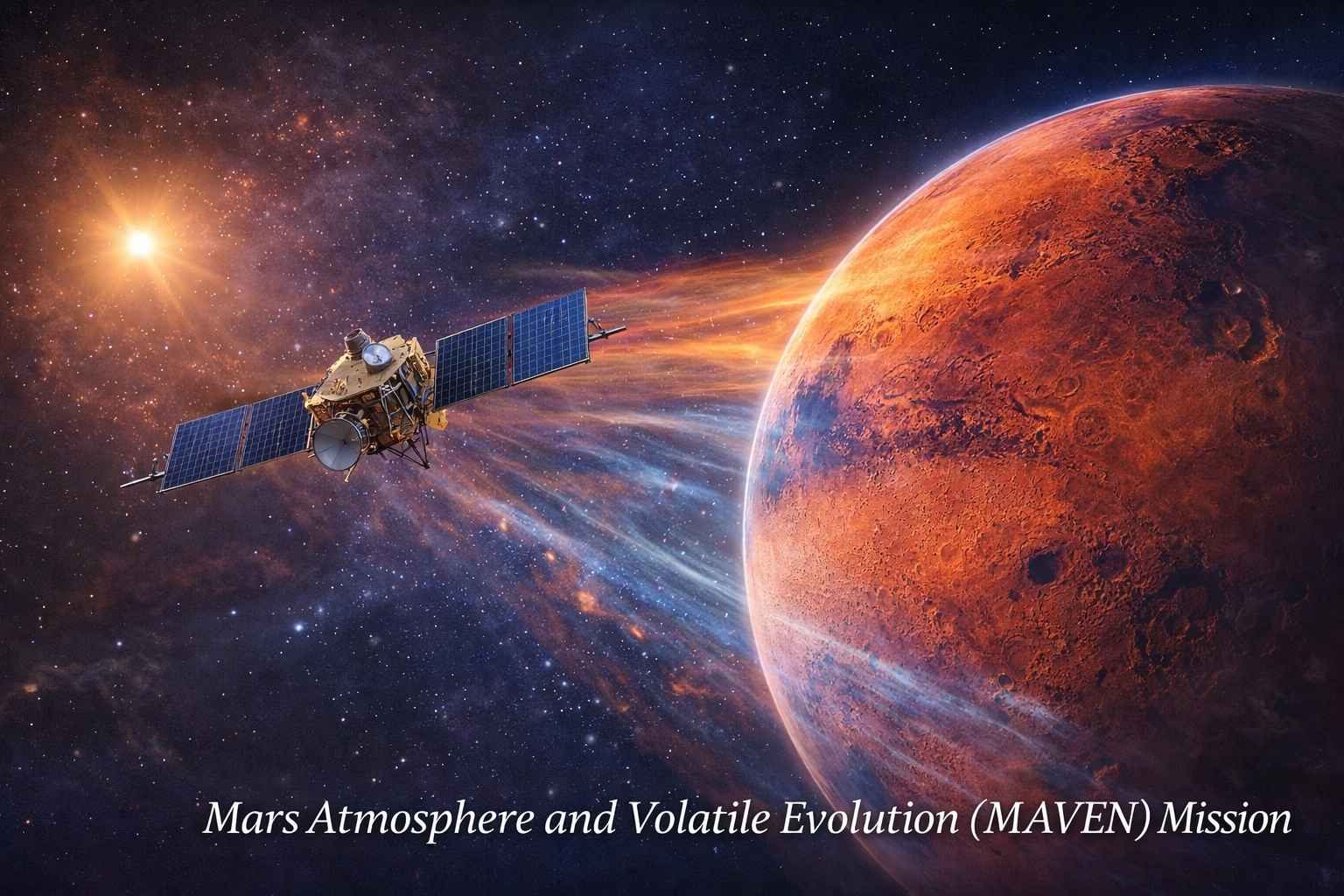
The NASA recently reported a loss of contact with the MAVEN spacecraft, which has been orbiting Mars for over a decade to study how the planet’s atmosphere escapes into space. Developments related to space missions and planetary science are highly relevant for GS Paper III and are regularly covered for aspirants preparing through UPSC coaching in Hyderabad.
About MAVEN Mission
- MAVEN is the first mission dedicated to studying the upper atmosphere of Mars.
- It is part of NASA’s Mars Exploration Program, aimed at understanding the planet’s habitability and climate changes.
- The mission investigates how the loss of atmospheric gases to space influenced Mars’s transition from a warm, wet planet to the cold, dry world we see today.
Launch and Orbit
- Launched in November 2013 and reached Mars in September 2014.
- Orbits Mars every 3.5 hours, coming as close as 150 km to the surface.
Scientific Instruments
- Solar Wind Package: Examines interactions between solar wind and the Martian ionosphere, explaining how the absence of a global magnetic field allowed atmospheric stripping.
- Ultraviolet Spectrometer: Studies the composition and dynamics of the upper atmosphere.
- Mass Spectrometer: Analyses the chemical composition of atmospheric particles and escaping gases.
These instruments provide crucial insights often discussed in space technology segments of Hyderabad IAS coaching.
Key Findings
- MAVEN discovered that Mars has lost nearly two-thirds of its early atmosphere to space.
- This loss explains why Mars shifted from a potentially habitable environment to its current barren state.
Conclusion
MAVEN has been central to understanding Mars’s atmospheric evolution. The recent communication loss underscores the importance of maintaining long-term planetary missions to unravel the mysteries of habitability beyond Earth.
This topic is available in detail on our main website.