

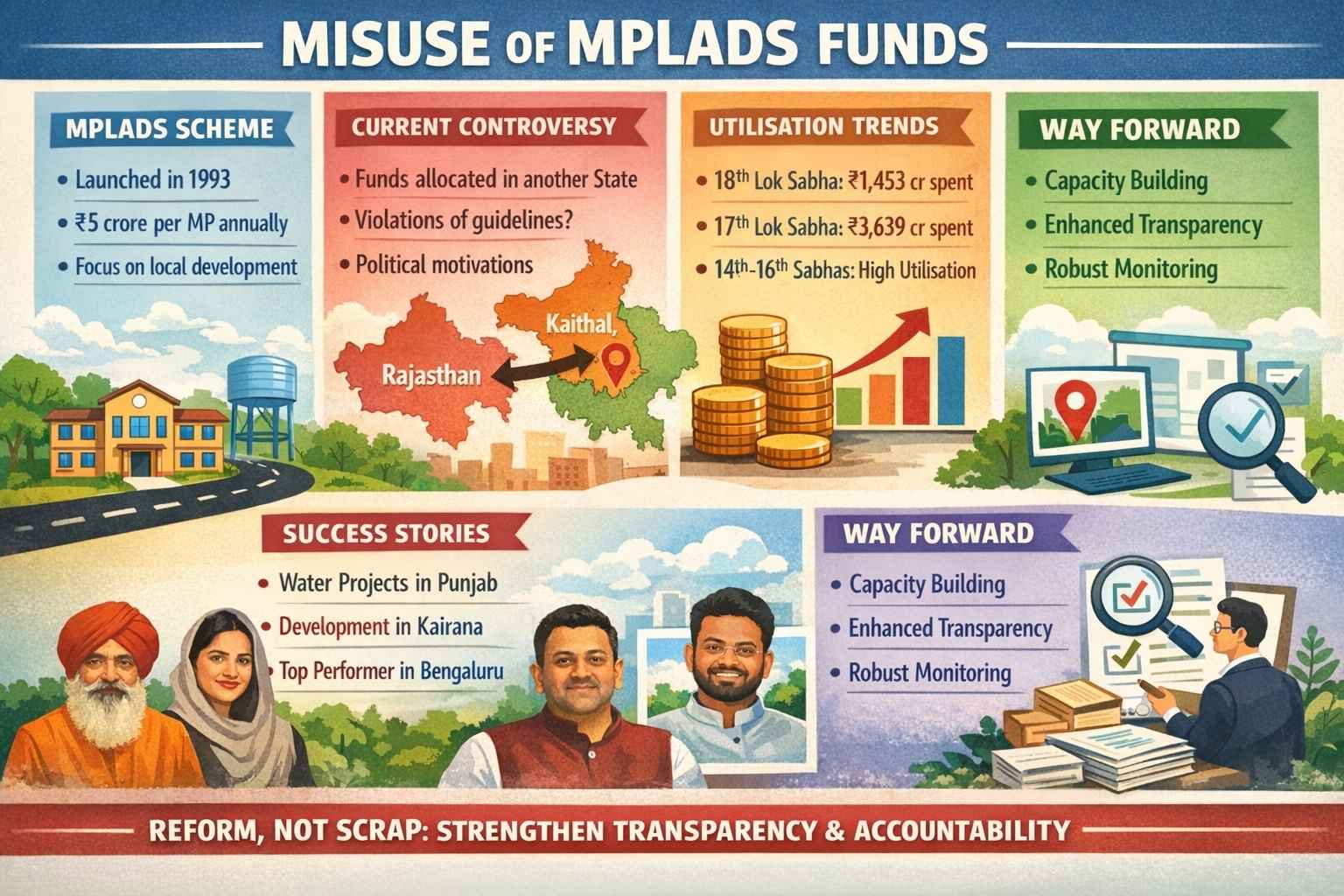
A recent controversy over alleged misuse of MPLADS (Members of Parliament Local Area Development Scheme) funds by some MPs has reignited debate on whether the scheme should be scrapped or strengthened. The issue is relevant for GS Paper II (Governance, Accountability) and is commonly analysed by aspirants preparing through UPSC coaching in Hyderabad.
MPLADS Scheme
- MPLADS was launched in 1993 as a Central Sector Scheme, fully funded by the Government of India.
- It allows MPs to recommend developmental projects worth ₹5 crore annually in their constituencies, focusing on durable community assets such as roads, schools, and water facilities.
- The scheme is monitored through the MPLADS dashboard, which tracks allocations and expenditures.
The Current Controversy
- Allegations emerged that three MPs from Rajasthan allocated funds for projects in Kaithal district, Haryana, instead of their own constituencies.
- Critics argued that this violated the spirit of the scheme, while the MPs cited 2023 guidelines, which permit:
- Up to ₹50 lakh annually outside the constituency/State.
- Up to ₹1 crore in cases of severe calamities.
- The episode reflects broader concerns about political motivations and cross-State allocations.
Utilisation Trends
- 18th Lok Sabha (ongoing): ₹5,486 crore allocated; ₹1,453 crore spent so far.
- 17th Lok Sabha (2019–24): ₹4,837 crore allocated; ₹3,639 crore spent; 41,143 projects completed out of 96,211 recommended.
- 16th Lok Sabha (2014–19): Only 8.7% funds unused.
- 15th Lok Sabha (2009–14): 3.47% funds unused.
- 14th Lok Sabha (2004–09): Less than 1% funds unused.
Despite some underutilisation—especially during the COVID period—overall data indicates that the scheme has largely remained effective.
Examples of Effective Use
- Sant Balbir Singh Seechewal (Punjab): Spent over ₹9.34 crore to address water scarcity.
- Iqra Choudhary (Kairana): Maintained a transparent MPLADS profile with geotagged project images.
- Tejasvi Surya (Bengaluru South): Utilised ₹19.36 crore, ranking among top performers.
- Abhishek Banerjee (Diamond Harbour): Completed 173 projects with ₹6.13 crore expenditure.
Arguments Against Scrapping
- Utilisation Remains Strong: Data shows high usage rates overall, suggesting misuse is the exception, not the norm.
- Localised Development Impact: MPLADS enables constituency-specific infrastructure addressing everyday civic needs.
- Accountability of MPs: Linking funds to constituency development strengthens representative responsibility.
- Loss of Flexibility if Scrapped: Abolition would remove a vital funding source for small but high-impact projects not covered by larger schemes—an issue often debated in governance discussions at Hyderabad IAS coaching.
Way Forward
- Capacity Building: Structured training for MPs and staff on planning and prioritisation of projects.
- Transparency Mechanisms: Wider use of geotagging, real-time dashboards, and citizen-accessible records.
- Robust Monitoring: Institutionalise stronger social and statutory audits to detect irregularities early and ensure compliance—best practices frequently emphasised in civils coaching in Hyderabad.
Conclusion
The MPLADS scheme has played a significant role in creating community assets and addressing local development needs. While instances of misuse exist, they do not define the scheme. Strengthening transparency, monitoring, and capacity-building mechanisms is a more constructive approach than discontinuation.
This topic is available in detail on our main website.