
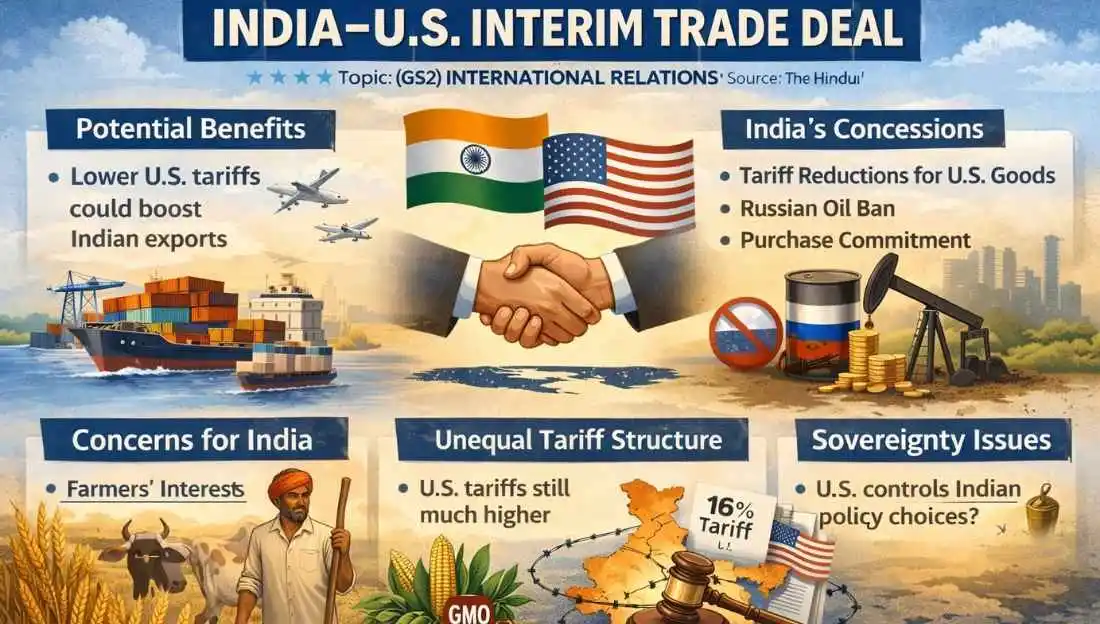
India and the U.S. recently signed an interim trade agreement after tariff disputes, but the deal has raised concerns about its impact on farmers, sovereignty, and unequal tariff concessions — an important issue for GS-II preparation in UPSC coaching in Hyderabad.
Background
- In 2025, U.S. President Donald Trump imposed 25% tariffs on Indian imports and penalised India for importing Russian crude oil.
- The interim deal reduces U.S. tariffs on Indian goods from 50% to 18%, while India makes major concessions — a development often analysed in IAS coaching in Hyderabad under India–U.S. relations.
India’s Concessions
- Tariff Reductions – India agreed to lower tariffs and non-tariff barriers on U.S. industrial goods and agricultural products.
- Russian Oil Ban – India committed to stop importing Russian oil “directly or indirectly.”
- Purchase Commitment – India pledged to buy $500 billion worth of U.S. products (energy, aircraft, metals, technology, coal) over five years.
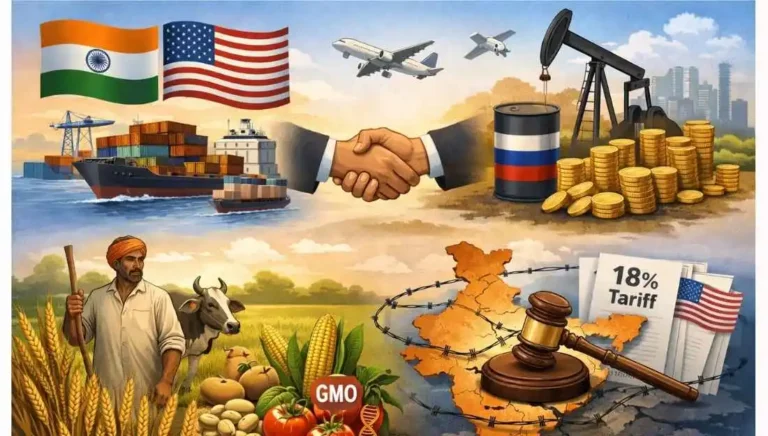
Potential Benefits
- Lower U.S. tariffs could help Indian textiles and labour-intensive exports gain competitiveness.
- Expands Indian business presence in the world’s largest economy.
- However, benefits may be diluted as the U.S. signed a similar deal with Bangladesh, giving its textiles duty-free access — a comparative trade dimension discussed in UPSC online coaching.
Concerns for India
- Farmers’ Interests – No clear protection for cereals and sensitive crops, raising fears of U.S. agribusiness entry.
- GM Food Imports – India agreed to address U.S. “long-standing concerns,” possibly opening doors to genetically modified food products.
- Unequal Tariff Structure – India removed barriers, but the U.S. still imposes 18% tariffs (much higher than the pre-2025 average of 2.5%).
- Sovereignty Issues – The U.S. retains the right to re-impose tariffs if India resumes Russian oil imports, raising questions of external influence over India’s trade decisions — a debate relevant for civils coaching in Hyderabad aspirants.
Conclusion
- The interim India–U.S. trade deal provides short-term market access gains but raises serious doubts about fairness, farmer protection, and sovereignty. For India, ensuring clear safeguards in the final agreement — especially on agriculture and independent policy space — will be crucial to balance economic opportunities with national interests and food security
This topic is available in detail on our main website.