
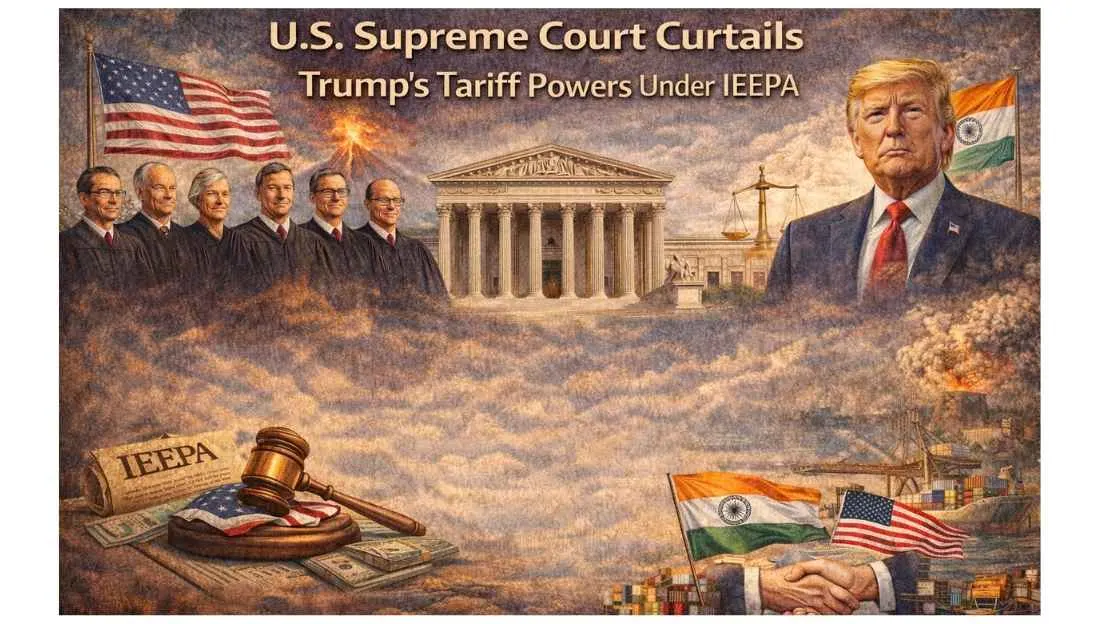
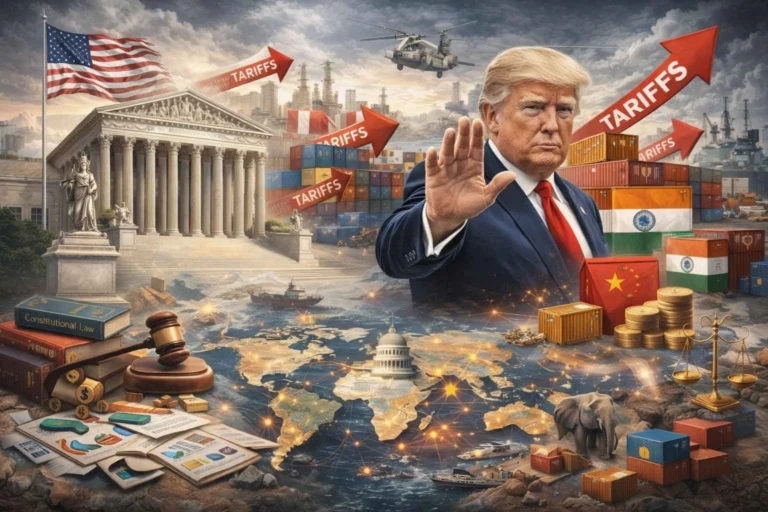
The U.S. Supreme Court (SCOTUS) has ruled that President Donald Trump cannot use the International Emergency Economic Powers Act (IEEPA) to impose tariffs, striking down his claim of unilateral authority. This limits presidential powers and strengthens democratic checks and balances — a key development in global trade politics often analysed in UPSC coaching in Hyderabad.
Background of the Case
• President Trump used the IEEPA to impose tariffs on several countries, including India.
• He claimed extraordinary powers to set tariffs of unlimited scope and duration.
• The Supreme Court ruled (6–3) that IEEPA does not authorize tariffs, as the law contains no reference to duties or taxation — a constitutional interpretation issue frequently discussed in IAS coaching in Hyderabad.
Court’s Observations
• No U.S. President has previously interpreted IEEPA as granting tariff powers.
• The Court emphasized that clear congressional authorization is required for taxation or tariff imposition.
• Chief Justice John Roberts and two conservative justices joined the liberal bloc in striking down Trump’s interpretation.
Impact on Tariffs
• Tariffs imposed under other laws, such as Section 232 of the Trade Expansion Act (1962), remain unaffected.
• Trump announced plans to impose tariffs under Section 122 of the Trade Act (1974), which allows temporary tariff hikes for 150 days.
• India had faced tariffs up to 50% earlier due to U.S. objections over its oil imports from Russia.
Implications for India
• The ruling changes the dynamics of ongoing India–U.S. trade negotiations.
• Indian negotiators may find more room for concessions since U.S. punitive tariff powers have been curtailed.
• It reduces uncertainty in bilateral trade talks and strengthens India’s bargaining position — an important angle covered in UPSC online coaching.
Broader Significance
• The ruling reinforces checks and balances in U.S. democracy.
• It curtails executive overreach and ensures that trade policy remains subject to legislative oversight.
• The decision highlights the importance of constitutional institutions in limiting excessive use of presidential powers.
Way Forward
• Strengthen Institutional Oversight: Ensure that trade and tariff decisions remain under Congressional authority to prevent unilateral misuse of executive powers.
• Promote Stable Trade Relations: India and other countries should leverage this ruling to push for predictable trade agreements free from sudden tariff shocks.
• Balance Executive Flexibility with Accountability: While Presidents need flexibility in emergencies, clear legal boundaries must be maintained to safeguard rule of law and global trust.
International Emergency Economic Powers Act (IEEPA)
• Enacted in 1977, IEEPA authorises the U.S. President to regulate international commerce during a declared national emergency.
• Powers include:
• Restricting or blocking financial transactions with foreign entities.
• Freezing foreign assets under U.S. jurisdiction.
• Imposing sanctions on individuals, companies, or countries deemed a threat.
• Controlling imports and exports linked to national security concerns.
• Importantly, IEEPA was designed for economic sanctions, not for imposing broad tariffs.
Trump’s Decisions under IEEPA
• In 2025, Trump issued executive orders imposing sweeping tariffs on most U.S. imports under IEEPA.
• He argued that tariffs were necessary to protect U.S. industries and national security.
• Tariffs were applied to multiple countries, including India, with rates as high as 50% on certain goods.
• These measures collected nearly $175 billion in global tariffs before being challenged in court.
• The U.S. Supreme Court (2026) ruled (6–3) that IEEPA does not authorise the President to impose tariffs, striking down Trump’s use of emergency powers.
• Following the ruling, Trump shifted strategy by proposing a 10% global tariff under Section 122 of the Trade Act (1974), which allows temporary tariff hikes.
Conclusion
The SCOTUS ruling is a landmark in limiting presidential overreach in trade policy. For India, it offers relief from unpredictable tariff hikes and opens space for more balanced negotiations. At a broader level, it strengthens democratic institutions and ensures that economic powers are exercised within constitutional limits — a perspective frequently highlighted in civils coaching in Hyderabad.