
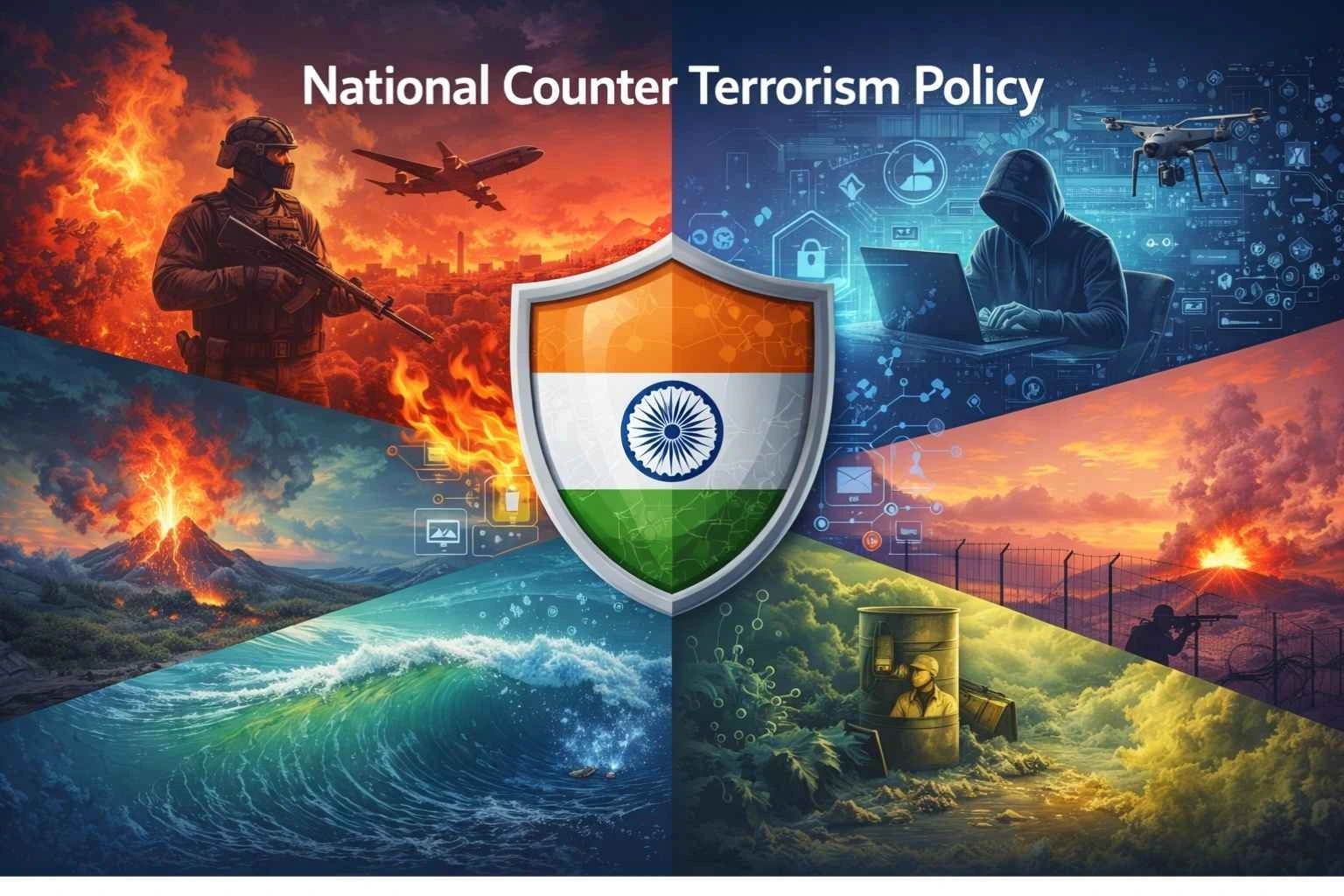
Recently, the Union Home Ministry unveiled India’s first-ever National Counter Terrorism Policy, titled PRAHAAR, aimed at tackling terrorism threats across land, water, air, and cyberspace — a key development for aspirants preparing under UPSC coaching in Hyderabad.
Nature of Threats
• India faces terrorist challenges on all three fronts — land, water, and air.
• Critical sectors such as power, railways, aviation, ports, defence, space, and atomic energy are vulnerable to attacks.
• Both state and non-state actors are involved in targeting India.
Cyber and Technological Dimensions
• Terror groups increasingly use cyber-attacks, drones, robotics, and encryption technologies.
• Platforms like social media, instant messaging apps, dark web, and crypto wallets are exploited for propaganda, funding, and coordination.
• Criminal hackers and foreign handlers are actively engaged in facilitating terror strikes.
Cross-Border and Global Terrorism
• India continues to face sponsored terrorism from across the border, especially in Punjab and Jammu & Kashmir.
• Global outfits such as al-Qaeda and IS attempt to incite violence through sleeper cells.
• Extremists abroad collaborate with local outfits for logistics and terrain knowledge.
Policy Principles
• Terrorism is not linked to any religion, ethnicity, or nationality.
• Focus on criminalising all terrorist acts and denying terrorists access to funds, weapons, and safe havens.
• Emphasis on community engagement: moderate preachers, NGOs, and civil society are involved to counter radicalisation.
• Move towards a uniform anti-terrorism structure across States for standardised responses — a dimension frequently analysed in IAS coaching in Hyderabad.

Challenges
• Difficulty in intercepting terrorist access to CBRNED materials (Chemical, Biological, Radiological, Nuclear, Explosive, Digital).
• Increasing reliance on organised criminal networks for logistics and recruitment.
• Need for legal expertise at every stage of investigation to strengthen prosecution.
Way Forward
• Strengthen Legal and Institutional Frameworks: Involve legal experts in investigations and ensure uniform anti-terror structures across States.
• Enhance Cybersecurity and Technology Safeguards: Build robust systems to counter drone misuse, cyber-attacks, and digital anonymity.
• Promote International Cooperation: Combine national actions with regional and global partnerships to address transnational terrorism effectively — an important theme covered in UPSC online coaching.
Conclusion
The PRAHAAR policy marks a significant step in India’s counter-terrorism strategy. By integrating legal, technological, and community-based measures, it aims to build a comprehensive and coordinated response to evolving terror threats — a critical topic for aspirants enrolled in civils coaching in Hyderabad.