
India’s upcoming Gaganyaan mission has brought attention to how astronauts safely return from space and survive the extreme conditions of atmospheric re-entry — a crucial space technology topic frequently analysed in UPSC coaching in Hyderabad.
Thermal Protection and Heatshield
• More than 98% of re-entry energy is dissipated into the atmosphere as heat.
• Capsules are protected by heatshields with thermal protection systems.
• Two methods are used: ablation, where the shield chars and erodes to carry heat away, and insulation, which prevents heat from reaching the capsule’s structure.
Re-entry Corridor
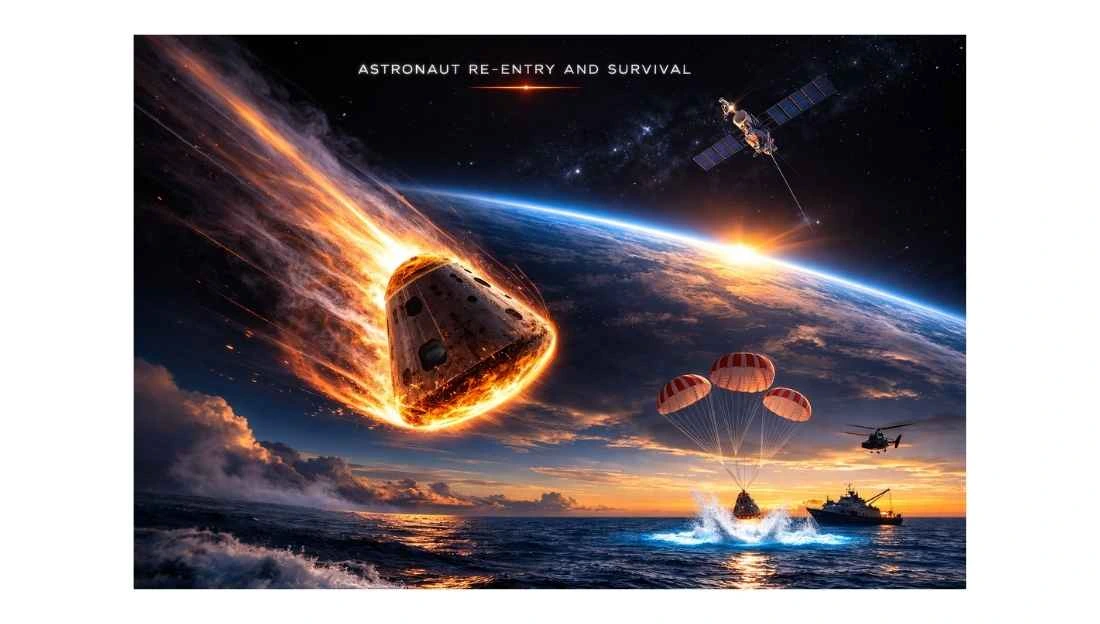
• To return, the capsule performs a deorbit burn, reducing speed so gravity pulls it back into the atmosphere.
• The re-entry corridor is a narrow atmospheric window: Too shallow an angle makes the capsule skip off the atmosphere back into space.
• Too steep an angle causes excessive heating and structural stress.
• Precise guidance ensures the capsule stays within safe limits.
Challenge of Re-entry
• Re-entry is the reverse of launch: instead of fighting gravity, the spacecraft must shed immense orbital velocity.
• Scientists initially feared re-entry would be impossible because the kinetic energy converts into extreme heat that could melt any material.
• The breakthrough came with the blunt body theory, which showed that rounded capsules deflect most heat into the surrounding air rather than absorbing it.
Semi-Ballistic Flight
• A purely ballistic body falls like a stone, but a semi-ballistic body uses an offset centre of gravity to fly at an angle of attack.
• This creates aerodynamic lift in addition to drag, allowing the capsule to steer and glide.
• Controlled manoeuvres help guide the capsule toward the targeted landing zone.
Communication Blackout
• During re-entry, extreme heat ionises air molecules, forming a plasma sheath that blocks radio signals.
• This causes a temporary communication blackout between astronauts and ground control.
• Engineers reduce this risk by using relay satellites and high-frequency signals that can pass through thinner plasma regions.

Parachute Deployment
• Aerobraking slows the capsule, but at lower altitudes the speed is still too high for safe landing.
• A multi-stage parachute system is deployed to further reduce velocity.
• This ensures a soft landing, usually in the sea, where recovery teams can reach the astronauts.
Gaganyaan Re-entry
• ISRO validated re-entry technology through the 2007 Space Capsule Recovery Experiment (SRE) and the 2014 CARE mission.
• In Gaganyaan, the service module will perform the deorbit burn and then separate, burning up during re-entry.
• The crew module will re-enter as a semi-ballistic body, guided by thrusters to stay within the corridor.
• A three-stage parachute system will ensure safe splashdown in the Bay of Bengal, the designated landing zone — a development widely discussed in IAS coaching in Hyderabad and UPSC online coaching platforms.
Conclusion
Surviving re-entry requires precise engineering, robust heatshields, careful navigation, and controlled landing systems. ISRO’s Gaganyaan mission will demonstrate India’s ability to safely return astronauts from orbit, marking a major milestone in human spaceflight capability — a significant topic for aspirants preparing through civils coaching in Hyderabad.
This topic is available in detail on our main website.