
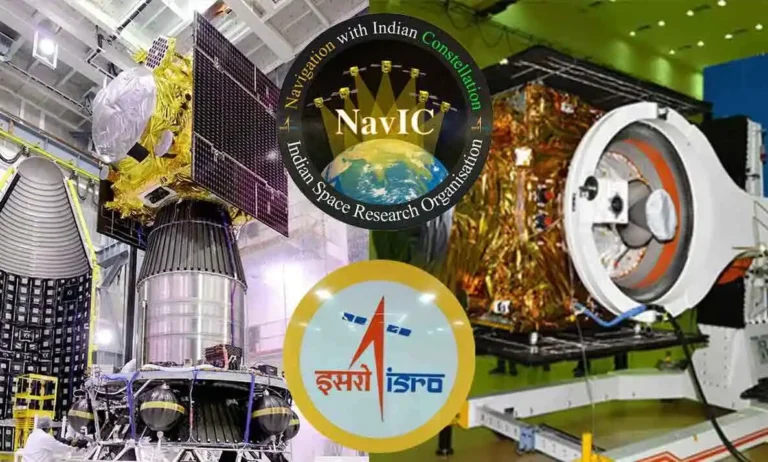
India’s regional navigation system NavIC has suffered another setback after the atomic clock on IRNSS 1F failed, reducing positioning capability. This comes soon after the NVS 02 satellite failed to reach its intended orbit, raising concerns about India’s GPS ambitions. Such science and technology developments are important for aspirants preparing through IAS coaching in Hyderabad, UPSC online coaching, and other civil services preparation programs.
About NavIC (IRNSS)
• NavIC stands for Navigation with Indian Constellation, India’s regional satellite navigation system.
• Designed to provide accurate positioning services over India and up to 1,500 km beyond its borders.
• Planned as a seven-satellite constellation, similar to GPS, with accuracy of about 10 metres.
• Signals are stronger in India’s terrain because satellites are positioned directly above the region.
Understanding such technological systems is important for students preparing through UPSC coaching in Hyderabad and Hyderabad IAS coaching institutes, where science and technology topics are a key part of the UPSC syllabus.
Current Status of Satellites
• Operational satellites: IRNSS 1B, IRNSS 1C, IRNSS 1I, and NVS 01.
• IRNSS 1F lost positioning data due to atomic clock failure.
• IRNSS 1A is nearly defunct after earlier clock failures.
• Many satellites have crossed their 10-year design life.
• Replacement missions faced issues: IRNSS 1H failed in 2017, IRNSS 1I succeeded in 2018.
These developments are often discussed in IAS coaching and civils coaching in Hyderabad to help aspirants understand India’s space capabilities and challenges.
NVS 02 Satellite Failure
• Launched in January 2025 on GSLV F15, ISRO’s 100th mission.
• Failed to move into operational orbit due to electrical malfunction in the engine ignition system.
• Review found a connector disengagement broke the circuit, preventing orbit transfer.
Such current affairs in space technology are frequently covered in UPSC online coaching and structured UPSC coaching in Hyderabad programs.
Challenges in NavIC Programme
• Atomic Clock Failures: Critical for precise time measurement and navigation accuracy.
• User Segment Delays: CAG report (2018) noted receiver development began late, slowing adoption.
• Aging Satellites: Several early satellites nearing end of life.
These challenges highlight systemic issues that are often analysed in Hyderabad IAS coaching programs for better conceptual clarity in GS Paper 3.
Advancements in New Generation NavIC
• Indigenous Atomic Clocks: Developed by ISRO to reduce dependence on foreign systems.
• Extended Mission Life: New satellites designed for 12 years.
• Addition of L1 Frequency Band: Improves interoperability with GPS and usability in smartphones.
• Enhanced Applications: Aviation, shipping, railways, and consumer devices already using NavIC signals.
Such technological advancements are important for aspirants studying through IAS coaching and civils coaching in Hyderabad, as they demonstrate India’s push for technological self-reliance.
Global Context
• Global GNSS systems: GPS (USA), GLONASS (Russia), Galileo (EU), BeiDou (China).
• Regional systems: NavIC (India), QZSS (Japan).
• Global systems use 20+ satellites in Medium Earth Orbit; regional systems rely on fewer satellites in geosynchronous orbits for regional accuracy.
Understanding global comparisons is essential for students enrolled in UPSC coaching in Hyderabad and UPSC online coaching, especially for analytical questions in the examination.
Conclusion
NavIC is strategically vital for India’s self-reliance in navigation and security. However, recent setbacks in atomic clock functionality and satellite deployment highlight the need for robust technology upgrades, timely replacements, and stronger user adoption. For aspirants preparing through IAS coaching in Hyderabad, UPSC coaching in Hyderabad, and Hyderabad IAS coaching, such developments are crucial for mastering science and technology topics in UPSC.
This topic is available in detail on our main website.