
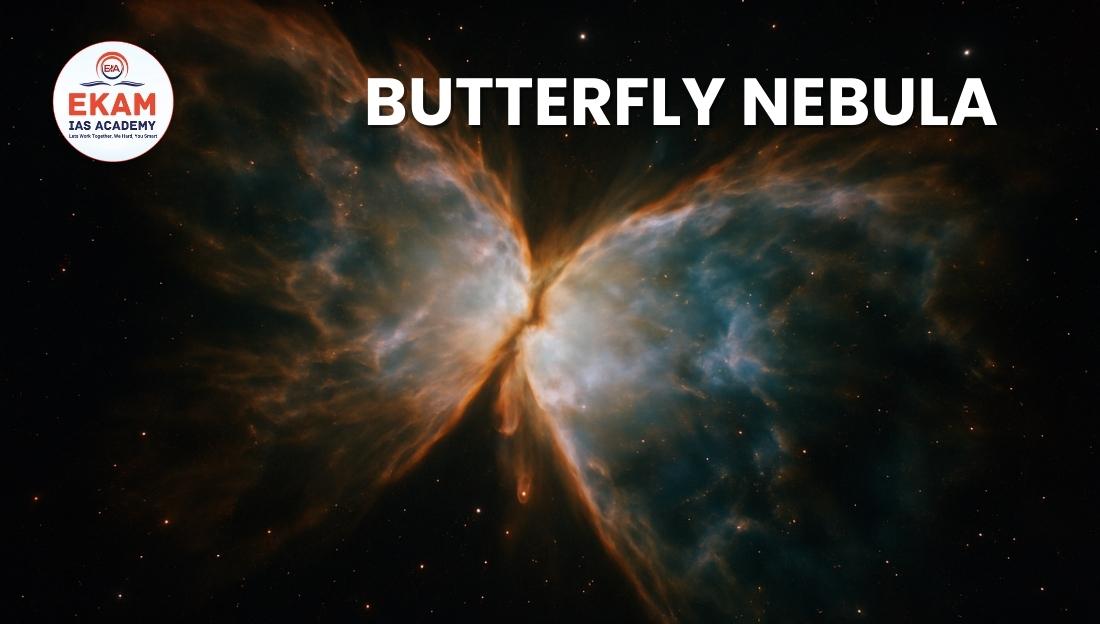
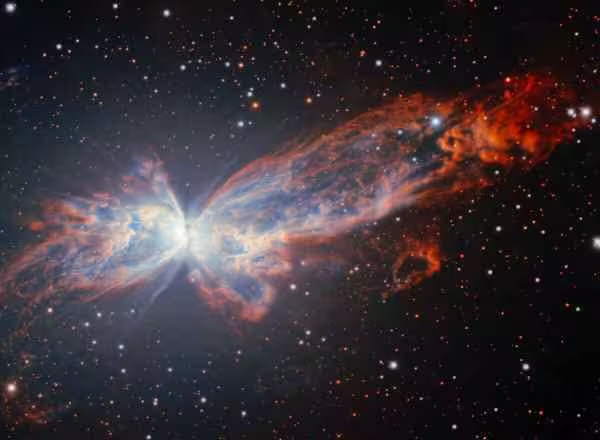
Recently, Chile’s Gemini South telescope imaged the Butterfly Nebula in extraordinary detail. The nebula lies 2,500–3,800 light-years away, formed by glowing gas expelled from a dying white dwarf star.
What are Space Observing Satellites?
- Satellites designed to observe space objects like stars, galaxies, planets, and nebulae.
- They operate above Earth’s atmosphere, avoiding distortion caused by air and pollution.
- Examples: Hubble Space Telescope (USA), James Webb Space Telescope (USA/Europe), Gaia (Europe).
- They provide data on cosmic evolution, star formation, and exoplanets.
India’s Space Observing Efforts
- Astrosat (2015): India’s first dedicated multi-wavelength space observatory.
- Observes in X-ray, UV, and optical bands.
- Helps study binary star systems, black holes, and galaxies.
- Future Plans:
- ISRO is planning XPoSat (X-ray Polarimeter Satellite) to study cosmic X-ray sources.
- India is also collaborating internationally for deep space missions.
WHAT ARE NEBULAS?
- Nebula = vast cloud of gas and dust in space.
- Types:
- Emission Nebula: glows due to ionized gas (e.g., Orion Nebula).
- Reflection Nebula: reflects light of nearby stars.
- Planetary Nebula: formed from dying stars (e.g., Butterfly Nebula).
- Dark Nebula: dense clouds blocking starlight.
- Importance:
- Sites of star birth and death.
- Provide clues about stellar evolution.
Light-year: Distance light travels in one year (~9.46 trillion km).
White dwarf: End stage of medium-sized stars, very dense and faint.
Astrosat: India’s first space observatory, important for UPSC science and tech section.
XPoSat: Upcoming Indian mission to study X-ray polarization.
Conclusion
With missions like Astrosat and XPoSat, India is steadily building capacity in space-based astronomy. Understanding nebulas and telescopes is crucial for UPSC aspirants, linking current affairs with science and technology.
This topic is available in detail on our main website.