
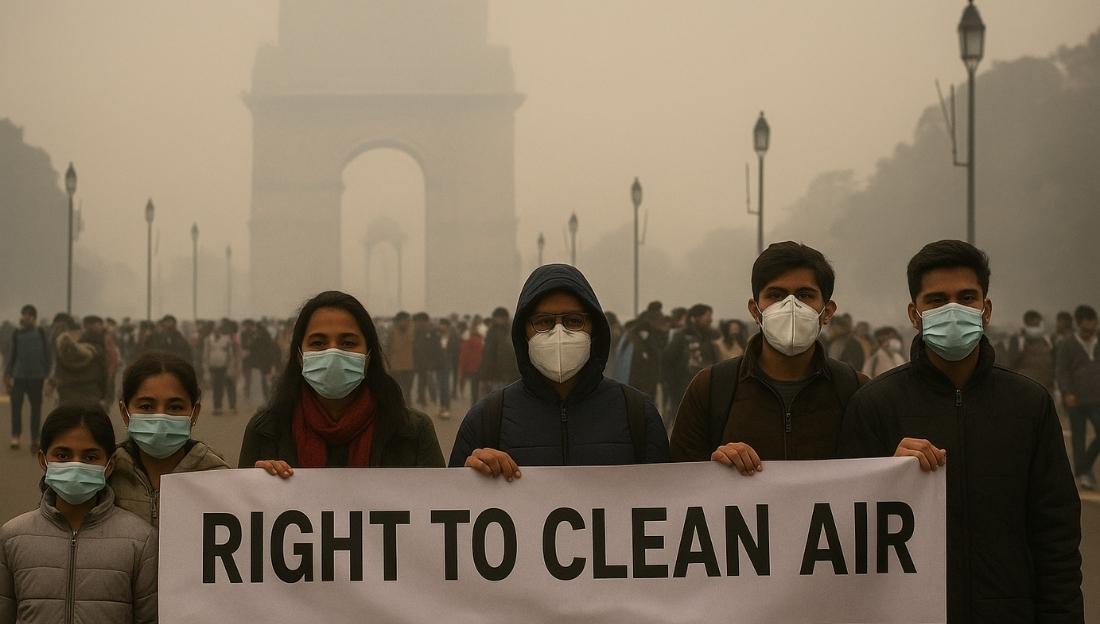
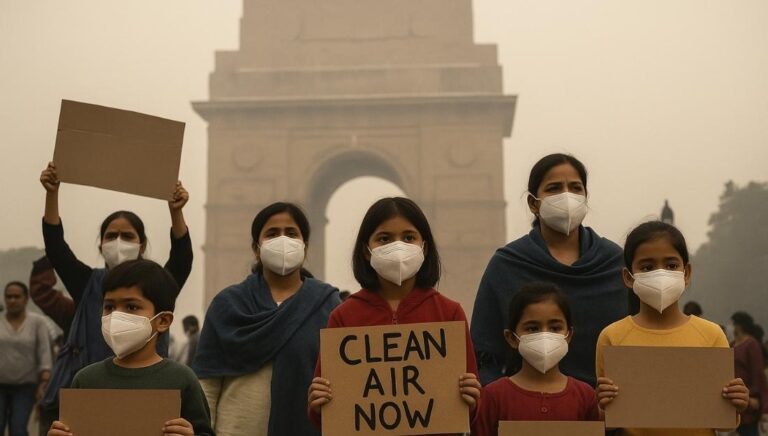
The protests at India gate raised alarm about Delhi’s hazardous air, marking a rare public outcry for children’s right to breathe.
Air Pollution: A Public Health Emergency
- The health dimension of pollution has become unavoidable: respiratory illnesses, especially among children, are now chronic in Delhi.
- Despite the severity, air pollution does not receive the same national prioritisation as communicable diseases, leaving the health ministry marginally involved.
- Classifications like “very poor” underestimate the real danger, masking the alarming toxicity to which citizens are routinely exposed.
Why Current Policies Are Cyclical
- Governments routinely announce emergency measures—odd-even schemes, smog guns, sprinklers—only after pollution peaks, reflecting reactivity rather than prevention.
- Each winter, the GRAP framework triggers familiar, short-term actions without addressing root causes such as crop burning, transport emissions, or industrial pollution.
- Lack of accessible, transparent real-time data widens the gap between official claims and citizens’ lived experiences.
Failures in Governance and Accountability
- Multiple agencies share responsibility, yet none is singularly accountable, creating administrative fragmentation.
- Pollution management spikes seasonally rather than functioning as continuous governance. India lacks a “clean air by design” model.
- Public expenditure on air quality interventions remains opaque, with little clarity on whether investments yield measurable improvements.
Way Forward
- Strengthen Health-Centric Governance: Establish a single accountable authority for monitoring, enforcement, and coordination across sectors (transport, agriculture, industry).
- Integrate public health data into pollution policy and issue health advisories based on real-time AQI.
- Tackle Major Emission Sources with Structural Reforms: Expand clean energy transition, faster EV adoption, and strict industrial emission norms and Scale up in-situ stubble management.
- Improve Monitoring: Expand CAAQMS coverage, make real-time pollution data public, and enforce penalty-based mechanisms.
Constitutional and Ethical Dimensions
- Article 21 encompasses the right to clean and breathable air, giving citizens a constitutional basis to demand action.
- Pollution disproportionately harms marginalised groups, transforming it into a question of equity and justice.
- The state’s limited response reflects a breach of its moral obligation to safeguard life and health.
How India Monitors Air Pollution
Central Pollution Control Board (CPCB) – National Air Quality Monitoring Programme (NAMP)
- CPCB operates one of the world’s largest air quality monitoring systems under NAMP.
- Measures key pollutants like PM10, PM2.5, SO₂, NO₂, O₃, CO, NH₃, benzene.
Continuous Ambient Air Quality Monitoring Stations (CAAQMS)
- Automated real-time monitoring stations installed in major cities.
- Provide hourly data for Air Quality Index (AQI).
- India has 500+ CAAQMS stations, covering most urban centres.
- Data flows directly to CPCB.
System of Air Quality and Weather Forecasting and Research (SAFAR)
- Developed by IITM Pune & Ministry of Earth Sciences.
- Provides real-time air quality data, short-term forecasts (1–3 days), and source contribution maps.
- Functional in Delhi, Mumbai, Pune, and Ahmedabad.
Air Quality Index (AQI) Framework
- India uses a unified AQI system introduced in 2014 with 6 categories: Good → Severe.
- Colour-coded public alert system used by government, media, and health advisories.
Conclusion
India’s air quality crisis stems more from institutional inertia than from the absence of policy frameworks. Protecting the right to breathe demands a shift from symbolic, seasonal measures to consistent, accountable, and health-centred governance.
This topic is available in detail on our main website.