
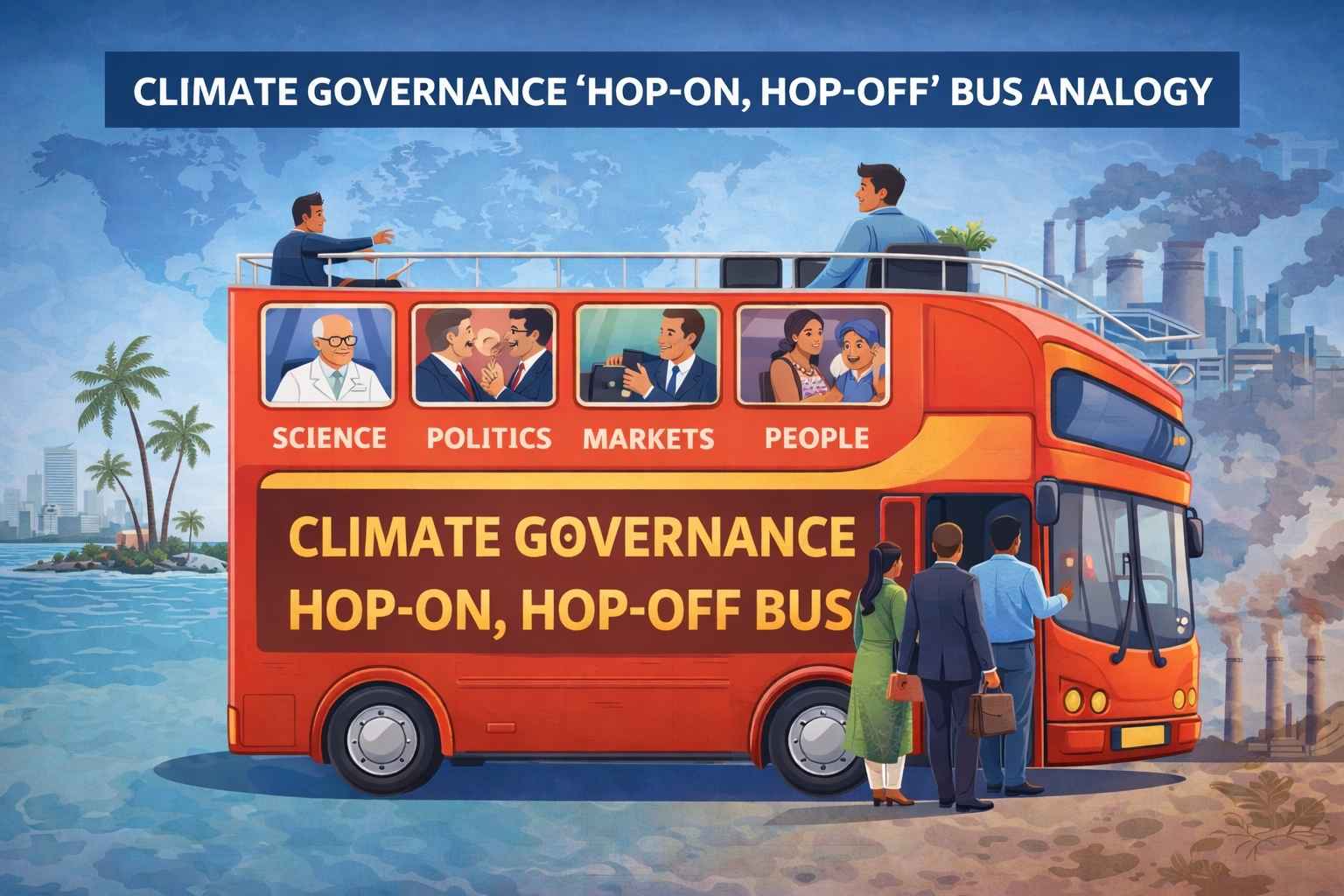
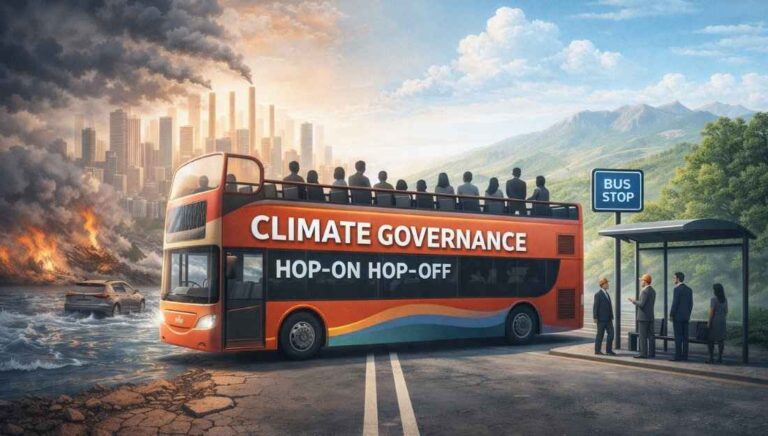
Former Environment Secretary C.K. Mishra compared global climate governance to “hop-on, hop-off” buses, highlighting the lack of direction and accountability in international climate negotiations—an analogy frequently discussed in UPSC coaching in Hyderabad while analysing global governance failures.
Current State of Climate Governance
- CMP & CMA Meetings: Function like buses circling endlessly without obligation to reach climate goals.
- Politics Dominates: National interests override global urgency; consensus often means veto power for all.
- Economics Influence: Short-term profits outweigh long-term ecological concerns.
- Common People: Focused on immediate needs, they become victims of climate disasters rather than active stakeholders—an issue relevant for GS-III and essay preparation in IAS coaching in Hyderabad.
Role of Different Actors
- Scientists: Have already established risks and scenarios; delays now stem from politics, not science.
- Politicians: Manage expectations, postpone decisions, and avoid costs.
- Markets: Driven by opportunism, not precaution; future generations ignored in profit calculations.
- Individuals: Concerned with livelihood, not distant climate threats.
COP30 Outcomes
- Global Mutirão Package: Promoted cooperation but remained voluntary.
- 1.5°C Target: Politically unrealistic; emissions projected to cross threshold in early 2030s.
- Finance: Needs exceed $2.4–3 trillion annually; current flows under $400 billion. No binding timetable for funds.
- Adaptation: Pledge to triple finance lacked baseline or binding sources. Indicators adopted but unclear.
- Loss & Damage Fund: Opened for applications but underfunded.
- Technology Transfer: Announced programmes but lacked financial backing.
- Capacity Building & Just Transition: Strong statements, but no binding commitments or resources.
Structural Issues
- Drift, Not Collapse: Governance continues but remains inadequate.
- Voluntary Language: Encouragement without obligations.
- Gap Between Needs & Delivery: Climate urgency unmet by political will.
Way Forward
- Strengthen Binding Commitments: Move beyond voluntary pledges to enforceable obligations.
- Prioritise Finance & Adaptation: Ensure predictable funding for developing nations.
- Balance Justice & Pragmatism: Uphold common but differentiated responsibilities while ensuring global cooperation.
Conclusion
COP remains the only universal forum for coordinated climate response, despite flaws. The challenge is clear: while nations can “hop on and hop off” negotiations, humanity cannot hop off the planet.
This topic is available in detail on our main website.