

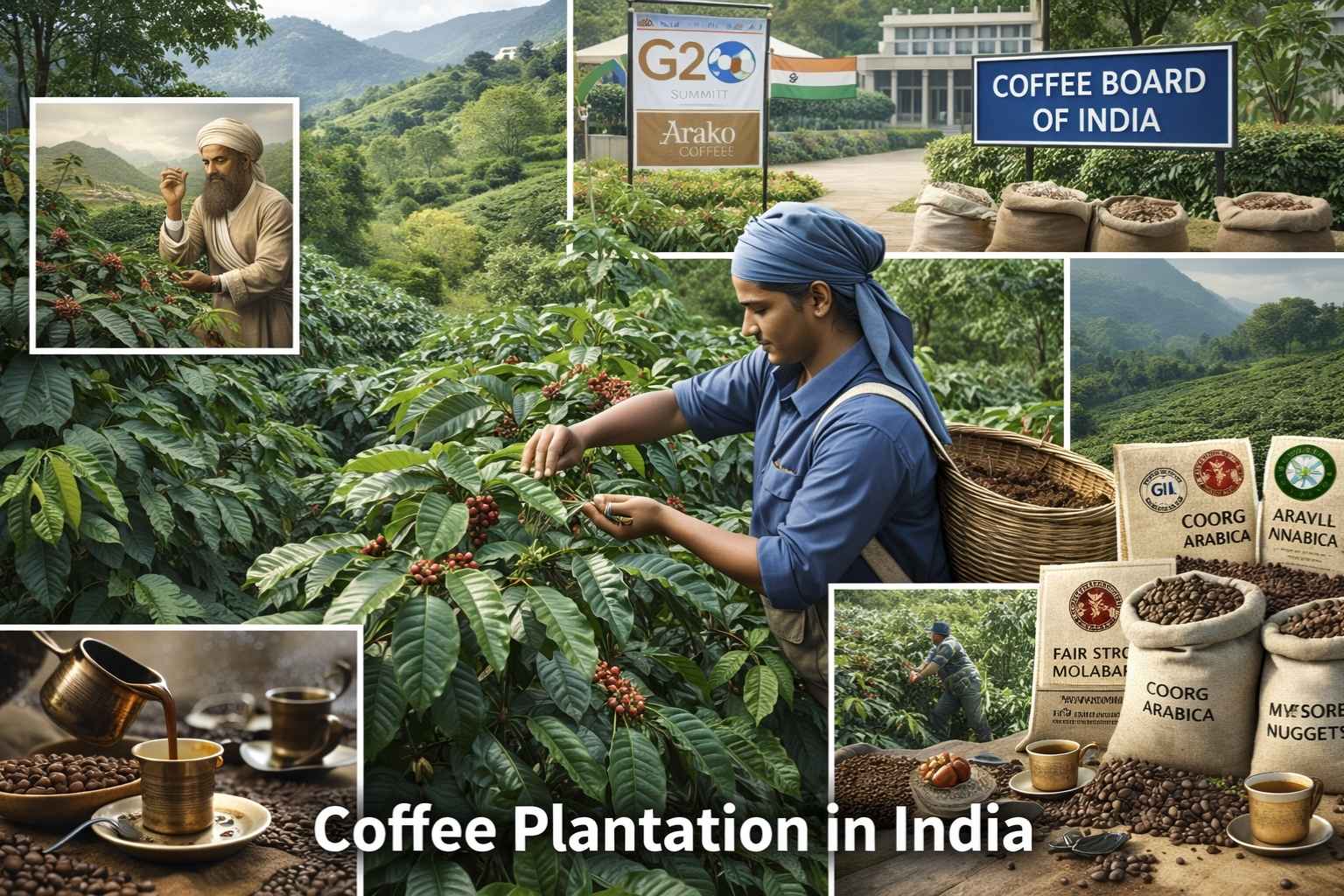
India’s coffee plantation sector has gained renewed prominence due to a sharp rise in exports to USD 1.8 billion in 2024–25, India emerging as the 5th largest coffee exporter globally, and increased international recognition through GI tags and the global showcasing of Araku Coffee at the G20 Summit. These developments are particularly relevant for aspirants preparing agriculture and trade-related topics through a UPSC Academy in Hyderabad.
Historical Background
- Baba Budan’s Journey (17th Century): Coffee cultivation began when Baba Budan brought seven coffee seeds from Yemen and planted them in the Baba Budan Giri hills of Karnataka.
- Ethiopian Origin: Coffee originally came from the Kaffa region of Ethiopia and later spread to Arabia and India.
- Arab Influence: Arabs were the first to cultivate and trade coffee commercially.
- British Era Expansion: During the 18th century, the British established large plantations in South India, building roads, curing units, and export networks.
- Global Identity: Over time, Indian coffee gained recognition for its shade-grown and mild-flavoured characteristics.
AgroClimatic Requirements
- Soil: Deep, fertile, welldrained soils rich in organic matter; slightly acidic pH.
- Rainfall: 1000–2500 mm annually for flowering and berry formation.
- Temperature:
- Arabica: 15–25°C
- Robusta: 20–30°C
- Altitude:
- Arabica: 1000–1500 m
- Robusta: 500–1000 m
- Shade: Requires dense natural shade, which enhances bean quality.
- Humidity: Optimal relative humidity is 70–90%.
Traditional Regions (Western Ghats)
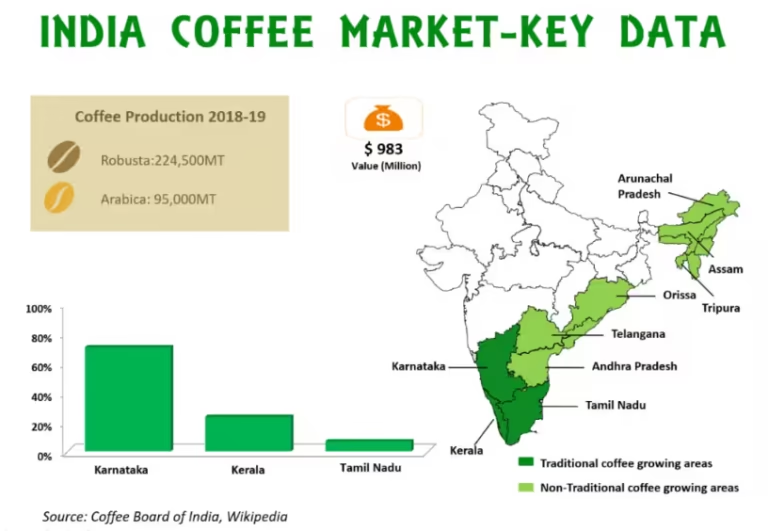
- Karnataka: Produces 70% of India’s coffee; major areas include Kodagu and Chikkamagaluru.
- Kerala: Wayanad and Idukki dominate Robusta production.
- Tamil Nadu: Nilgiris, Dindigul, and Theni grow highaltitude Arabica.
NonTraditional Regions (Eastern Ghats)
- Andhra Pradesh: Araku Valley known for tribal organic coffee.
- Odisha: Koraput and Rayagada emerging as organic coffee hubs.
NorthEastern States
- Assam, Meghalaya, Manipur, Mizoram, Nagaland, Tripura—small but expanding plantations.
Role of the Coffee Board of India
- Statutory Body: Established under the Coffee Act, 1942; headquarters in Bengaluru
- Key Functions:
- Promotes replanting, productivity, and sustainable practices
- Identifies new coffee-growing zones using scientific tools
- Supports tribal farmers through training, finance, and market access
- Strengthens branding, quality certification, and export promotion
The Board plays a vital role in linking agriculture with exports—an important GS III theme discussed in Best IAS Academy in Hyderabad.
Significance
- India produces 3.6 lakh tonnes annually; 70% is exported to over 120 countries.
- Specialty coffees like Monsooned Malabar, Mysore Nuggets, Kaapi Royale fetch premium prices.
- Domestic consumption is steadily rising.
- Coffee supports tribal livelihoods, biodiversity, and rural employment.
Recent Developments
- 5th World Coffee Conference (2023) held in Bengaluru focusing on sustainability and circular economy.
- Araku Coffee showcased at the G20 Summit, boosting global visibility.
- GI Tags awarded to 7 Indian coffees including Coorg Arabica and Araku Valley Arabica.
- Exports surged to USD 1.8 billion in 2024–25, making India the 5th largest exporter.
- GST cut to 5% on processed coffee products.
- Trade agreements like IndiaUK FTA and IndiaEFTA TEPA provide dutyfree access to premium markets.
- Koraput Coffee (Odisha) emerging as a successful tribal-led model with fair pricing and doorstep procurement.
- 2024–25: Government promoting climateresilient coffee varieties under the Coffee Board’s R&D initiatives.
Conclusion
Coffee plantation in India represents a successful convergence of sustainable agriculture, tribal livelihood support, biodiversity conservation, and export-led growth. With continued policy support, climate-resilient practices, and enhanced market access through global trade agreements, Indian coffee is well positioned to strengthen both its economic contribution and ecological footprint.
For UPSC aspirants analysing agriculture, geography, and trade through platforms like the UPSC Academy in Hyderabad, coffee plantation serves as a rich case study linking environment, economy, and inclusive development.
This topic is available in detail on our main website.