
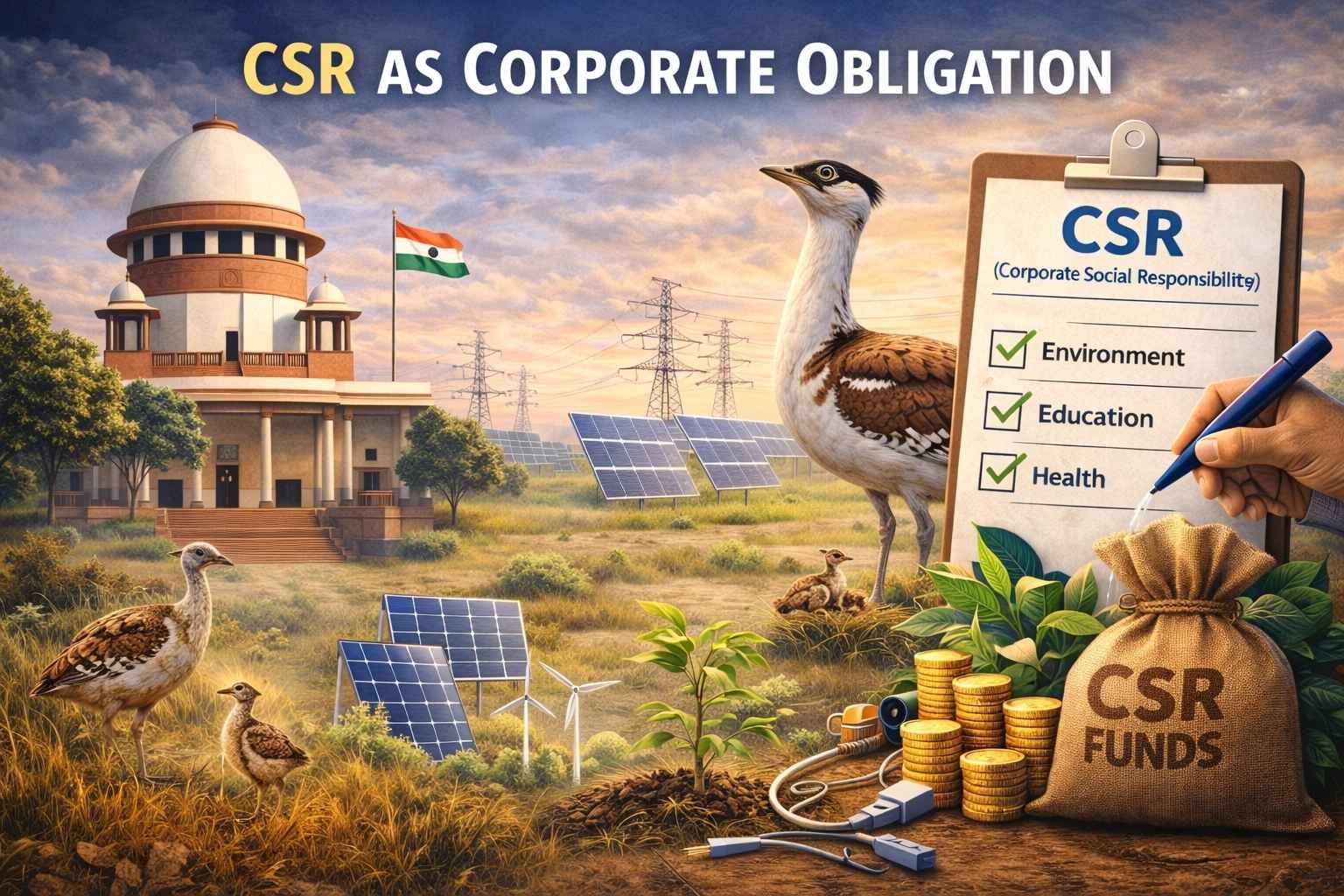
On December 19, the Supreme Court of India ruled that corporate environmental responsibility falls within the scope of Corporate Social Responsibility (CSR) under the Companies Act, strengthening conservation efforts for the Great Indian Bustard. The ruling carries major implications for environmental governance and corporate accountability, themes regularly discussed in polity and environment coverage for aspirants associated with UPSC coaching in Hyderabad.
Background of the Case
- The Supreme Court has been monitoring the deaths of Great Indian Bustards due to overhead transmission lines since 2021.
- Earlier orders restricted power lines across 99,000 sq. km and required feasibility studies for undergrounding.
- In 2024, an expert committee was set up to balance species protection with renewable energy expansion.
Key Points of the Judgment
- CSR is now treated as an enforceable duty under the Companies Act.
- Spending CSR funds on environmental and wildlife protection is seen as fulfilling Article 51A(g) (duty to protect environment).
- Strengthens the legal basis for demanding corporate financing for grassland restoration, chick breeding, and species recovery projects.

Limitations of the Verdict
- The judgment does not specify which companies must contribute, how much, or when.
- Penalties for non-compliance remain under existing CSR provisions.
- Mapping habitats of bustards remains a challenge as they move across regions.
- Effectiveness depends on government and utility execution of undergrounding and rerouting projects.
Shift in Approach
- Moves from a large-area restriction (2021 order) to priority habitat zones.
- Reduces conflict with renewable energy projects.
- Focuses on detailed habitat and infrastructure planning.
What are CSR Funds?
- Corporate Social Responsibility (CSR) refers to mandatory spending by certain companies on social and environmental projects.
- Governed by Section 135 of the Companies Act, 2013.
- Companies with net worth of ₹500 crore, turnover of ₹1,000 crore, or net profit of ₹5 crore must spend 2% of average net profits of the last three years on CSR activities.
- Activities include education, health, environment, rural development, and conservation projects.
- Companies must form a CSR committee, disclose spending in annual reports, and face penalties for non-compliance —topics often analysed at the Best IAS Academy in Hyderabad.
Significance
- The judgment formally integrates environmental protection into corporate legal obligations.
- It creates a viable financing pathway for wildlife conservation and habitat restoration.
- It marks an important step toward aligning corporate conduct with constitutional duties and sustainable development goals, a key analytical area for students of Top UPSC Coaching in Hyderabad.
Conclusion
The Supreme Court has elevated CSR from voluntary charity to a legal obligation for environmental protection. Its success will depend on effective implementation and whether corporate funds translate into real conservation outcomes.
This topic is available in detail on our main website.