
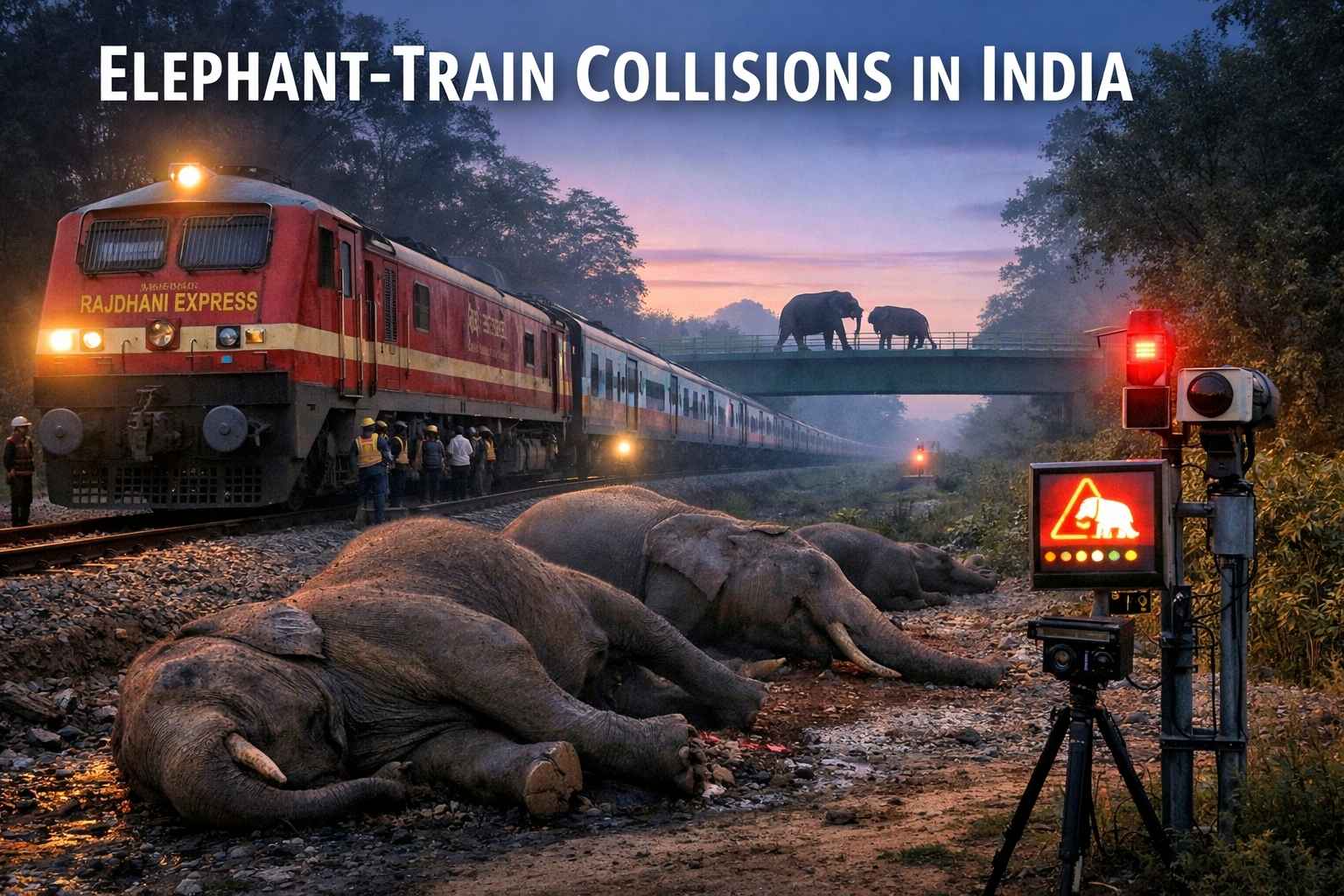
Seven elephants were recently killed after being hit by the Delhi-bound Rajdhani Express in Assam’s Hojai district, highlighting the urgent need for stronger mitigation measures against elephant–train accidents.
Such environment and biodiversity-related issues are regularly analysed in depth for aspirants preparing through Hyderabad IAS coaching platforms.
Background of issue:
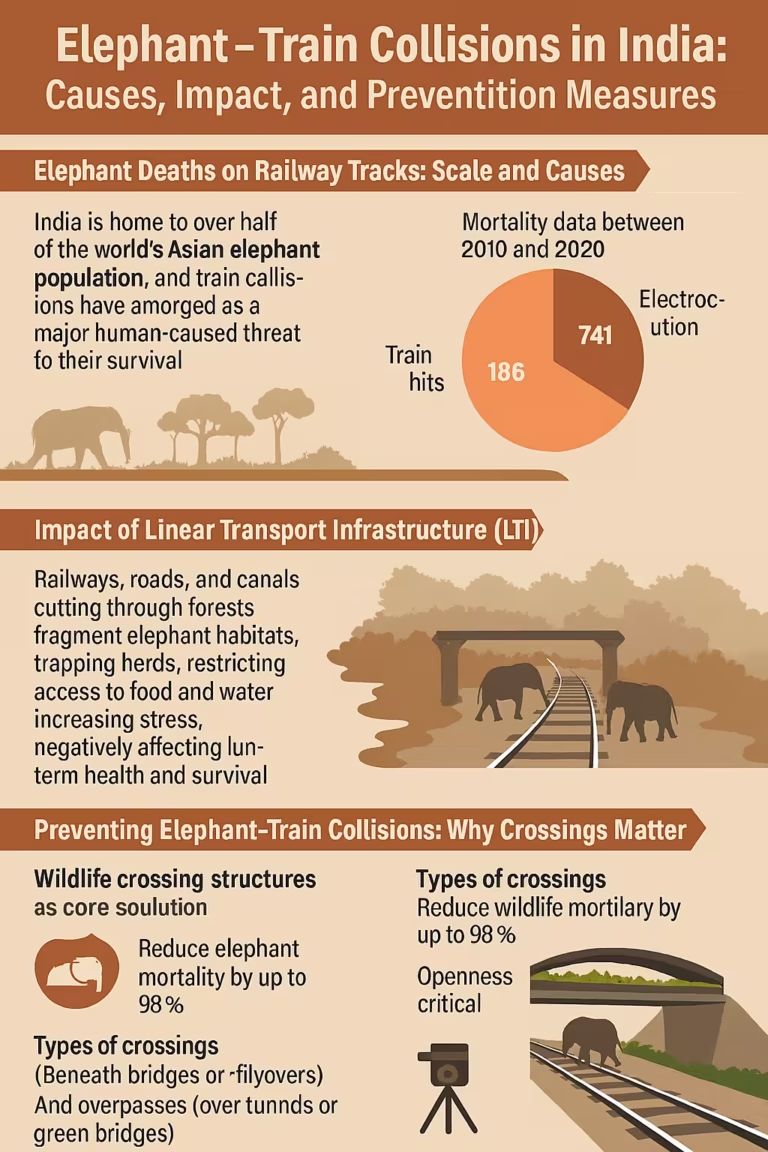
- India hosts more than half of the global Asian elephant population.
- Train collisions are a major human-induced threat to their survival.
- Between 2010–2020, 1,160 elephants died due to unnatural causes. Electrocution: 741 deaths. Train accidents: 186 deaths.
- Railway infrastructure indirectly contributes to multiple causes of elephant mortality, making it a recurring topic in GS Paper III discussions at the Best IAS Academy in Hyderabad.
Impact of Linear Transport Infrastructure (LTI)
- Railways, highways, and canals fragment habitats.
- Restrict access to food and water, increasing stress and vulnerability.
- Long-term survival of herds is negatively affected.
Behavioural Factors
- Most collisions occur at night.
- Male elephants are more prone, especially during crop-raiding seasons.
- Seasonal movement patterns increase exposure to railway tracks.
Preventive Measures – Crossings and Route Planning
- IUCN (2023) handbook stresses avoiding elephant corridors during infrastructure planning.
- Wildlife crossings reduce mortality by up to 98%.
- Types: Underpasses (beneath bridges/flyovers). Overpasses (green bridges/tunnels).
- For elephants, crossings must be open and spacious (minimum 6–7 m height).
- Placement guided by GPS telemetry and camera traps to identify hotspots.
Technology-Based Solutions
- Early-warning systems alert train operators in advance.
- Locomotive-based systems: FLIR cameras detect obstructions up to 750 m.
- Ground-based systems: cameras, acoustic, and seismic sensors at crossing points.
- AI and machine learning improve accuracy, reducing false alarms.
Indian Railways’ Initiatives
- Pilot projects using AI-based monitoring launched in 2023 (Northeast Frontier Railway).
- Extended to Kerala–Tamil Nadu border in 2024.
- Early results show promising outcomes, but adoption remains limited.
Conclusion
Elephant–train collisions in India highlight the urgent need for habitat-sensitive infrastructure development supported by modern technology. Sustainable solutions must integrate ecological planning with transport policy and wildlife conservation—an approach increasingly emphasised in environment and disaster-related analyses by aspirants associated with Top UPSC Coaching in Hyderabad.
This topic is available in detail on our main website.