
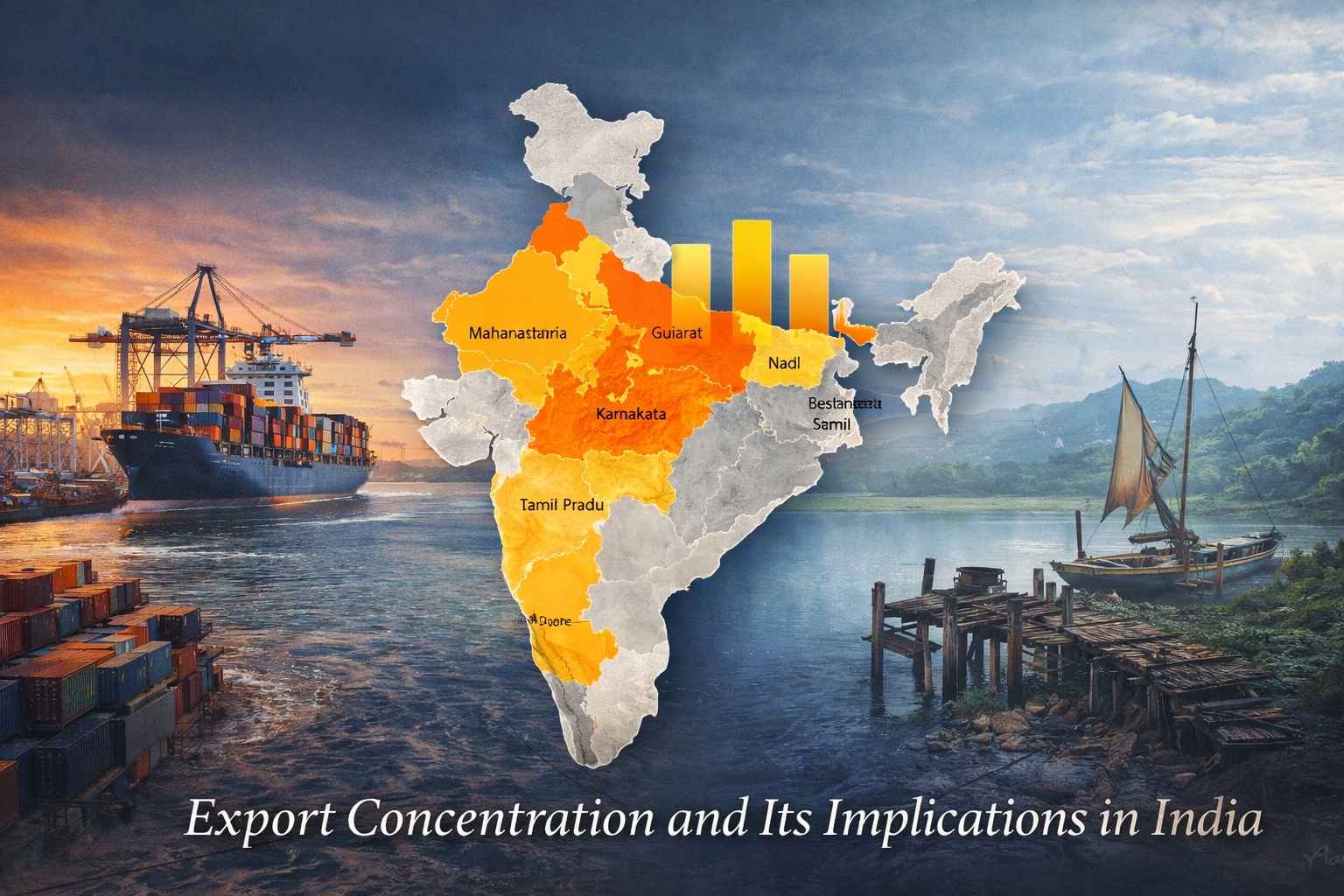
Latest RBI State-wise export data shows that India’s exports are increasingly dominated by a small group of States, raising concerns about regional imbalance. This trend has important implications for inclusive growth and is frequently analysed in GS Paper III (Economy) discussions by aspirants preparing through UPSC coaching in Hyderabad.
Uneven Distribution of Exports
- India’s export growth is not evenly spread, as five States—Maharashtra, Gujarat, Tamil Nadu, Karnataka, and Uttar Pradesh—contribute nearly 70% of total exports.
- This concentration has increased over time, indicating that export activity is becoming more clustered rather than geographically diversified.
- National-level export figures hide the widening gap between export-performing States and lagging regions.
Emergence of a Core–Periphery Structure
- Coastal western and southern States are increasingly integrated into global supply chains due to better ports, infrastructure, and industrial ecosystems.
- Northern and eastern hinterland States are gradually getting disconnected from export-driven growth.
- Instead of backward regions catching up, regional inequality is becoming structurally entrenched—a pattern commonly discussed in regional development debates at Hyderabad IAS coaching.
Changing Nature of Global Trade
- Global merchandise trade growth has slowed significantly, limiting opportunities for new entrants.
- International investors now prefer economies with high economic complexity, advanced logistics, and technological depth rather than just cheap labour.
- This shift reduces the scope for labour-intensive manufacturing, which earlier helped countries industrialise.
Capital-Intensive Export Growth
- Export expansion in India is increasingly driven by automation and high capital investment.
- ASI data shows that capital formation is rising faster than employment, indicating capital deepening.
- The increase in fixed capital per worker means fewer jobs are created per unit of output.
Weak Link Between Exports and Employment
- Manufacturing’s share in total employment has remained stagnant at around 12%, even during periods of strong export growth.
- High-growth export sectors such as electronics and petrochemicals are highly automated and region-specific.
- As a result, export growth is generating value without generating large-scale employment—an issue often highlighted in economy classes at civils coaching in Hyderabad.
Financial and Credit Imbalances
- Export-oriented States show high Credit–Deposit ratios, indicating effective recycling of local savings into local industries.
- Hinterland States have low Credit–Deposit ratios, meaning their savings are often invested in developed regions.
- This financial imbalance further restricts industrial growth in poorer States.
Exports Reflect Capacity, Not Transformation
- Exports are increasingly an outcome of existing industrial strength and institutional capacity, rather than a tool for development.
- States that already possess infrastructure, skilled labour, and financial depth are able to export more.
- Relying solely on export growth as a measure of development can therefore be misleading and exclusionary.
India’s Initiatives to Develop Every State as an Export Hub
- Districts as Export Hubs (DEH) Initiative aims to identify at least one export-potential product in every district and promote local exports.
- One District One Product (ODOP) encourages States to specialise in unique local products such as agricultural produce, handicrafts, and MSME goods for exports.
- Foreign Trade Policy (FTP) 2023 focuses on decentralised export promotion by empowering States and districts as active partners in trade growth.
- State Export Promotion Committees have been set up to prepare State-specific export action plans aligned with national trade goals.
Conclusion
India’s export trajectory reflects a structural shift toward capital-driven, regionally concentrated growth with a weak employment linkage. Addressing this imbalance requires focused investment in human capital, financial inclusion, and infrastructure in lagging States, rather than relying solely on aggregate export numbers. This nuanced understanding is essential for aspirants analysing development and trade issues through UPSC online coaching platforms.
This topic is available in detail on our main website.