
The Ministry of Statistics and Programme Implementation (MoSPI) has proposed a major reform in India’s GDP estimation framework by phasing out the long-standing ‘discrepancies’ component. The move aims to enhance transparency, credibility, and policy relevance of national income data—an issue frequently analysed by aspirants preparing the Indian economy through a UPSC Academy in Hyderabad.
‘Discrepancies’ in GDP Estimation
- GDP in India is estimated using two main methods:
- Production (Value-Added/Income) Approach
- Expenditure Approach
- Due to different data sources, coverage gaps, valuation methods, and timing issues, the two estimates often do not match.
- The gap between them is recorded as ‘discrepancies’, mainly under the expenditure-side GDP, which is considered less robust in early estimates.
- Positive discrepancy: Production-side GDP is higher
- Negative discrepancy: Expenditure-side GDP is higher.
Why Discrepancies Are a Concern
- Large discrepancies reduce clarity about the real drivers of economic growth.
- They complicate macroeconomic analysis and weaken confidence in headline GDP numbers.
- In recent quarters, discrepancies have reached 3–4% of GDP, leading to sharp future revisions in growth estimates.
- Post-pandemic volatility has further increased fluctuations, raising concerns among economists, investors, and rating agencies.
Proposed Reform
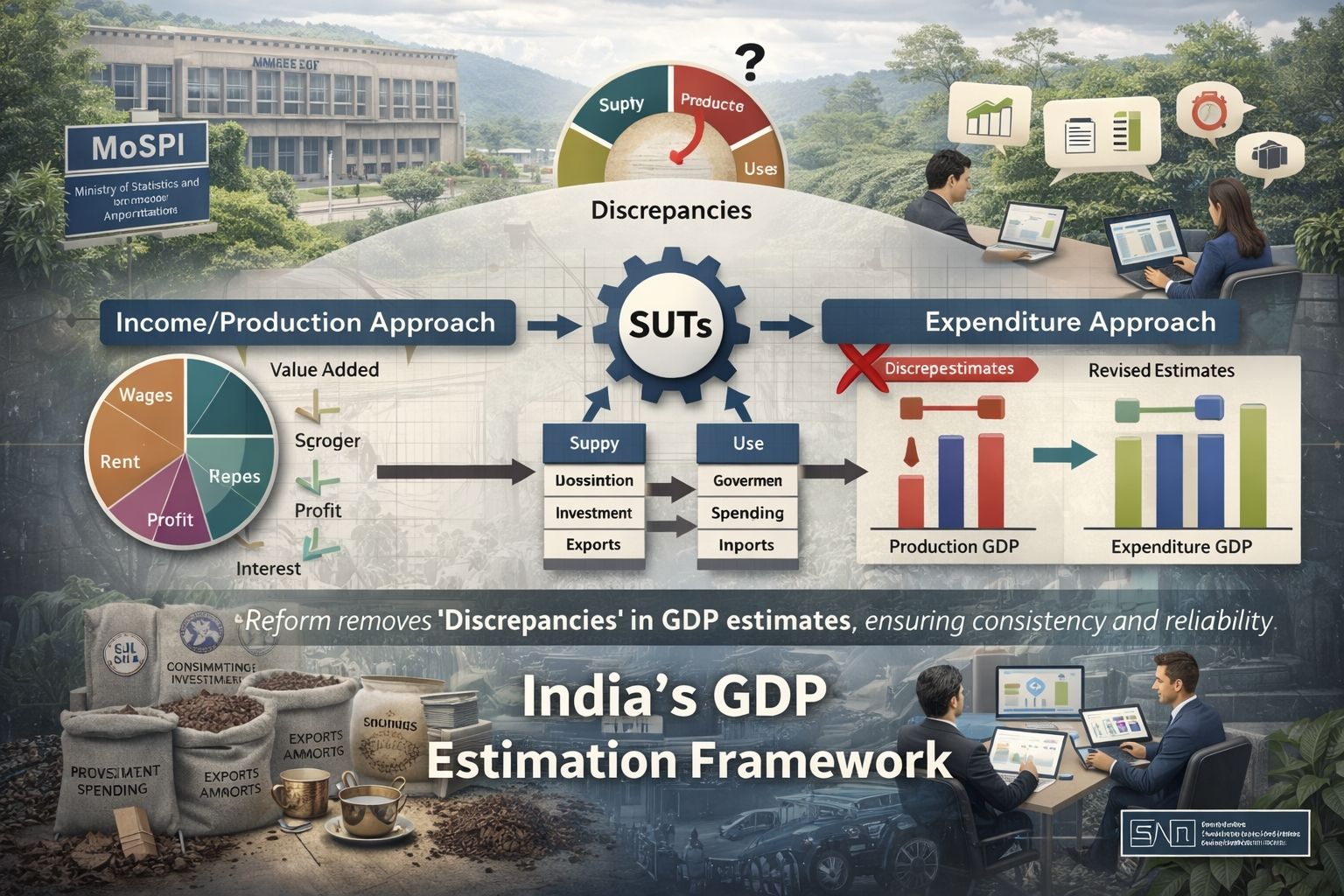
- MoSPI plans to integrate Supply and Use Tables (SUTs) more closely with annual national accounts.
- SUTs ensure that total supply equals total use for every product and service in the economy.
- Under the new approach:
- Discrepancies will be minimised in early GDP estimates, and
- Fully eliminated in final estimates once comprehensive data is available.
- This approach follows the UN System of National Accounts (SNA) framework.
Strategic Importance for India
- Strengthens tactical and last-mile air defence
- Cost-effective counter to drones and cruise missiles
- Enhances survivability of ground forces and critical assets
- Crucial in a security environment marked by hybrid warfare and asymmetric threats
These dimensions are regularly analysed in IAS Coaching in Hyderabad under GS-III Security and Defence modules.
Role of Supply and Use Tables (SUTs)
- SUTs match domestic production and imports with: Intermediate consumption, Final consumption, Capital formation,Exports.
- They impose accounting consistency, improving reliability and internal coherence of GDP data.
Expert Views and Concerns
- Economists largely welcome the move as it improves transparency, interpretability, and credibility of GDP figures.
- However, concerns remain regarding: Outdated surveys, especially in services and informal sectors
- Heavy reliance on judgement-based adjustments, which may reduce transparency if not clearly disclosed
Challenges and Way Forward
- Structural complexity of India’s large informal economy requires stronger statistical capacity.
- Regular updating of surveys and base-year datasets is essential.
- Improve administrative data systems and real-time data collection (GST, digital payments, enterprise data).
- Ensure methodological transparency to maintain public trust.
WHAT IS GDP?
Gross Domestic Product (GDP) is the total value of all final goods and services produced within a country in a given year.
How is GDP of a Nation Calculated?
GDP is calculated using three main methods. Ideally, all three should give the same value.
Production (Value Added) Method
- Measures value added at each stage of production.
- Formula:
GDP = Value of Output – Value of Intermediate Goods - Example:
- Farmer grows wheat → mill makes flour → bakery makes bread
- Only final value is counted to avoid double counting.
- Most reliable method in developing countries like India.
Income Method
- Measures income earned by all factors of production.
- Includes:
- Wages (labour)
- Rent (land)
- Interest (capital)
- Profit (entrepreneurs)
- Formula:
GDP = Wages + Rent + Interest + Profit + Taxes – Subsidies
Expenditure Method
- Measures total spending in the economy.
- Formula:
GDP = C + I + G + (X – M)- C = Consumption
- I = Investment
- G = Government spending
- X – M = Exports – Imports
Conclusion
Phasing out ‘discrepancies’ from India’s GDP estimates marks a significant methodological reform aimed at improving statistical integrity and policy relevance. Its success will depend on data quality, survey modernisation, transparency, and institutional capacity. If effectively implemented, the reform will provide a clearer and more reliable picture of India’s growth trajectory, strengthening economic governance.
For UPSC aspirants studying macroeconomic indicators through platforms like the UPSC Academy in Hyderabad, this reform offers a high-value contemporary example linking statistics, policy credibility, and economic decision-making.
This topic is available in detail on our main website.