
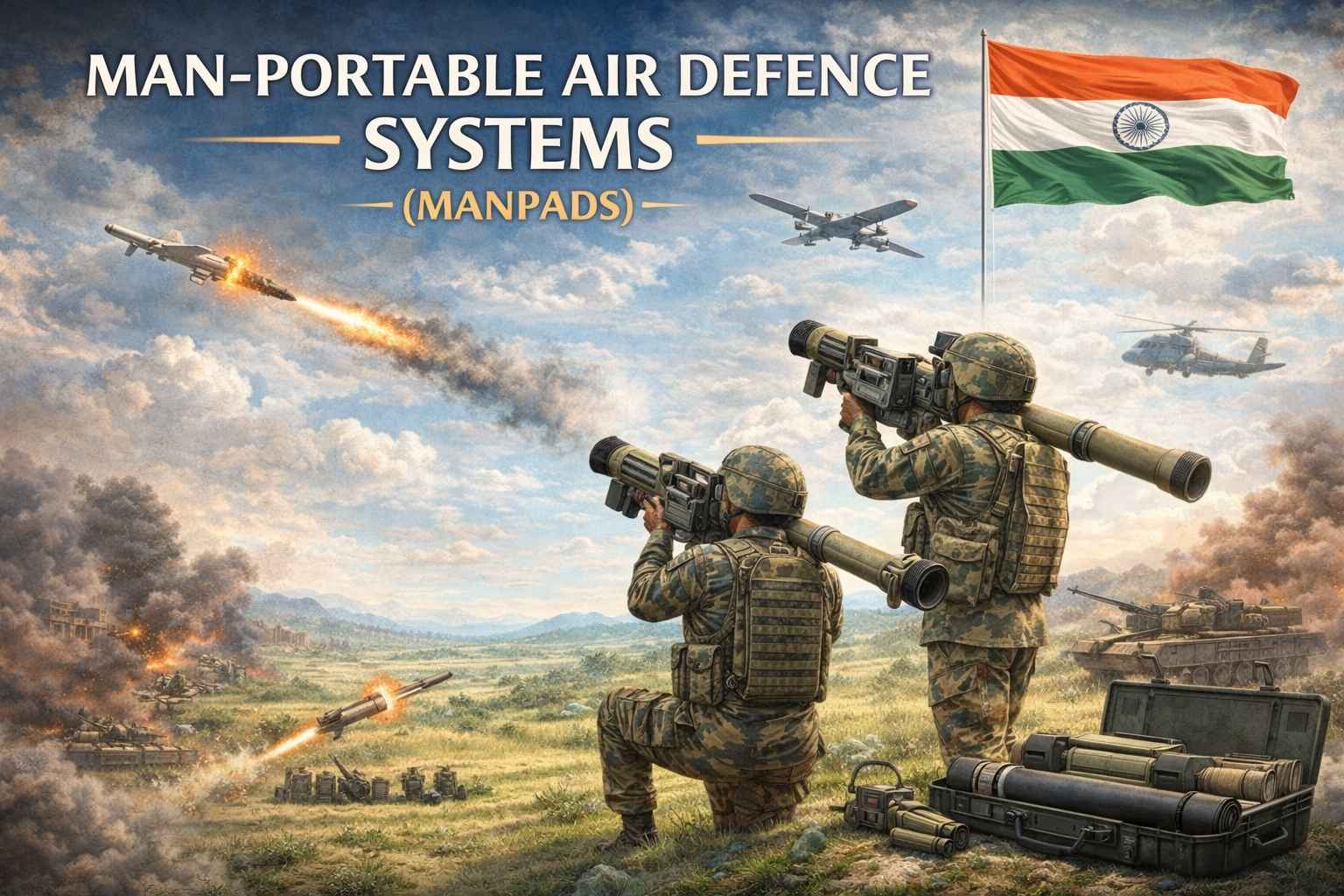
The Indian Army is reorienting its Man-Portable Air Defence Systems (MANPADS) to counter the growing threat posed by low-flying, sub-sonic cruise missiles and drones. This development reflects the changing nature of warfare and is a key contemporary issue for aspirants studying defence preparedness through platforms such as a UPSC Academy in Hyderabad.
What are MANPADS?
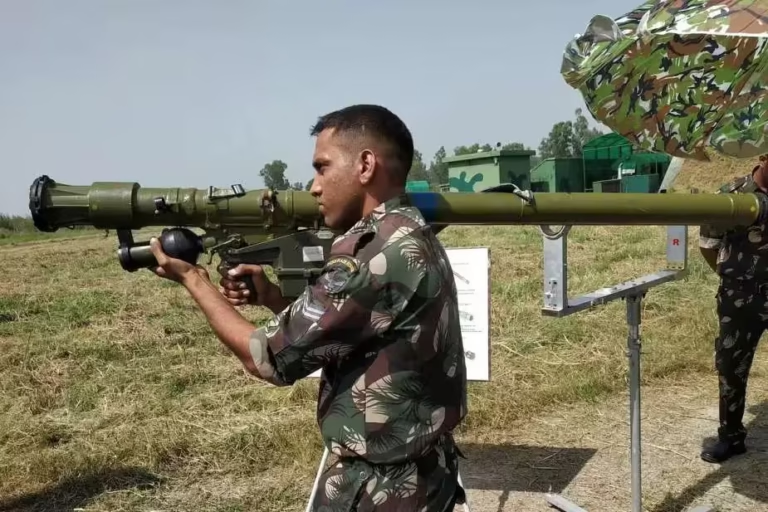
Man-Portable Air Defence Systems (MANPADS) are short-range surface-to-air missile systems that can be operated by a single soldier or a small team.
They are commonly known as shoulder-fired anti-aircraft missiles and are designed to engage:
- Low-flying aircraft
- Helicopters
- Unmanned Aerial Vehicles (UAVs)
- Sub-sonic cruise missiles
MANPADS provide last-mile air defence at the tactical level, a concept frequently discussed in GS-III classes at the Best IAS Academy in Hyderabad.
Key Features
- Highly portable: Usually less than 2 metres long.
- Lightweight: Weigh around 20 kg, making them easy to deploy.
- Quick reaction weapon for frontline air defence.
- Effective against low-altitude and slow-moving aerial targets.
Historical Background
- First introduced in the 1960s by: USA – Redeye missile, Soviet Union – Strela missile
- Developed to provide infantry units with organic air defence capability.
- Today, around 105 countries use MANPADS.
- Only about 12 countries, including India, manufacture them.
Famous MANPADS Systems
- FIM-92 Stinger – United States
- 9K32 Strela-2 (SA-7) – Soviet Union
- FN-16 – China (newer generation system)
Types of MANPADS
- Command Line-of-Sight (CLOS): Missile is guided manually by the operator using remote control.
- Laser-Guided (Beam Rider): Missile follows a laser beam aimed at the target.
- Infrared (Heat-Seeking): Most common type. Locks onto the heat signature of aircraft engines.
Main Components
- Missile sealed inside a launch tube
- Gripstock (firing and control unit)
- Battery unit to power guidance and firing systems
Strategic Importance for India
- Strengthens tactical and last-mile air defence
- Cost-effective counter to drones and cruise missiles
- Enhances survivability of ground forces and critical assets
- Crucial in a security environment marked by hybrid warfare and asymmetric threats
These dimensions are regularly analysed in IAS Coaching in Hyderabad under GS-III Security and Defence modules.
Conclusion
In an era of drone warfare and precision-guided munitions, MANPADS remain a critical pillar of modern air defence due to their mobility, affordability, and effectiveness. India’s renewed focus on upgrading and reorienting MANPADS reflects a pragmatic response to evolving aerial threats and reinforces national defence preparedness.
For UPSC aspirants preparing Security and Defence topics through institutions like the UPSC Academy in Hyderabad, MANPADS serve as an important example of how technology, doctrine, and threat perception intersect in modern warfare.
This topic is available in detail on our main website.