
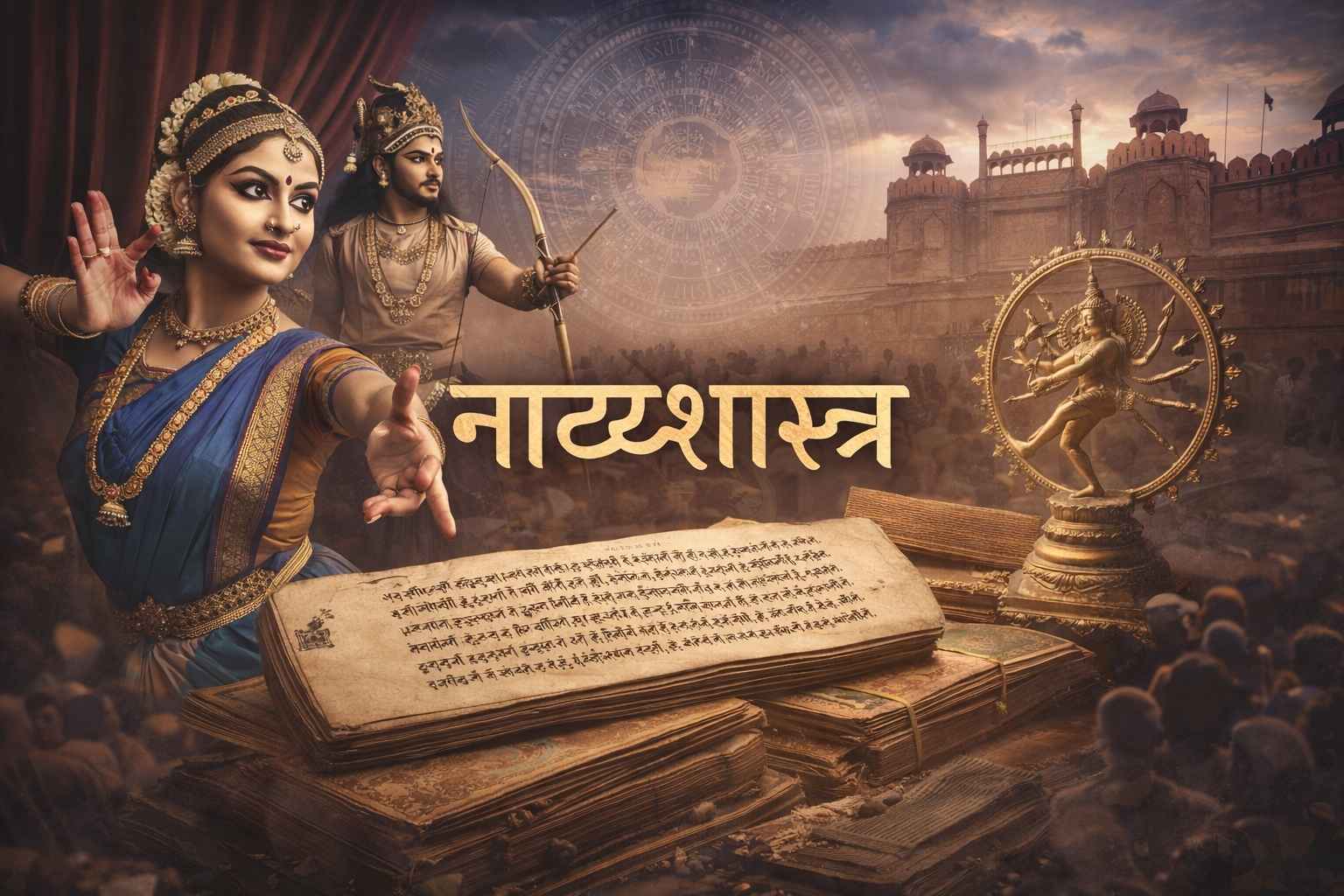
The Indira Gandhi National Centre for the Arts (IGNCA) recently organised an academic programme titled “Natyashastra – Synthesis of Theory and Praxis” during the 20th session of UNESCO’s Intergovernmental Committee for the Safeguarding of Intangible Cultural Heritage, held at the Red Fort, Delhi. The event highlighted the enduring relevance of the Natyashastra in India’s cultural and artistic traditions—an important topic for aspirants preparing Indian Art and Culture through a UPSC Academy in Hyderabad.
About Natyashastra
- The Natyashastra is an ancient Sanskrit treatise dealing with drama, dance, and music.
- The term combines ‘Natya’ (dramatic performance) and ‘Shastra’ (systematic knowledge or science).
- It is traditionally attributed to sage Bharata Muni.
- Scholars date its composition between 2nd century BCE and 2nd century CE.
- It is regarded as the earliest comprehensive text on performing arts in South Asia.
Themes and Concepts
- The text contains nearly 36,000 verses, covering:
- Natya (drama)
- Abhinaya (expression and performance)
- Sangita (music)
- Bhava (emotions)
- Rasa (aesthetic experience)
- Its central contribution is the theory of Rasa, explaining how art creates emotional fulfilment.
- Bharata identified eight Rasas:
Shringara, Hasya, Karuna, Raudra, Veera, Bhayanaka, Bibhatsa, and Adbhuta. - Through effective bhava, a performer evokes rasa in the audience, making drama a tool of moral and spiritual enlightenment.
Global Recognition
- UNESCO has included the Natyashastra in its Memory of the World Register, recognising its universal cultural value.
- This reflects India’s growing role in shaping global cultural discourse.
Role of IGNCA
- IGNCA is an autonomous institution under the Ministry of Culture.
- Its mandate includes documentation, preservation, research, and dissemination of Indian heritage.
- It operates through specialised divisions such as Kalanidhi, Kalakosa, Janapada Sampada, Kaladarsana, and Cultural Informatics Lab.
Conclusion
The Natyashastra remains a living foundation of Indian performing arts, influencing artistic expression across centuries. Contemporary scholarly engagement by institutions like IGNCA and international recognition by UNESCO underline India’s sustained commitment to preserving, revitalising, and globally projecting its intangible cultural heritage.
For UPSC aspirants studying Indian culture and heritage through platforms such as the UPSC Academy in Hyderabad, the Natyashastra represents a core cultural text linking aesthetics, philosophy, and civilisational continuity.
This topic is available in detail on our main website.