

Severe air pollution in Delhi and NCR has reignited debates on the Right to a Healthy Environment as an intrinsic part of the Right to Life under Article 21 of the Constitution. Recent government measures such as hybrid schooling and work-from-home advisories have been criticised as inadequate, underscoring the need for stronger legal and policy interventions. This issue has become a recurring theme in polity and environment discussions for aspirants preparing through UPSC coaching in Hyderabad.
Constitutional Basis of Environmental Rights
- Article 21: Right to life includes the right to live with dignity, which courts have interpreted to cover the right to a clean and healthy environment.
- Article 48A: Directive Principle obliges the State to protect and improve the environment.
- Article 51A(g): Fundamental Duty of citizens to safeguard natural resources.
- Judicial precedents like MC Mehta v. Union of India and Subhash Kumar v. State of Bihar expanded Article 21 to include environmental protection.
Judicial Interpretations
- Olga Tellis Case (1985): Linked livelihood to the right to life.
- MC Mehta Cases: Established principles of “polluter pays” and “precautionary principle.”
- Vellore Citizens Welfare Forum (1996): Sustainable development recognized as part of constitutional law.
- Right to Clean Air: Courts have repeatedly held that clean air is essential for life and health.
Current Context – Delhi NCR Pollution
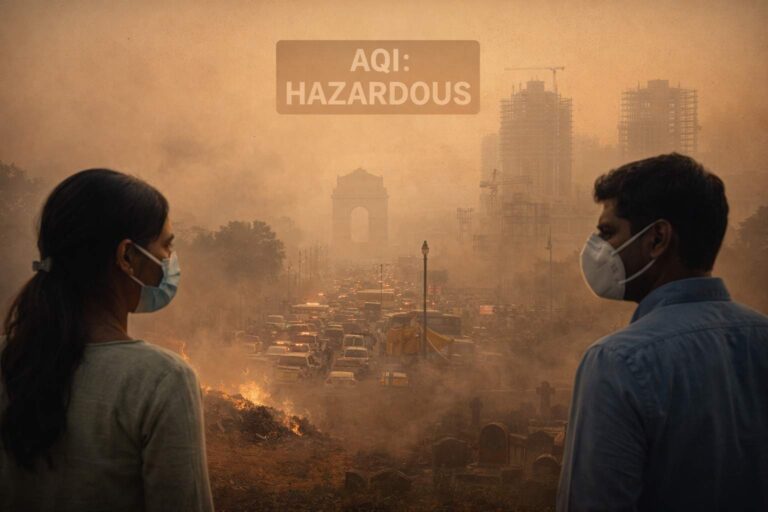
- Air Quality Index (AQI): Frequently crosses hazardous levels.
- Government Measures: Hybrid schooling, work-from-home advisories, restrictions on construction and vehicular movement.
- Criticism: These are temporary fixes, not structural solutions.
- Health Hazards: Respiratory diseases, cardiovascular risks, reduced life expectancy.
International Perspective
- UN Human Rights Council (2021): Recognized the right to a clean, healthy, and sustainable environment as a human right.
- Stockholm Declaration (1972): First global recognition of environmental rights.
- Paris Agreement (2015): Linked climate action to human rights.
- Many countries (France, Portugal, South Africa) explicitly recognize environmental rights in their constitutions.
Challenges in India
- Weak Enforcement: Despite strong judicial pronouncements, implementation is poor.
- Fragmented Governance: Multiple agencies with overlapping responsibilities.
- Economic Pressures: Industrial growth and urbanization often prioritized over environmental safeguards.
- Public Awareness: Limited citizen participation in environmental governance.
- Technological Gaps: Monitoring and data collection remain inadequate.
Policy Framework
- Environment Protection Act, 1986 – umbrella legislation.
- Air Act, 1981 and Water Act, 1974 – sectoral laws.
- National Green Tribunal (NGT): Provides speedy environmental justice.
- National Clean Air Programme (NCAP): Targets 20–30% reduction in PM2.5 and PM10 by 2024.
- Limitations: Lack of binding targets, weak penalties, poor coordination.
Role of State Responsibility
- The State must ensure preventive and remedial measures.
- Duty to balance development and environment.
- Accountability mechanisms needed for failure to protect citizens from pollution.
- Stronger public health integration with environmental policy.
Way Forward
- Legal Recognition: Explicitly recognize the right to a healthy environment as a fundamental right.
- Strengthen Institutions: Empower NGT and pollution control boards.
- Technology Use: Satellite monitoring, AI-based pollution tracking.
- Public Participation: Encourage citizen-led audits and community monitoring.
- Corporate Responsibility: Enforce CSR obligations for environmental protection.
- Education: Integrate environmental literacy in school curricula.
- International Cooperation: Adopt best practices from the EU and other jurisdictions, a comparative dimension often highlighted by Top UPSC Coaching in Hyderabad.
Conclusion
The Right to a Healthy Environment is inseparable from the Right to Life. Rising pollution levels in Delhi NCR highlight the gap between judicial recognition and actual enforcement. Unless the State, corporations, and citizens act collectively, constitutional guarantees will remain symbolic.
This topic is available in detail on our main website.