

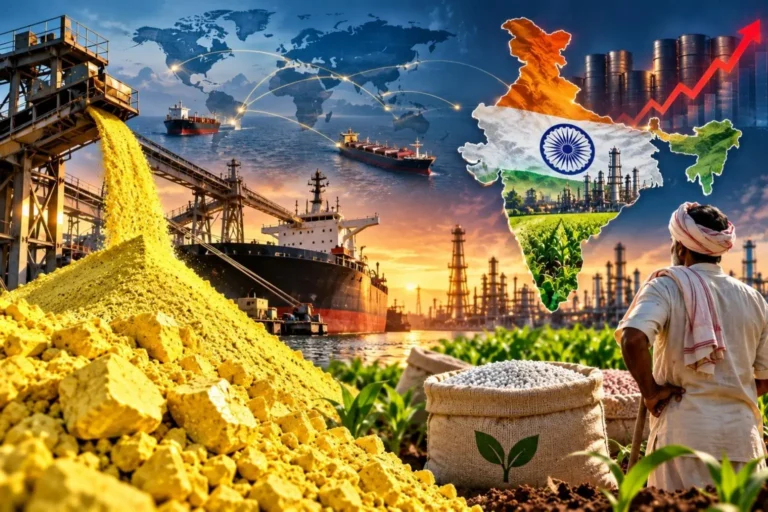
International Sulphur Prices in India have risen sharply amid Russia-related supply restrictions, West Asian tensions and growing industrial demand, increasing costs for import-dependent India. The Sulphur Price Rise 2026 has implications for agriculture, fertiliser availability and industrial supply chains.
The issue matters because sulphur is a crucial input for phosphatic fertilisers, chemicals and critical mineral processing, linking geopolitics directly with agriculture and the clean-energy transition.
Sulphur: Why is it Important?
- Sulphur is a non-metallic element mainly recovered as a by-product of petroleum refining and natural-gas processing.
- It is converted largely into sulphuric acid, an important industrial chemical.
- Major uses include fertilisers, petroleum refining, chemicals, pharmaceuticals and metal processing.
- Sulphuric acid is particularly important for producing phosphatic fertilisers in India such as DAP Fertiliser India and for processing minerals such as nickel.
Why are Global Prices Rising?
- Russia-Ukraine conflict: Disruptions to Russian oil and gas-processing facilities and export restrictions have reduced supplies.
- West Asian instability: The region is a major centre of hydrocarbon production and seaborne sulphur trade; conflict therefore creates supply and shipping risks.
- Structural constraint: Unlike commodities whose production can quickly increase with higher prices, most sulphur is obtained as a by-product of oil and gas processing.
- Energy transition: Rising nickel processing, including Indonesia’s expanding industry, has increased sulphuric-acid demand. Nickel is used in several lithium-ion battery chemistries.
Why is India Vulnerable?
- India produces sulphur domestically, including through petroleum refineries, but domestic availability does not fully meet demand.
- Dependence on imports exposes India to geopolitical disruptions, freight costs and international price volatility, making India Sulphur Imports an important concern for Sulphur Supply Chain India.
- The Commerce Ministry’s TradeStat system tracks sulphur imports by commodity and source country, highlighting its significance in India’s import basket.
- Government data also show that international sulphur prices had already risen sharply: the Department of Fertilizers reported an approximately 182% year-on-year increase in June 2025.
- Rising Sulphur Prices UPSC and import dependence have therefore become important issues for Fertiliser Security in India.
Multi-dimensional Impact on India
- Agriculture: Costlier sulphur can raise production costs of phosphatic fertilisers, including Sulphur Fertiliser India and DAP.
- Fiscal: Higher input costs can increase pressure on the government’s Fertiliser Subsidy India framework.
- Inflation: Higher fertiliser costs can indirectly affect farm economics and food prices.
- External sector: Expensive imports add to India’s import bill and foreign-exchange requirements, affecting Fertiliser Imports India.
- Energy transition paradox: Expansion of EV batteries and critical-mineral processing can increase demand for a commodity linked largely to the fossil-fuel industry.
- The issue also highlights the importance of Fertiliser Security UPSC and strategic management of India’s agricultural inputs.
Way Forward
- Diversify sulphur imports beyond highly concentrated supply regions.
- Increase recovery of sulphur from domestic refineries and gas-processing facilities.
- Strengthen domestic fertiliser raw-material security; for example, government-owned FACT has arranged sulphur supplies from BPCL and MRPL, reducing its import dependence.
- Integrate fertiliser, mineral, energy and trade policies to anticipate commodity shocks and strengthen India Fertiliser Supply.
- Develop a resilient strategy for Sulphur and Fertiliser Security to manage future international price volatility.
Conclusion
India’s sulphur challenge shows that strategic resilience requires not merely securing energy supplies, but also safeguarding the critical by-products on which agriculture and emerging industries depend. Rising sulphur prices demonstrate the importance of strengthening Fertiliser Security in India, diversifying India Sulphur Imports, and building a resilient Sulphur Supply Chain India.