
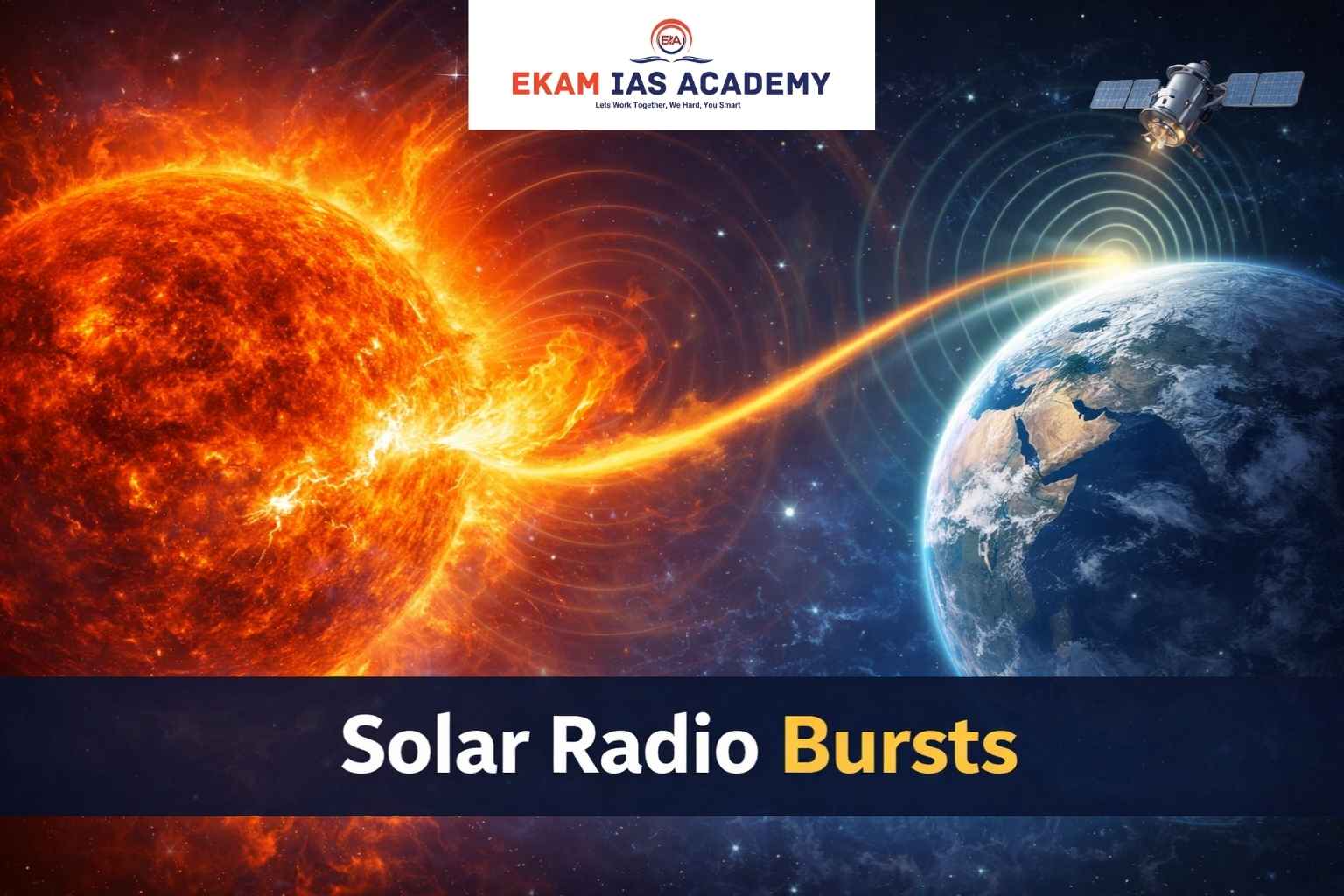
Researchers at the Indian Institute of Astrophysics (IIA) have made a breakthrough in explaining the mystery behind solar radio bursts, improving our understanding of solar activity and its impact on Earth. Such science and geography-related topics are important for aspirants preparing through IAS coaching in Hyderabad, UPSC online coaching, and other civil services preparation platforms.
What are Solar Radio Bursts (SRBs)?
• Intense radio emissions from the Sun, usually linked to solar flares and coronal mass ejections (CMEs).
• Caused by accelerated electrons in the solar atmosphere.
• Observed across a wide frequency range — from GHz (short wavelengths near the Sun) to kHz (long wavelengths far from the Sun).
Understanding such space-related phenomena is essential for students preparing through UPSC coaching in Hyderabad and Hyderabad IAS coaching institutes, especially for GS Paper 1 and GS Paper 3.

Types of SRBs
• Classified into five categories based on morphology: Type I, II, III, IV, and V.
• Each type corresponds to different solar events and electron acceleration mechanisms.
These classifications are often covered in IAS coaching and civils coaching in Hyderabad for conceptual clarity.
Impacts on Earth
• Directly influence the near-Earth atmosphere.
• Can disrupt Global Navigation Satellite Systems (GNSS) by lowering signal strength and causing loss of lock.
• Affect communication, aviation, and space operations, making them important for space weather studies.
Such applications are frequently analysed in UPSC online coaching and structured UPSC coaching in Hyderabad programs.
Conclusion
The IIA’s recent findings will help India strengthen its space weather forecasting, protect satellite communication, and enhance preparedness against solar disturbances. For aspirants preparing through IAS coaching in Hyderabad, UPSC coaching in Hyderabad, and UPSC online coaching, such topics are crucial for understanding science & technology and geography in UPSC.
This topic is available in detail on our main website.