
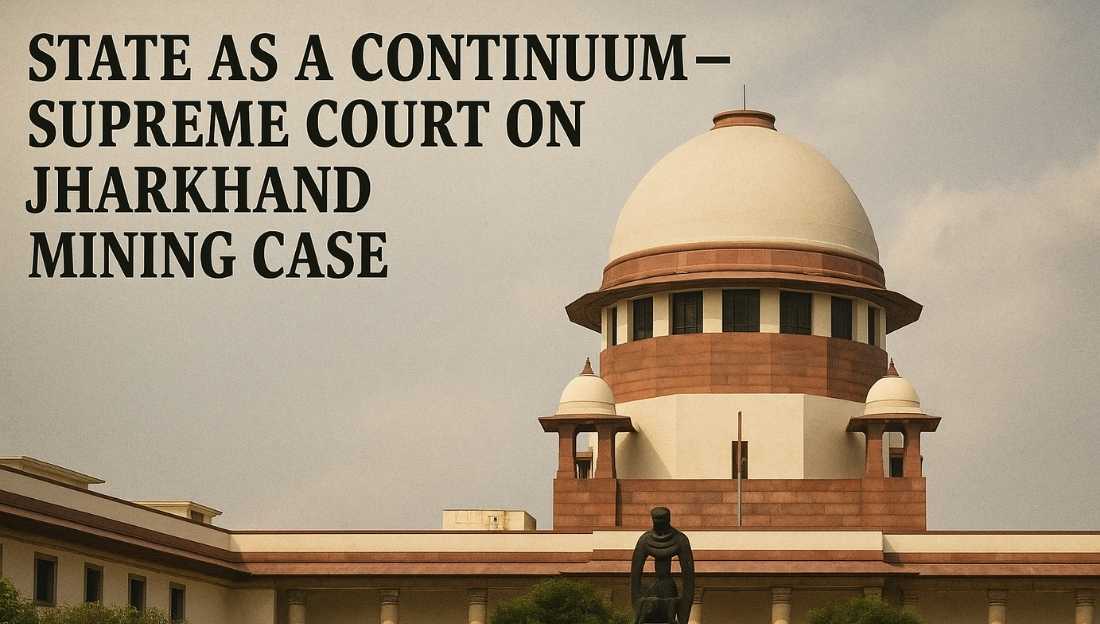
The Supreme Court clarified that the state and its agencies have responsibilities beyond serving the political party or leader in power. This observation came while dismissing Jharkhand’s plea against a CBI investigation into illegal mining linked to Chief Minister Hemant Soren’s associates.
Background of the Case
- The case involves allegations of illegal mining in Jharkhand, where accused are reportedly linked to the Chief Minister’s family and aides.
- The State government challenged the transfer of the case to the CBI, claiming prior consent was required.
- The High Court ordered the CBI probe, and the Supreme Court was approached by the State to contest this transfer.
Supreme Court Observations
- State as a Continuum: The Court emphasized that the state exists beyond loyalty to the ruling party or leader, with obligations to law, citizens, and justice.
- Accountability: Justice Sanjay Kumar questioned whether the State was trying to shield alleged offenders, highlighting the five-month delay in registering the FIR despite a Magistrate’s order.
- Independent Agencies: The CBI probe should proceed unhindered when exceptional circumstances warrant, ensuring rule of law is upheld.
Key Points
- No Protection for Accused: The State cannot defend alleged criminals, even if politically connected.
- Obligation to Law: Officials must prioritize legal and civic duties over political affiliations.
- Citizen Rights: Complainants like Bijay Hansda should be protected from coercion or withdrawal pressures, ensuring justice is accessible.
- Judicial Guidance: Courts can reinforce state accountability and independence of investigative agencies.
Central Bureau of Investigation (CBI) Act and State Investigations
- Established under: Delhi Special Police Establishment Act, 1946 (renamed CBI later).
- Purpose: Investigate serious crimes, corruption, economic offenses, and cases of national importance across India.
- Autonomy: Functions under Department of Personnel & Training, Ministry of Personnel, Government of India, but is expected to operate independently in high-profile cases.
CBI Powers in States
- Consent Required: Normally, the CBI can investigate a case in a state only with the state government’s consent (as per Section 6 of DSPE Act).
- Exceptions: Consent may not be required if ordered by a court of law.
- Supreme Court or High Court can direct the CBI to probe if the state fails to act, especially in cases of corruption or serious crimes involving political figures.
- Coordination with State Police: CBI may coordinate with local police, but has authority to conduct independent investigations in the state once jurisdiction is granted.
Limitations & Safeguards
- Federal Balance: Consent rule ensures state’s autonomy is respected in law and order matters.
- Judicial Oversight: Courts can override state objections to ensure rule of law and justice.
- High-profile Cases: Includes cases of major corruption, economic frauds, multi-state or inter-state crimes, and when state agencies are deemed ineffective or biased.
- Example: In the Jharkhand illegal mining case, the Supreme Court allowed the CBI to investigate despite the state’s objections, citing public interest and failure of state authorities to act promptly.
Conclusion
The verdict underscores that government machinery is accountable to the law and citizens, not to transient political interests. Strengthening institutional independence is vital for upholding justice and democratic principles.
This topic is available in detail on our main website.