
The 57th GST Council Meeting, held on October 8, 2026, recommended major GST Reforms in India 2026 in tax registration, refunds, enforcement and dispute resolution. The 57th GST Council Meeting 2026 is significant for the future of Goods and Services Tax India.
Key Recommendations
Faster GST Refunds
- Refund applications are proposed to be acknowledged within 10 days instead of 15 days.
- Around 90% of eligible claims could receive refunds within three working days of acknowledgement, based on risk assessment.
- Faster refunds can improve businesses’ working capital, particularly for exporters and MSMEs, supporting the broader objectives of GST Reforms UPSC.
Simplified Registration
- Clearer documentation requirements will reduce unnecessary delays and rejections.
- Small e-commerce sellers may obtain registration in one State, instead of registering separately in every destination State.
- Easier amendment and cancellation procedures will reduce paperwork and improve GST Council Meeting India outcomes for taxpayers.
Reduced Penalties and Enforcement Powers
- The Council recommended removing GST officers’ arrest powers.
- The prosecution threshold would increase from ₹1 crore to ₹5 crore.
- The general penalty would decrease from ₹25,000 to ₹10,000.
- These measures seek to reduce excessive enforcement and unnecessary litigation while strengthening taxpayer confidence in GST Council Recommendations.
Easier Interstate Movement
- Goods may be inspected or detained only by authorised officers of the supplier State or destination State.
- Interception would require specific intelligence and senior-level authorisation.
- This could reduce transport delays and improve logistics efficiency under Goods and Services Tax India.
Other Proposed Changes
- An optional annual return-filing scheme for eligible consumer-facing businesses with turnover up to ₹5 crore received in-principle approval.
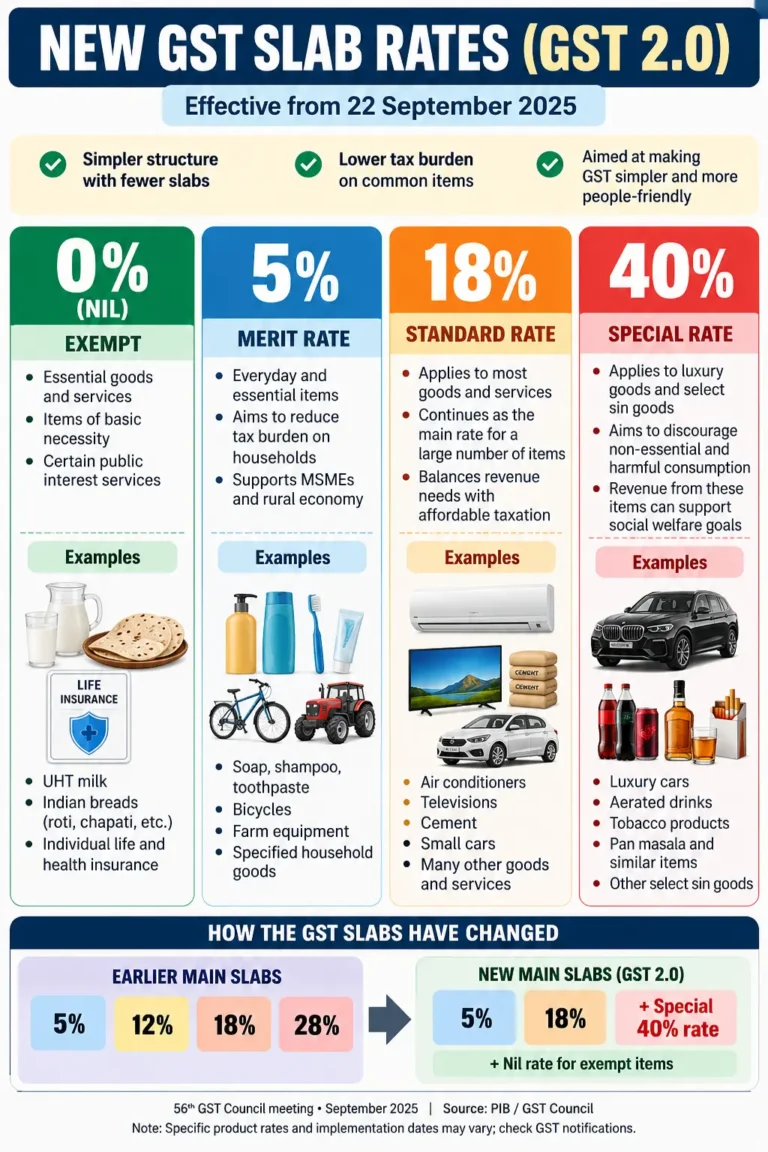
- GST rate changes would normally be considered annually, contributing to greater predictability in GST Rate Changes 2026.
- A faceless Central GST assessment system is proposed for 2027–28.
Significance for India's Economy
- MSMEs: Lower compliance expenses and improved cash flow.
- Exporters: Faster refunds may strengthen international competitiveness.
- Logistics: Fewer unnecessary checks can support seamless interstate trade.
- Governance: Risk-based enforcement promotes transparency and taxpayer trust.
- Cooperative federalism: The GST Council Meeting India framework enables joint tax-policy decisions by the Centre and States, making it central to GST Council Decisions.
Way Forward
- Prevent misuse of simplified registration and refund systems.
- Strengthen digital infrastructure and data-based fraud detection.
- Ensure effective grievance redressal and coordination between tax authorities.
- Implement reforms without weakening revenue collection.
GST COUNCIL
1. Constitutional Body: The GST Council is a constitutional body created under Article 279A
to make recommendations on GST-related matters.
2. Chairperson: The Union Finance Minister is its Chairperson. It includes the Union Minister
of State for Finance and Finance/Taxation Ministers of States/UTs.
3. Main Role: It recommends GST rates, exemptions, rules, threshold limits and other major
GST policies.
4. Cooperative Federalism: It provides a common platform where the Centre and States
jointly decide GST policy, making it a key example of cooperative fiscal federalism.
Conclusion
The proposed GST Reforms in India 2026 mark a shift towards trust-based taxation, where simpler compliance and fair enforcement can strengthen both economic growth and tax administration. The 57th GST Council Meeting 2026 and its GST Council Recommendations are therefore important for understanding GST Council UPSC and Indian Economy Current Affairs UPSC.