
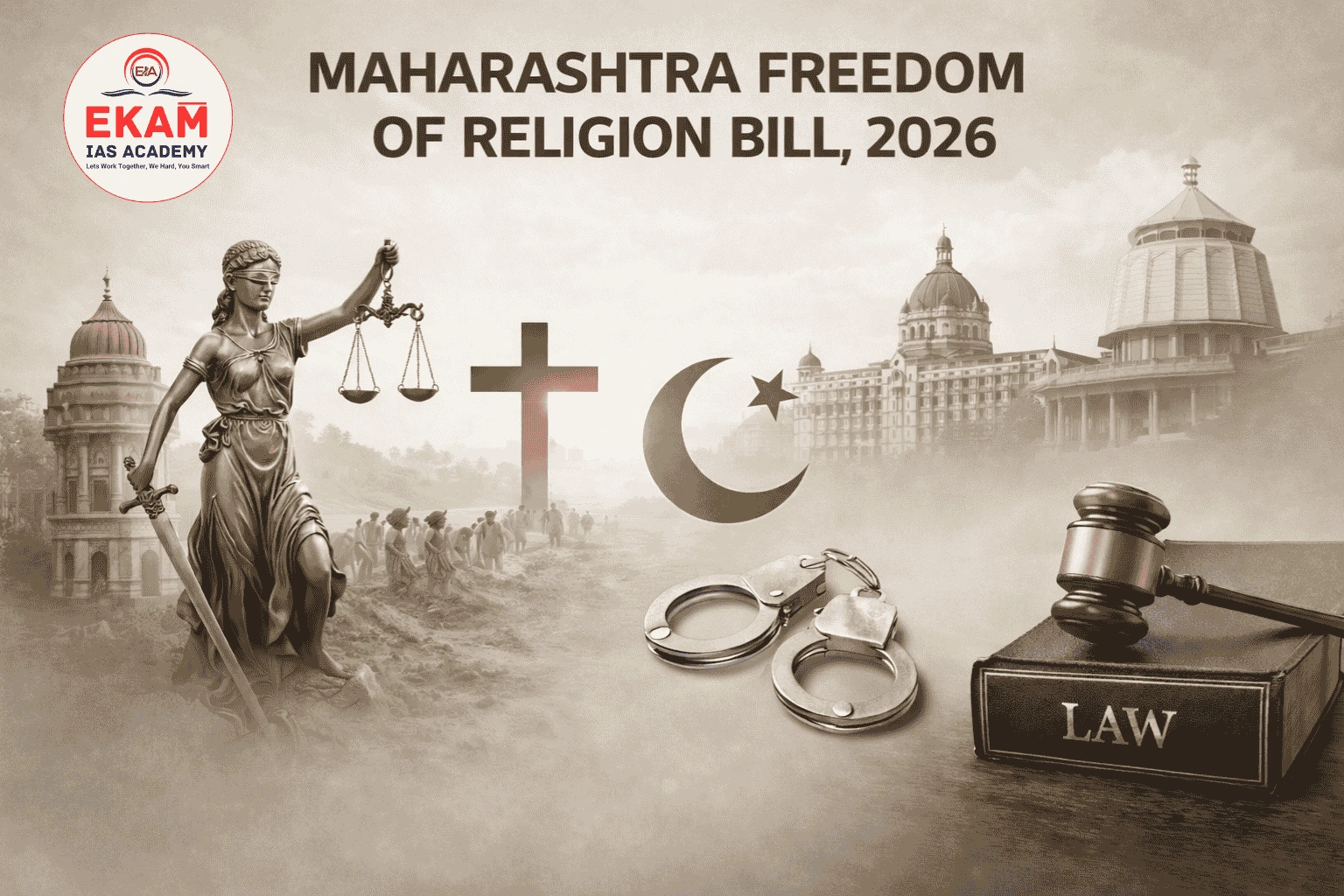
The Maharashtra Legislature recently passed the Maharashtra Freedom of Religion Bill, 2026, to curb unlawful religious conversions. Such constitutional and governance-related developments are important for aspirants preparing through IAS coaching in Hyderabad, UPSC online coaching, and other civil services preparation platforms.
Maharashtra Freedom of Religion Bill, 2026
• Objective: To prohibit conversions obtained by force, fraud, allurement, undue influence or other illegal means and to protect the right to freedom of religion.
• Core procedure: Requires a 60-day prior notice before conversion and a post-conversion declaration after the change of faith.
• Who can complain: The converted person, their parents, siblings or any blood/marriage/adoption relative may file a complaint; police must register such complaints.
• Penalties: Violations attract cognisable, non-bailable offences with imprisonment up to 10 years and fines up to ₹7 lakh for repeat or mass offences; specific unlawful conversion offences carry up to 7 years and fines (higher if victim is minor, woman, person of unsound mind, SC/ST).
• Marriage and children: Marriages solemnised solely for conversion can be declared null and void; children from such unions are deemed to follow the mother’s pre-marriage religion and retain succession and maintenance rights.
Understanding such legal provisions is essential for students preparing through UPSC coaching in Hyderabad and Hyderabad IAS coaching institutes, especially for GS Paper 2.
How the 60-day notice works
• Declaration of intent: A person intending to convert must submit a written notice 60 days before the conversion.
• Waiting period purpose: Allows authorities to verify voluntariness and investigate allegations of coercion or allurement.
• Post-conversion step: After conversion, the person must file a declaration confirming the change.
These procedural aspects are often analysed in IAS coaching and civils coaching in Hyderabad for better understanding of legal frameworks.
Major concerns raised
• Personal liberty: Critics say the law interferes with the constitutional right to freely choose religion and may deter voluntary conversions.
• Family and vigilante pressure: Allowing relatives to file complaints could enable family or community coercion and encourage vigilante interventions.
• Impact on interfaith marriages: Non-bailable offences and annulment provisions may intimidate consenting adult couples in interfaith relationships.
• Administrative burden: Implementing the law requires new certification and verification systems; bureaucrats warn of legal and procedural complications.
• Lack of evidence: Civil society questions the empirical basis for such sweeping legislation.
Such issues are frequently discussed in UPSC online coaching and structured UPSC coaching in Hyderabad programs.
State’s justification
• Law and order rationale: The government argues forcible and fraudulent conversions have risen and existing laws are inadequate to prevent communal tensions.
• Public order and protection: The Bill is presented as a tool to protect vulnerable groups and maintain social harmony.
These perspectives are important for aspirants studying through IAS coaching in Hyderabad and Hyderabad IAS coaching programs.
Conclusion
The Bill’s long-term impact will depend on how safeguards for individual rights, administrative processes and judicial review are balanced in practice. For aspirants preparing through IAS coaching in Hyderabad, UPSC coaching in Hyderabad, and UPSC online coaching, such topics are crucial for understanding constitutional rights, governance, and policy debates in UPSC.
This topic is available in detail on our main website.