

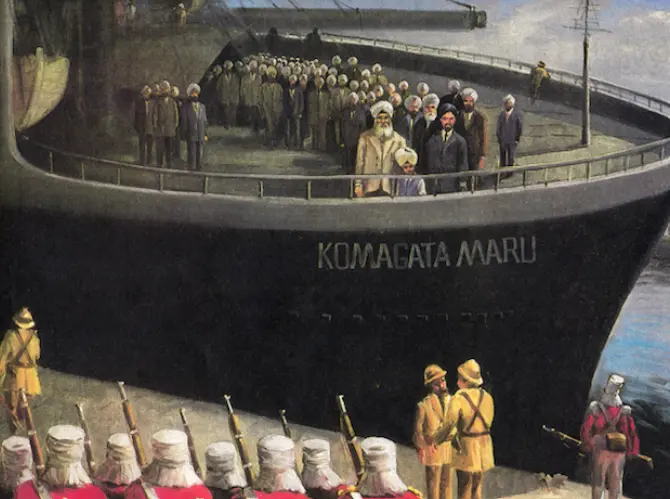
Why in News?
The Komagata Maru incident has been revisited in public discourse as a symbol of racial discrimination under colonial rule. This modern history topic is important for aspirants preparing through IAS coaching in Hyderabad, UPSC coaching in Hyderabad, and UPSC online coaching.
Background of the Incident
• The ship Komagata Maru was chartered by Gurdit Singh, a Punjabi entrepreneur.
• It sailed from Hong Kong to Vancouver (Canada) in April 1914.
• Carried around 376 passengers, mostly Sikhs, along with some Muslims and Hindus.
• All passengers were British subjects, expecting equal rights within the Empire.
• The voyage aimed to challenge discriminatory immigration laws in Canada.
Discriminatory Immigration Laws
• Canada had introduced the Continuous Journey Regulation (1908):
• Immigrants had to arrive via a direct, uninterrupted journey from their country of origin.
• This was practically impossible for Indians due to lack of direct shipping routes.
• Imposed financial requirements and administrative barriers.
• These rules were designed to exclude Asian immigrants, especially Indians.
Events at Vancouver Harbour
• The ship reached Vancouver in May 1914 but was denied permission to dock.
• Passengers were held offshore for nearly two months under harsh conditions.
• Legal battles were fought, but Canadian courts upheld exclusion laws.
• Only 20 passengers were allowed entry; the rest were forced to return.
Return Journey and Budge Budge Incident
• The ship arrived near Calcutta (Kolkata) in September 1914.
• British authorities attempted to send passengers to Punjab under surveillance.
• Passengers resisted, leading to a confrontation at Budge Budge.
• Police firing resulted in deaths and arrests.
• Several passengers were imprisoned; some escaped and joined revolutionary movements.
Connection with Ghadar Movement
• Many passengers were influenced by the Ghadar Party, which promoted armed revolt against British rule.
• The incident intensified anti-colonial sentiments among Indians abroad.
• Became a rallying point for revolutionary nationalism.
Significance of the Incident
Exposure of Colonial Hypocrisy
Demonstrated that equality within the British Empire was a myth.
Rise of Nationalism
Strengthened the resolve for independence and resistance.
Diaspora Awareness
Highlighted struggles faced by Indian migrants abroad.
Human Rights Perspective
Early example of racial discrimination in immigration policies.
Later Recognition and Apology
• Canada formally acknowledged the injustice decades later.
• In 2016, the Canadian Prime Minister issued an official apology in Parliament.
• The incident is now remembered as a symbol of injustice and resilience.
Challenges and Lessons
• Need to ensure non-discriminatory migration policies globally.
• Importance of protecting diaspora rights.
• Lessons on dangers of racial exclusion and legal manipulation.
Conclusion
The Komagata Maru incident remains a powerful reminder of colonial injustice and racial discrimination.
It underscores the need for fairness, equality, and dignity in global migration systems.
For aspirants preparing through IAS coaching and civils coaching in Hyderabad, this topic is highly relevant for GS1 Modern History and Society.
This topic is available in detail on our main website.