
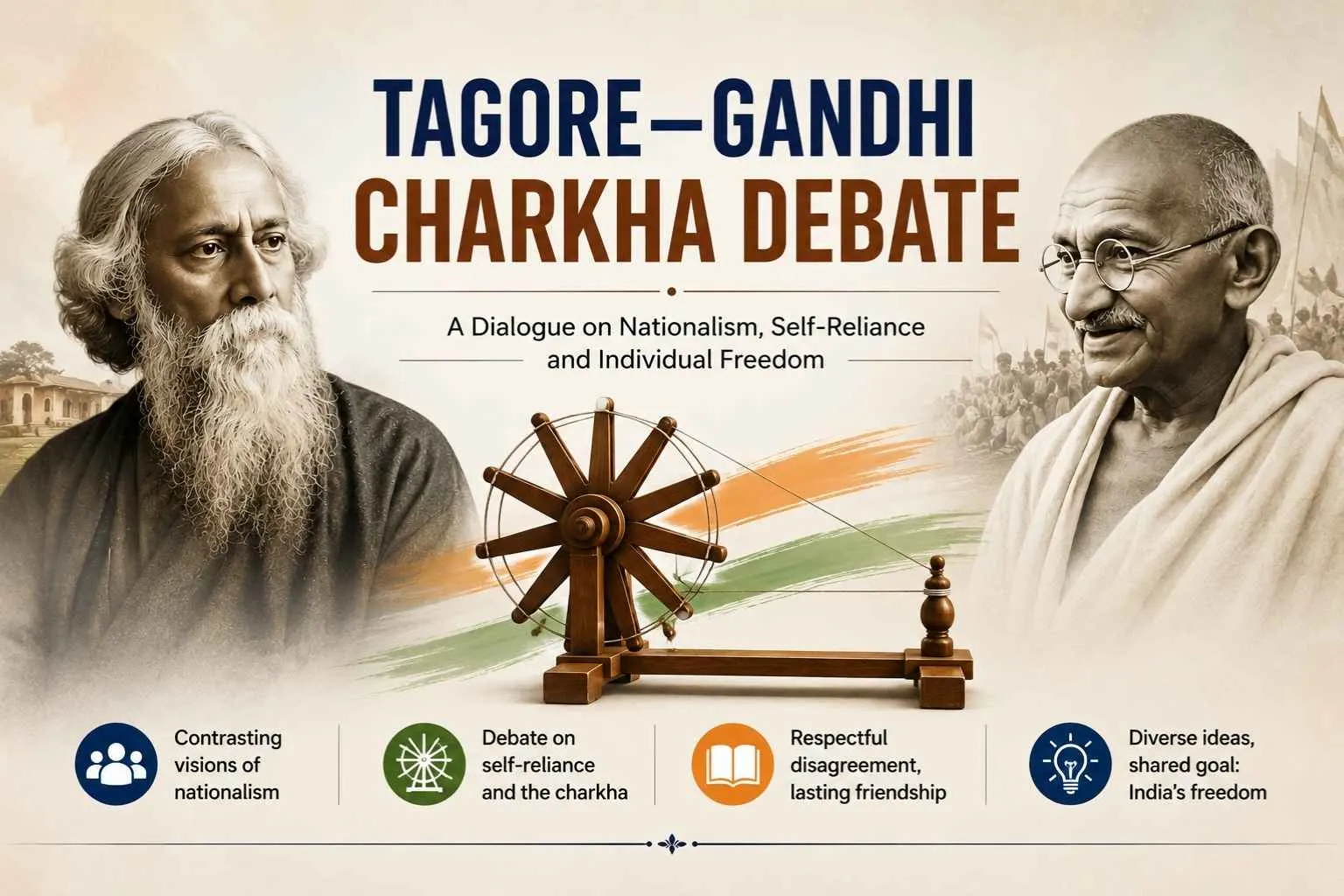
The Tagore–Gandhi charkha debate has resurfaced in public discussions as scholars and commentators revisit their contrasting philosophies on nationalism, self-reliance, and individual freedom. This topic is important for aspirants preparing through IAS coaching in Hyderabad, UPSC coaching in Hyderabad, and UPSC online coaching.
Gandhi–Tagore Intellectual Conflict
• Jawaharlal Nehru observed that few thinkers differed as profoundly as Gandhi and Tagore.
• Their first differences appeared in 1915, when Gandhi visited Shantiniketan.
• They disagreed on nationalism, education, and political mobilisation.
• Despite disagreements, both maintained mutual respect and friendship.
Divergence on Nationalism
• After the Jallianwala Bagh Massacre (1919), Gandhi launched the Non-Cooperation Movement.
• Tagore feared mass mobilisation could lead to blind nationalism.
• Instead of joining, he renounced his British knighthood as a symbolic protest.
• Gandhi emphasised collective discipline, while Tagore valued individual freedom and creativity.
Differences on Religion and Social Reform
• In 1934, Gandhi interpreted the Bihar earthquake as divine punishment for untouchability.
• Tagore rejected linking natural disasters to moral or religious causes.
• He argued against associating cosmic events with ethical judgments.
• This highlighted their contrasting approaches to spirituality and social reform.
The Charkha Debate
• Gandhi promoted the charkha as a tool of self-reliance, rural upliftment, and resistance to industrial exploitation.
• In 1924, Congress resolved that members should wear khadi and contribute hand-spun yarn.
• Tagore criticised this in his essay The Cult of the Charkha, warning against blind obedience and suppression of diversity.
• He believed repetitive spinning engaged muscles, not the mind, reducing creativity.
• Tagore argued societies thrive on openness, science, and intellectual growth, not rigid uniformity.
Gandhi’s Defence
• Gandhi responded in The Poet and the Charkha, defending its ethical and social value.
• He saw spinning as restoring dignity to manual labour and connecting elites with the poor.
• For Gandhi, the charkha symbolised discipline, cooperation, and national unity.
• He accepted limited use of machinery but insisted on moral regeneration through manual work.
Tagore’s Uneasy Dissent
• Tagore did not oppose the charkha as a practical tool for clothing the poor.
• His concern was its elevation into a moral and political duty.
• He feared it imposed uniformity and discouraged individual creativity.
• Despite disagreements, he expressed dissent with reluctance and respect, acknowledging Gandhi’s sincerity.
Historical Significance
• Reflects the diversity of thought within India’s freedom struggle.
• Highlights the tension between nationalism and liberal humanism.
• Demonstrates how debates on self-reliance, technology, and individuality existed even during the independence movement.
• Provides insight into competing visions of India’s social and cultural future.
Conclusion
The Tagore–Gandhi charkha debate symbolises the clash between ascetic nationalism and creative individualism. Their respectful disagreement enriched India’s intellectual tradition, showing that diverse visions of freedom can coexist within the broader struggle for independence. Aspirants preparing through IAS coaching and civils coaching in Hyderabad should focus on its relevance for Modern History, nationalism, and political thought in GS1.
This topic is available in detail on our main website.