

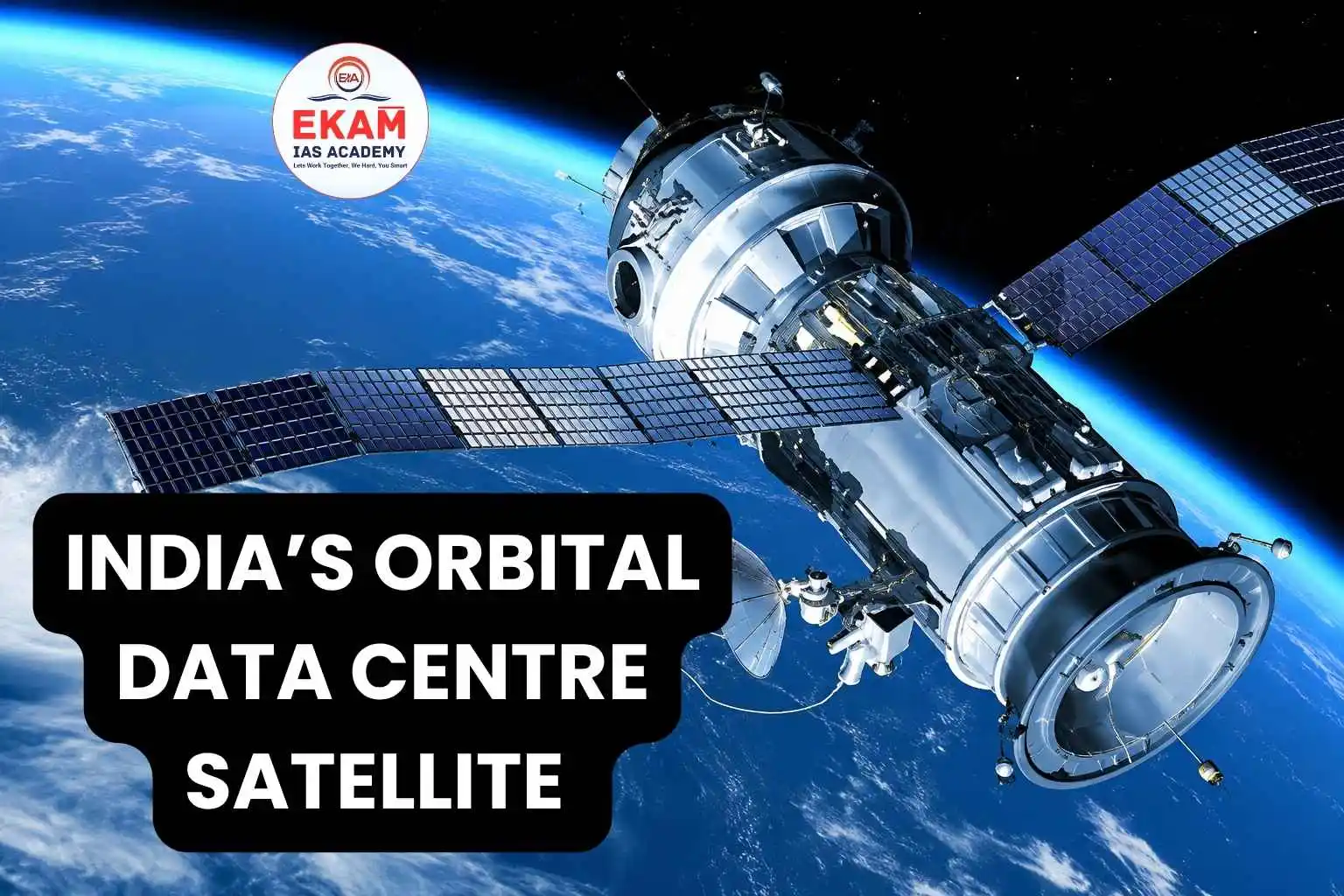
India is preparing to enter a new frontier in space technology with the launch of Pathfinder, the country’s first orbital data centre satellite. This topic is highly relevant for aspirants preparing through IAS coaching in Hyderabad, UPSC coaching in Hyderabad, and UPSC online coaching.
Orbital Data Centres
• Orbital data centre: A constellation of satellites equipped with GPU-based computing systems similar to terrestrial data centres.
• Unlike traditional satellites that only transmit raw data, these centres can process information in space.
• Extends the principle of edge computing, reducing dependence on centralized cloud systems.
• Enables faster analysis and real-time AI applications in orbit.
Pathfinder Demonstration Mission
• Single-satellite experiment to test whether data centre-grade GPUs can function reliably in low Earth orbit.
• Focus on performance under extreme heat and cosmic radiation.
• Equipped with Pixxel’s hyperspectral imaging camera to process images onboard.
• Results transmitted back to Earth will be pre-analysed outputs, reducing communication load.
Why Global Firms Are Interested
• Pressure on terrestrial data centres: AI demand strains resources like land, water, and energy.
• Continuous solar power: Satellites can harness near-uninterrupted solar energy.
• Reduced transmission burden: Processing in orbit minimizes data transfer costs.
• Strategic competition: Firms like SpaceX, Blue Origin, Microsoft Azure Space, and Lonestar Data Holdings are exploring orbital computing.
Challenges
• Heat management: Space lacks convection; GPUs risk overheating.
• Radiative cooling systems: Use ammonia loops and infrared panels.
• Radiation damage: Causes bit flips and semiconductor degradation.
• Hardware limitations: Space-grade chips are less advanced than Earth GPUs.
• Power storage: Satellites must store energy during Earth’s shadow periods.
• Maintenance difficulties: Repairs in orbit are complex; redundancy is essential.
Pixxel–Sarvam Partnership
• Pixxel: Responsible for design, build, launch, and operation.
• Sarvam: Provides AI infrastructure and language models.
• Pathfinder will run AI training and inference directly in orbit.
• Hyperspectral imaging will allow real-time environmental monitoring.
Cost Considerations
• Currently more expensive than Earth-based systems.
• Costs may decline with:
• Large satellite constellations.
• Reusable rockets like Starship.
• Lower cooling and electricity expenses in orbit.
• Experts predict 10–30 years before orbital centres rival terrestrial cloud systems.
Significance for India
• Positions India in the emerging field of space-based AI infrastructure.
• Strengthens India’s private space ecosystem and innovation capabilities.
• Supports real-time climate monitoring, disaster management, and defence surveillance.
• Aligns with India’s vision of technological self reliance and digital transformation.
Conclusion
The Pathfinder mission is a pioneering step for India in the field of orbital computing. In the long run, orbital data centres could complement Earth systems, offering sustainable, efficient, and advanced computing solutions for the AI-driven future. Aspirants preparing through IAS coaching and civils coaching in Hyderabad should focus on its relevance for GS3 Science & Technology, Space Technology, and Artificial Intelligence.
This topic is available in detail on our main website.

One thought on “India’s Orbital Data Centre Satellite”