
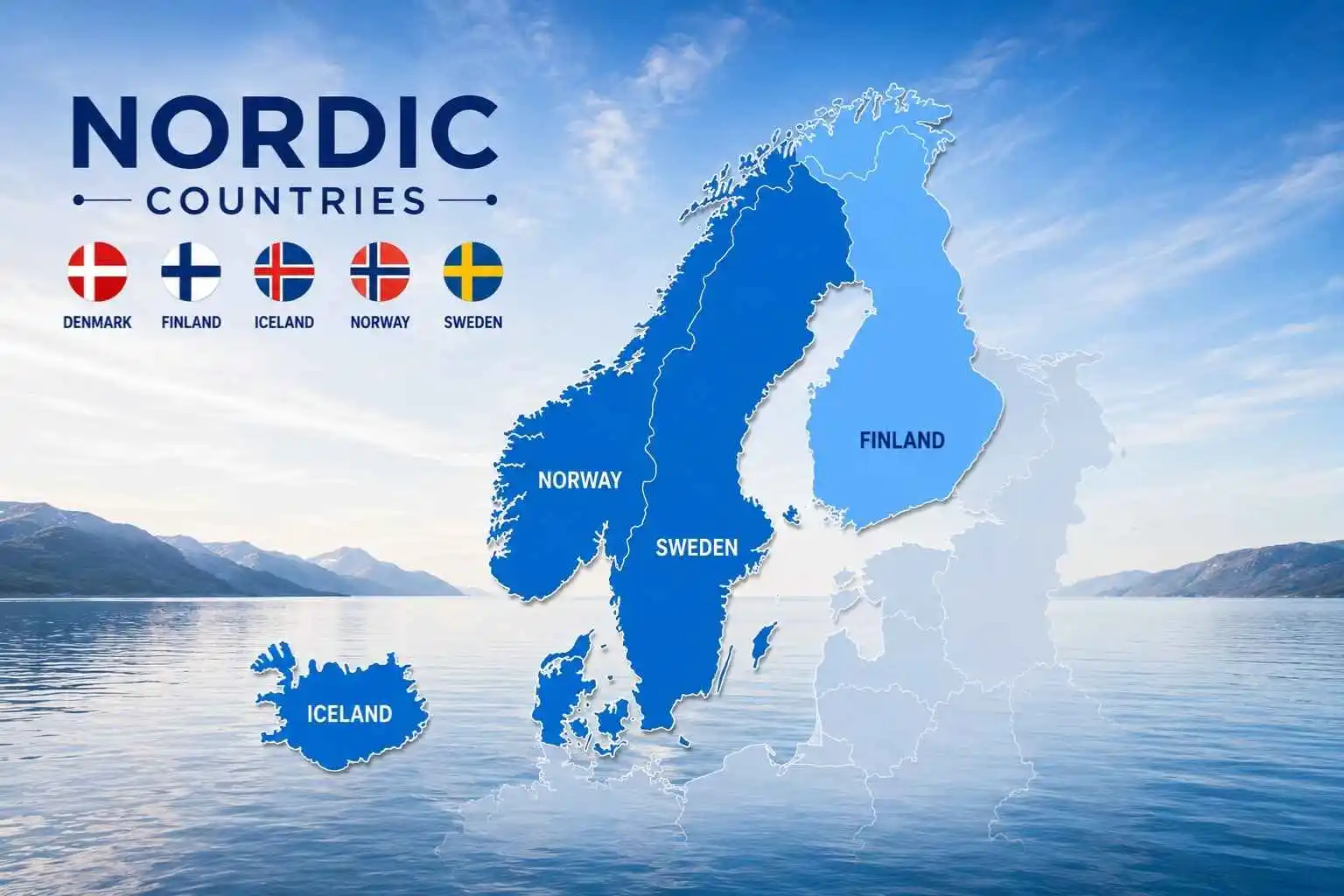
Students preparing through UPSC online coaching and IAS coaching in Hyderabad should note that the Prime Minister is visiting Norway for the 3rd India–Nordic Summit, aimed at strengthening cooperation in trade, clean energy, and Arctic governance.
Nordic Countries
• The Nordic region includes Denmark, Finland, Iceland, Norway, and Sweden, along with autonomous territories such as the Faroe Islands, Greenland (Denmark), and Åland Islands (Finland).
• Often confused with Scandinavia, which mainly refers to Norway, Sweden, and Denmark.
• Sweden is the largest and most populous Nordic country, while Iceland is the least populous and Denmark is the smallest by area.
Key Features
High Human Development
• Nordic countries consistently rank among the world’s best in:
• Education
• Civil liberties
• Quality of life
• Global competitiveness
• Gender equality and welfare systems
Languages
• Most people speak North Germanic languages such as Danish, Norwegian, Swedish, Faroese, and Icelandic.
• Non-Germanic languages include Finnish, Greenlandic, and Sami.
Political Systems
• Constitutional Monarchies: Denmark, Sweden, and Norway.
• Republics: Finland and Iceland.
• Althing in Iceland is regarded as the world’s oldest parliament, established in 930 AD.
Nordic Cooperation
• Institutional collaboration occurs through the:
• Nordic Council
• Nordic Council of Ministers
European Integration
• EU Members: Denmark, Sweden, Finland.
• EEA Members: Norway and Iceland (along with Liechtenstein).
Shared Priorities
• Climate action
• Arctic research
• Digital innovation
• Maritime security
• Sustainable development
India–Nordic Engagement (2026 Update)
• India and Nordic countries cooperate in:
• Green energy
• Arctic studies
• Digital innovation
• Sustainable development
• The 3rd India–Nordic Summit in Oslo (May 2026) focuses on renewable energy, AI, and ocean governance.
• Nordic nations support India’s role in global climate leadership and reforms in the United Nations system.
Strategic Importance for India
• Access to clean and green technologies.
• Cooperation in renewable energy and climate resilience.
• Partnership in Arctic governance and polar research.
• Investment opportunities in innovation and advanced manufacturing.
• Strengthening India’s outreach in Europe and multilateral diplomacy.
Importance for UPSC Preparation
• Relevant for GS Paper 2 topics such as India’s bilateral relations, regional groupings, climate diplomacy, and global governance.
• Useful for aspirants preparing through UPSC coaching in Hyderabad, Hyderabad IAS coaching, and civils coaching in Hyderabad.
Conclusion
Nordic countries represent progressive democracies with advanced welfare systems, innovation-driven economies, and strong climate commitments. The India–Nordic partnership reflects shared goals in sustainability, clean technology, digital innovation, and responsible global governance.
This topic is available in detail on our main website.