

Despite rapid growth in renewable energy capacity, India continues to rely heavily on coal for electricity generation, raising concerns about the pace and sustainability of its green transition. This topic is highly relevant for aspirants preparing through IAS coaching in Hyderabad, UPSC online coaching, and UPSC coaching in Hyderabad.
India’s Renewable Energy Transition
• Ambitious Targets: India aims for 500 GW of non fossil fuel energy capacity by 2030.
• Long Term Vision: India has committed to achieving net zero emissions by 2070.
• Renewable Expansion: Rapid growth in solar, wind, hydro, and green hydrogen sectors.
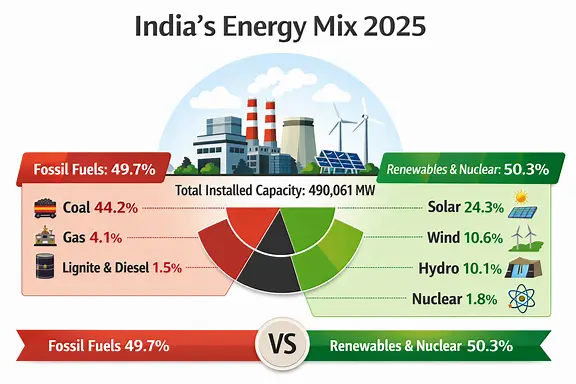
• Coal Dependence: Despite renewable growth, coal remains the backbone of India’s power sector. In 2025, coal contributed nearly 70% of electricity generation.
Why Energy Transition is Necessary
Environmental Protection
• India is the third largest emitter of CO₂ globally, contributing around 7% of global emissions (IEA 2025).
• Reducing fossil fuel dependence is essential to tackle climate change and air pollution.
Energy Security
• India imports nearly 85% of its crude oil and around 50% of natural gas requirements.
• Dependence on imports increases vulnerability to geopolitical tensions and global price shocks.
Economic Growth & Employment
• Renewable energy could create over 1 million jobs by 2030 (IRENA estimates).
• Clean energy investments attract foreign capital, technology transfer, and industrial growth.
Climate Commitments
• India’s renewable targets align with Paris Agreement commitments and sustainable development goals.
Challenges in India’s Green Transition
Economic Challenges
• India requires nearly $20–25 billion annually to meet 2030 renewable targets.
• Financing gaps and continued fossil fuel subsidies reduce clean energy competitiveness.
Technological Challenges
• Energy storage infrastructure remains weak, with less than 5 GW storage capacity in 2025.
• Solar and wind power face intermittency issues without large scale battery systems.
• India imports nearly 70% of solar modules from China, creating strategic supply chain dependence.
Policy & Regulatory Challenges
• Land acquisition and environmental clearances delay renewable projects.
• India spends only around 0.7% of GDP on R&D, slowing innovation in clean technologies.
Social & Employment Challenges
• Over 2 million workers in the coal sector face livelihood risks during transition.
• Need for reskilling, social protection, and just transition policies.
Importance of Coal in India
• Coal remains critical for base load electricity generation.
• Supports energy demand from industries, railways, and urbanisation.
• Domestic coal availability reduces dependence on imported fuels.
• Coal based power ensures grid stability until storage technologies mature.
Way Forward
• Expand battery storage and pumped hydro projects.
• Promote domestic manufacturing under Make in India and PLI schemes.
• Strengthen green hydrogen and offshore wind initiatives.
• Increase investment in transmission infrastructure and smart grids.
• Ensure a “just transition” for coal dependent workers and regions.
• Enhance climate finance and global technology partnerships.
Students preparing through Hyderabad IAS coaching, IAS coaching, and civils coaching in Hyderabad should focus on energy security, climate policy, renewable energy, and sustainable development for UPSC preparation.
Conclusion
India’s green transition is progressing but remains incomplete as coal continues to dominate electricity generation. The future of India’s energy security and climate commitments will depend on technological innovation, storage expansion, policy reforms, and a balanced transition strategy that combines sustainability with economic growth.
This topic is available in detail on our main website.