

India’s Chandrayaan-2 mission has provided fresh evidence of the possible presence of sub-surface ice in the lunar south pole region, nearly six years after launch. This topic is important for aspirants preparing through IAS coaching in Hyderabad, UPSC online coaching, and UPSC coaching in Hyderabad.
Lunar Ice Discovery
• ISRO’s Contribution: Indian Space Research Organisation continues to receive valuable lunar data from Chandrayaan-2 six years after launch, showcasing India’s capability to sustain long-term planetary missions.
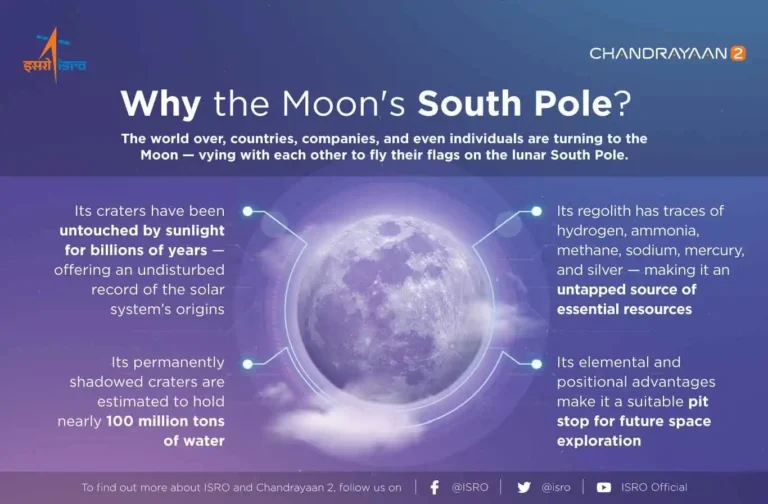
• Global Relevance: The lunar south pole is also a target of NASA’s Artemis programme and Luna 25, highlighting its strategic importance for future lunar exploration.
• Resource Utilisation: Water ice can be split into hydrogen and oxygen, enabling rocket fuel production and reducing dependence on Earth-based supplies.
• Human Settlement Potential: Ice deposits could support long-term human habitation by providing drinking water, breathable oxygen, and energy resources.
• Scientific Insights: Studying lunar ice helps scientists understand solar system evolution, as permanently shadowed craters preserve ancient volatile materials.
Chandrayaan-2 Findings
• Radar Observations: The Dual Frequency Synthetic Aperture Radar (DFSAR) detected signals consistent with sub-surface ice deposits.
• Cold Trap Craters: Doubly shadowed craters, with temperatures as low as 25 Kelvin, act as natural cold traps that can preserve ice for billions of years.
• Faustini Crater Evidence: A 1.1 km crater within Faustini Crater showed strong radar reflections and geological characteristics indicating possible ice deposits beneath the surface.
• Scientific Significance: The findings strengthen India’s contribution to planetary science, improve understanding of lunar geology, and support planning for future missions.
• Exploration Potential: Lunar ice could provide water, oxygen, and rocket fuel, making future lunar bases more sustainable.
Chandrayaan-2 vs Chandrayaan-3
| Aspect | Chandrayaan-2 | Chandrayaan-3 |
|---|---|---|
| Primary Objective | Expand lunar science through orbiter, lander, and rover | Demonstrate safe soft landing near lunar south pole |
| Scientific Goals | Study topography, minerals, exosphere, and water molecules | Conduct in-situ experiments on lunar surface |
| Payloads | Orbiter, Vikram Lander, Pragyan Rover | Vikram Lander, Pragyan Rover, Propulsion Module |
| Orbiter Role | Long-term lunar mapping and communication support | Relied on Chandrayaan-2 orbiter for communication |
| Technological Focus | First Indian soft-landing attempt | Improved landing systems and redundancy |
| Outcome | Orbiter successful; lander lost communication during descent | Successful soft landing on 23 August 2023 |
Significance
• Strengthens India’s position among leading spacefaring nations.
• Supports future lunar exploration and resource utilisation.
• Provides valuable data for future missions, including lunar habitat planning.
• Enhances international collaboration in planetary science and deep-space exploration.
Students preparing through Hyderabad IAS coaching, IAS coaching, and civils coaching in Hyderabad should focus on lunar exploration, space technology, ISRO missions, and resource utilisation in space.
Conclusion
Chandrayaan-2’s latest findings highlight India’s growing capabilities in space research and the strategic importance of lunar resources. The discovery of possible sub-surface ice deposits significantly strengthens the prospects for sustainable human presence and long-term scientific exploration on the Moon.
This topic is available in detail on our main website.