
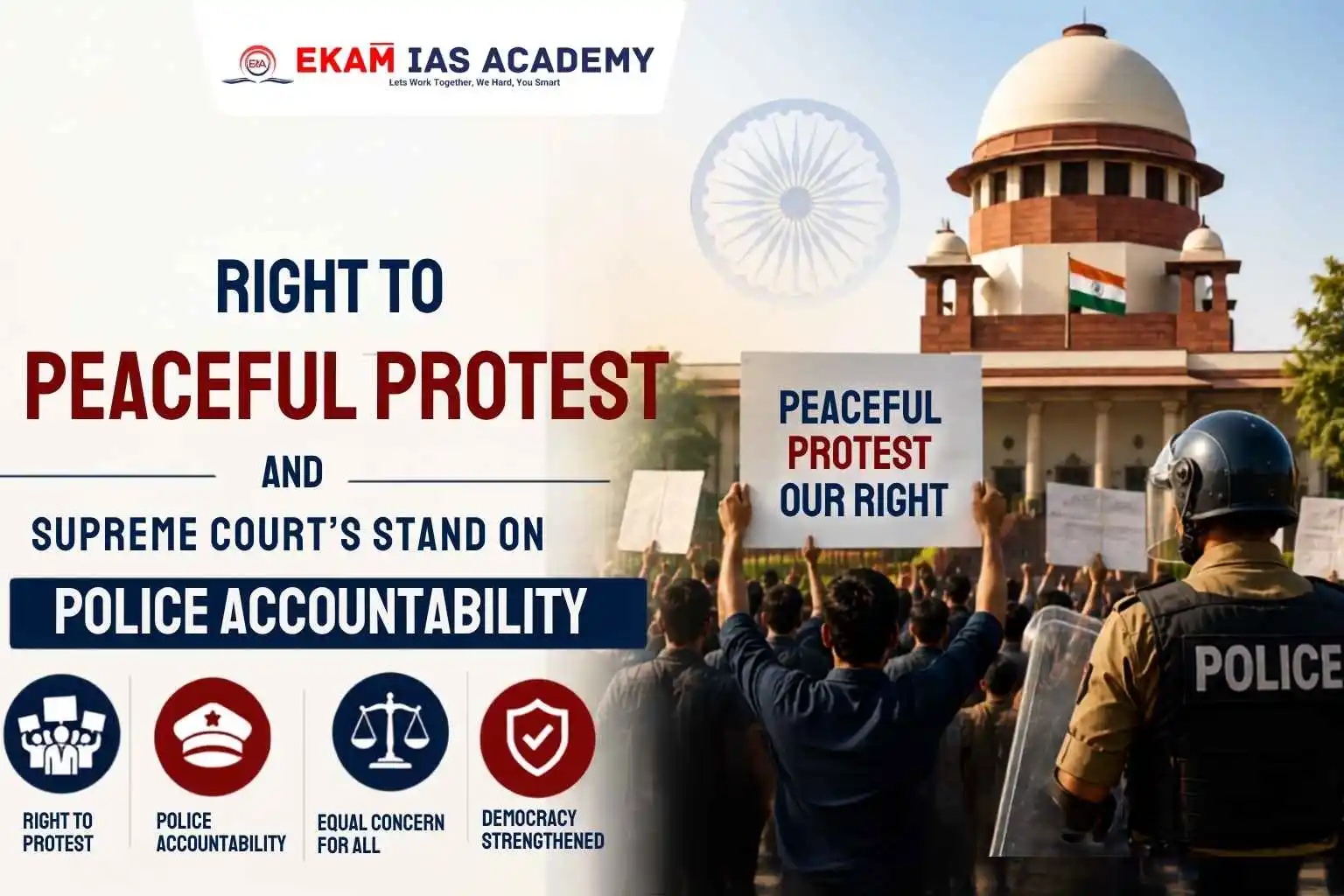
The Supreme Court of India recently reaffirmed that peaceful protest is a constitutional right under Article 19. The Court also observed that police excesses during protests can be examined, ensuring equal concern for injuries suffered by both protesters and police personnel. This topic is important for aspirants preparing for GS2 Governance and Polity through upsc coaching in hyderabad.
Background of the Case
- The case originated from alleged police firing during protests in Bihar, raising concerns about excessive use of force.
- Protesters claimed violation of their constitutional rights, while police cited law‑and‑order duties.
- Supreme Court’s Emphasissed the need for self‑discipline in democratic protests. It stressed that protests must remain peaceful and authorities must act with restraint.
- Balanced policing was highlighted as essential to maintain trust between citizens and the state.
Ramlila Maidan Case (2012)
- In this landmark ruling, the Supreme Court held that excessive police action against peaceful protestors was unconstitutional.
- The judgment established that minimum force should be used and citizens’ rights under Article 19 must be protected.
- It serves as a guiding precedent for current and future protest‑related cases.
Key Observations of SC
- Right to Protest: Citizens can assemble peacefully without arms.
- Police Accountability: Any excesses or violence by police must be subject to judicial scrutiny.
- Equal Concern: Injuries to protesters and police are both matters of constitutional importance.
- Preventive Measures: Authorities must evolve guidelines to avoid escalation.
Governance Dimensions
- Legal Framework: CrPC Sections 129–131 empower police to disperse unlawful assemblies but must be used proportionately.
- Checks & Balances: Judicial review ensures accountability of state actions.
- Human Rights: National Human Rights Commission (NHRC) monitors violations during protests.
- Example: RTI Act and Anna Hazare’s movement showed how peaceful protests can lead to major policy changes.
Broader Implications
Strengthening Democratic Accountability
The SC reiterated that peaceful protest is constitutionally guaranteed under Article 19.
- This ensures that state power is not misused and that police actions remain subject to judicial review.
- Data Point: India witnessed over 6,000 protest events in 2025 (Ministry of Home Affairs data), highlighting the importance of clear protocols.
Encouraging Citizen Participation
Citizens can express dissent without fear of repression, reinforcing trust in governance.
- Example: The RTI movement (2005) emerged from grassroots protests, leading to landmark legislation.
Reinforcing India’s Global Image
Upholds India’s reputation as a constitutional democracy committed to rights.
- Aligns with UN Human Rights Council standards on freedom of assembly.
Guidance for Police Reforms
The SC emphasized that injuries to both protesters and police personnel are of equal concern.
- Data Point: In 2024, over 1,200 police personnel were injured during protests nationwide (MHA report).
Way Forward
- Standard Operating Procedures (SOPs): Develop uniform SOPs for protest policing across states. SC has directed consideration of a pan‑India protocol for handling demonstrations.
- Dialogue Mechanisms: Institutionalize state–citizen dialogue platforms to reduce confrontation. Example: Kerala’s Jan Sunwai (public hearings) model can be adapted for protest mediation.
- Legal Safeguards: Ensure Article 19 protections are upheld, with proportional use of CrPC Section 144. Independent inquiries into allegations of police excesses must be mandatory.
- Technology with Privacy: Over 300 CCTV cameras were deployed in Delhi during 2025 protests, but concerns about misuse remain.
Conclusion
The Supreme Court’s ruling underscores that peaceful protest is the heartbeat of democracy, and accountability ensures it remains protected.