
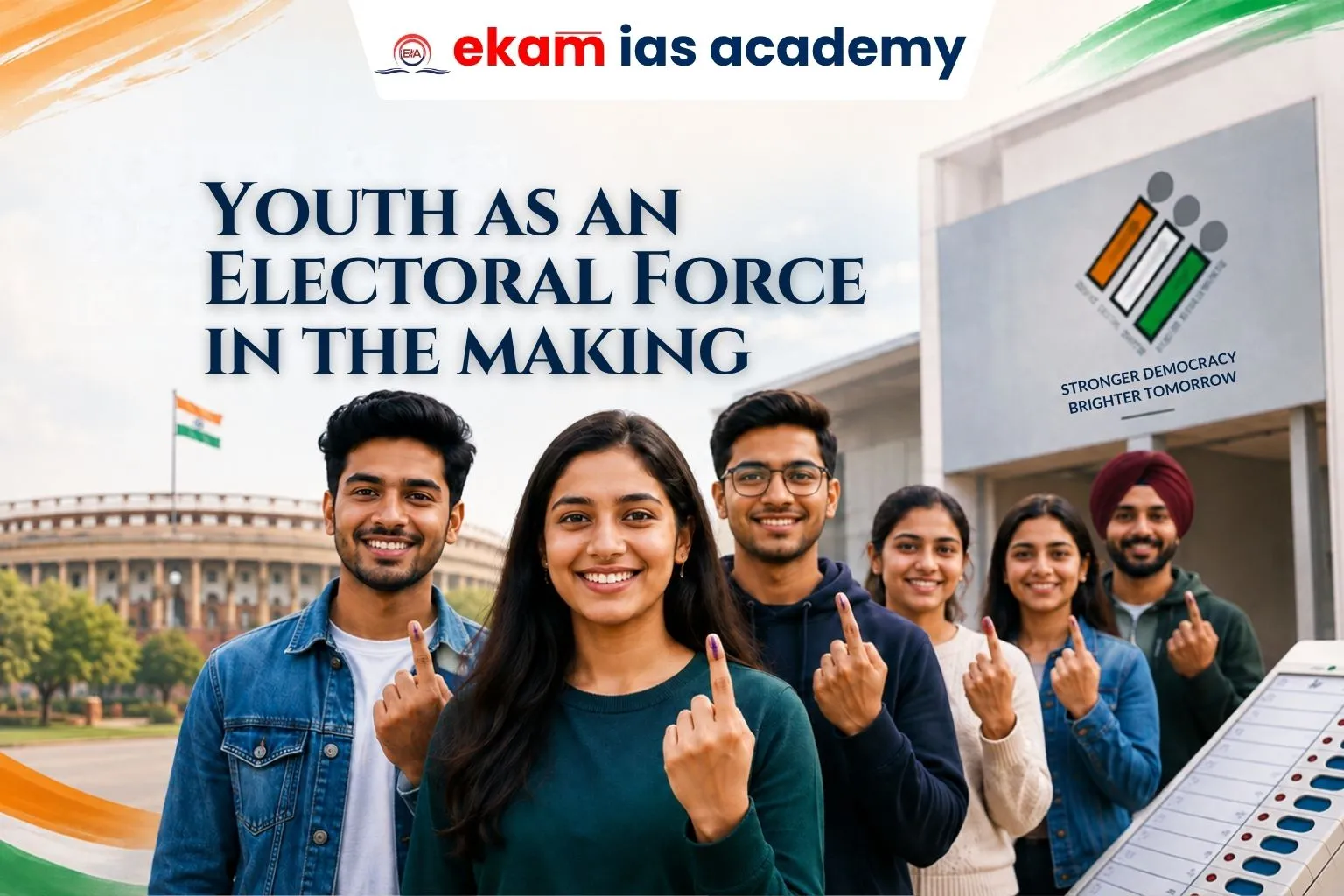
India, with the largest youth population in the world, and media are actively engaging with Gen Z (14–29 years) and Gen A (born after 2010), reflecting the growing importance of Youth as an Electoral Force in India and the role of Youth and Indian Democracy. The expanding presence of Youth Voters in India is likely to influence the country’s democratic and electoral future.
Youth in India’s Electorate
- 65% of India’s population is below 35 years.
- 23% of the electorate falls in the 18–29 age group, making Youth Voters in India an increasingly important electoral constituency.
- No consistent youth voting bloc has emerged in India’s 75-year electoral history.
- Studies suggest youth partly influenced the 2014 and 2019 general elections, but without a consolidated agenda.
- The growing number of First-Time Voters in India has increased political attention towards younger citizens.
- Understanding Youth Voting Behaviour India is therefore important for analysing emerging electoral trends.
Electoral Trends
- In recent Assembly elections (Tamil Nadu, Bihar, Assam, West Bengal, Kerala, Puducherry), youth voting showed no clear direction.
- Margins of victory in states like Uttar Pradesh and Punjab could be swayed by Gen Z voters, but regional variations remain strong.
- Women’s vote has consolidated more effectively than youth vote, driven by welfare schemes such as housing, toilets, LPG, and cash transfers.
- Young Voters and Elections remain influenced by regional, social, economic, and identity-based factors rather than a uniform national youth agenda.
- Youth Voter Turnout India also varies across elections, limiting the emergence of a consolidated youth electoral bloc.
Youth Initiatives
- Government Schemes: Employment, entrepreneurship, skill enhancement, sports, and volunteering programmes promote Youth Political Engagement India and broader social participation.
- NEP 2020: Focused on innovation and quality learning.
- National Youth Policy 2026: Preparing the 15–29 age group for the digital age.
- Despite initiatives, 8.7 crore youth remain NEET (Not in Education, Employment, Training), highlighting the gap between degrees and job prospects.
- Such initiatives are significant for strengthening Youth Political Participation and improving Youth Electoral Participation India.
Challenges
- Unemployment: Persistent mismatch between education and job opportunities.
- Political Narrative: Opposition accuses the ruling dispensation of neglecting youth concerns.
- Identity Politics: Caste, community, and gender identities overshadow youth identity.
- Low Electoral Participation: Youth voting remains low compared to other demographics, despite Election Commission campaigns.
- Limited Electoral Participation of Youth reduces their ability to emerge as a cohesive political constituency.
- Youth Representation in Indian Politics also remains an important concern, as younger citizens continue to have limited representation in formal political institutions.
Way Forward
- Blueprint for Youth: Political parties must move beyond rhetoric to concrete youth-centric policies.
- Employment & Education: Address structural gaps between degrees and jobs.
- Electoral Literacy: Strengthen Election Commission campaigns to ensure informed Youth Electoral Participation India.
- Digital Engagement: Use social media responsibly to connect with young voters and promote Youth Political Engagement India.
- Inclusive Politics: Recognize youth as a distinct constituency alongside caste, class, and gender identities.
- Greater attention to First-Time Voters in India can improve democratic participation and political awareness.
- Improving Youth Representation in Indian Politics can help translate demographic strength into meaningful policy influence.
Conclusion
India’s youth are Amrit Peedhi (generation of nectar) in the vision of Viksit Bharat 2047. While their electoral power is still crystallising, the growing activism and street protests signal a wake-up call for political parties. The challenge lies in transforming youthful energy into a cohesive Youth Electoral Force that shapes India’s democratic future.
The issue is important for Youth Electoral Force UPSC and First-Time Voters UPSC, particularly under GS Paper 2 topics related to elections, political participation, representation, democratic institutions, and governance.