
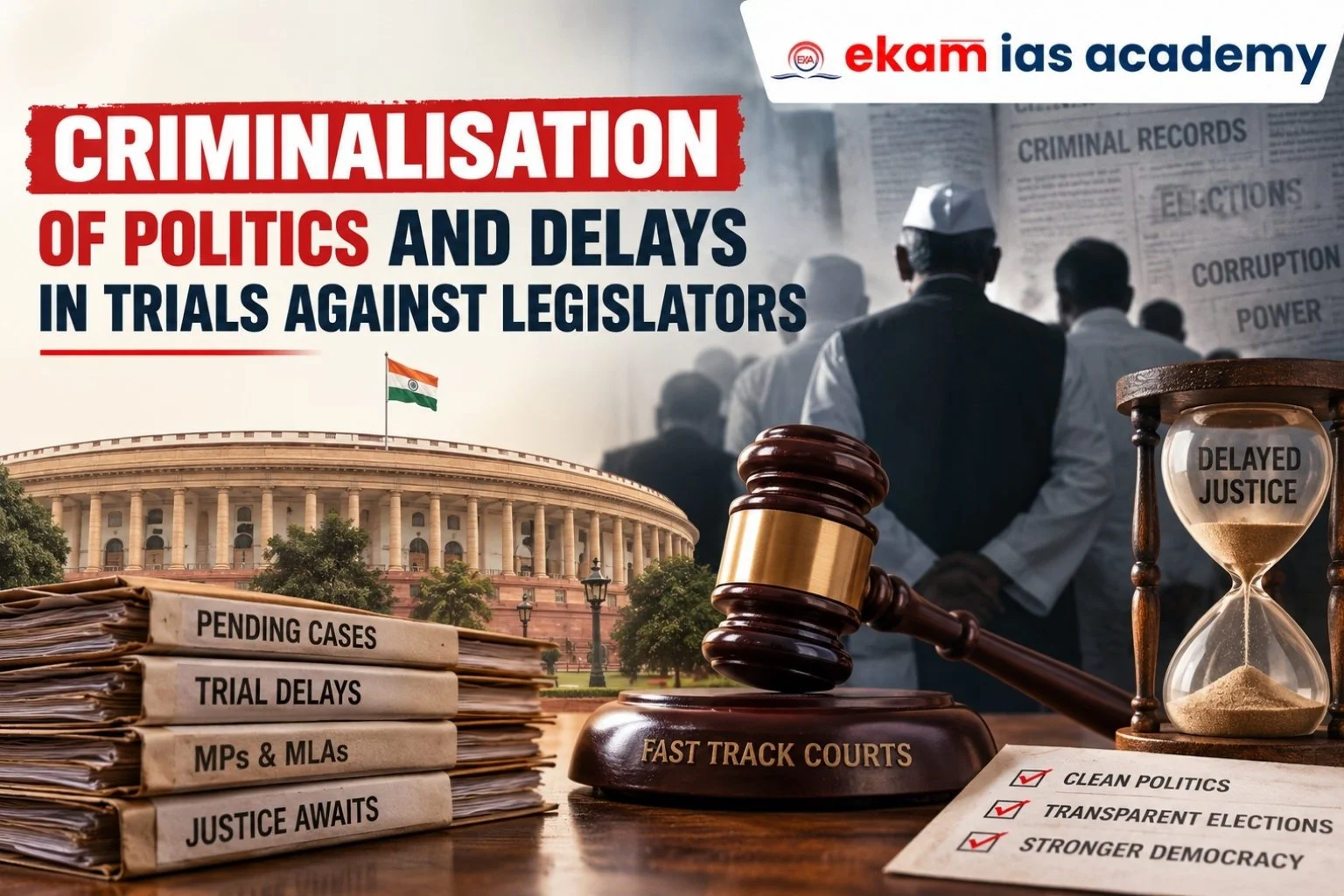
A recent report submitted to the Supreme Court has highlighted that special courts established to fast-track Criminal Cases Against MPs and MLAs have not substantially reduced pendency, raising concerns over Trial Delays Against MPs and MLAs.
Background
- In Ashwini Kumar Upadhyay v. Union of India (2017), the Supreme Court directed the establishment of 12 special courts across 10 States/UTs for speedy disposal of cases involving legislators.
- Priority was accorded to offences punishable with life imprisonment and crimes carrying five years or more of imprisonment.
- High Courts were directed to monitor progress and ensure minimal adjournments.
- The continuing pendency of Pending Criminal Cases Against Legislators has renewed the debate on Criminalisation of Politics in India.
What is Criminalisation of Politics?
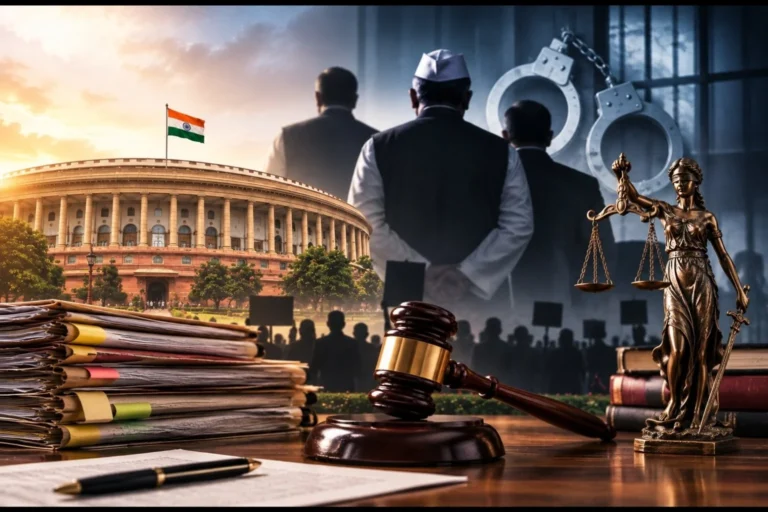
- Criminalisation of Politics refers to the increasing participation of individuals with criminal backgrounds in electoral politics and is an important issue under Criminalisation of Politics UPSC.
- Serious criminal cases include non-bailable offences or offences punishable with five years or more imprisonment.
- According to declared affidavits:
o 251 of 543 Lok Sabha MPs have pending criminal cases.
o 170 MPs face serious criminal charges.
o 75 of 233 Rajya Sabha MPs have criminal cases pending.
o 2,098 of 4,111 MLAs have declared criminal cases, with 1,286 facing serious charges.
Reasons for Criminalisation of Politics
- Weak Legal Framework: The Representation of the People Act, 1951 disqualifies candidates only after conviction, contributing to concerns surrounding Representation of People Act Criminal Cases.
- Judicial Delays: Trials often continue for years, enabling accused politicians to contest multiple elections and contributing to Criminalisation of Politics and Elections.
- Identity-Based Voting: Electoral choices are often influenced by caste, religion, or regional loyalties over criminal records.
- Crime-Politics Nexus: The Vohra Committee Report (1993) highlighted links among criminals, politicians, and bureaucratic networks, forming an important aspect of Political Criminalisation India.
Impact on Democracy
- Weakens democratic institutions and reduces public trust in governance.
- Promotes corruption, voter intimidation, and misuse of money power during elections.
- Undermines rule of law, allowing lawmakers with criminal cases to shape public policy.
- Erodes citizen confidence in electoral processes and representative democracy.
- Persistent Criminal Cases Against Politicians India can affect the credibility of democratic institutions.
Major Recommendations
- Law Commission (244th Report, 2014): Disqualify candidates once charges are framed for offences punishable with five years or more.
- Establish Fast Track Courts for MPs and MLAs for cases involving elected representatives.
- Establish Special Courts for MPs and MLAs to ensure speedy disposal of criminal cases.
- National Commission to Review the Working of the Constitution (2002): Strengthen transparency in political funding and candidate disclosures.
- Indrajit Gupta Committee (1998) and Second ARC (2007): Advocate partial state funding of elections to reduce black-money influence.
- These measures form an important part of Electoral Reforms and Criminalisation.
Supreme Court Interventions
- Lily Thomas Case (2013): Immediate disqualification upon conviction resulting in imprisonment of two years or more.
- Public Interest Foundation Case (2018): Mandated disclosure of candidates’ criminal records.
- 2020 Supreme Court Directions: Political parties must publish criminal antecedents and reasons for selecting such candidates within 48 hours of nomination.
- The interventions demonstrate the role of the Supreme Court on Criminal Cases Against Legislators in strengthening transparency and accountability.
Way Forward
- Establish independent prosecution mechanisms insulated from political interference.
- Ensure time-bound disposal of cases, appeals, and stay petitions.
- Strengthen implementation of the Witness Protection Scheme, 2018.
- Deploy digital case-tracking systems for monitoring investigations and trials.
- Strengthen Fast Track Courts for MPs and MLAs to address prolonged Trial Delays Against MPs and MLAs.
- Promote comprehensive Electoral Reforms and Criminalisation measures to address the issue.
Conclusion
The persistence of criminal cases against legislators reflects a serious challenge to India’s democratic framework. Curbing Criminalisation of Politics in India is essential for preserving the integrity, credibility, and effectiveness of democratic governance in India. Addressing Criminalisation of Politics Current Affairs through judicial reforms, electoral transparency, and time-bound trials remains important for Criminalisation of Politics Indian Polity UPSC.