

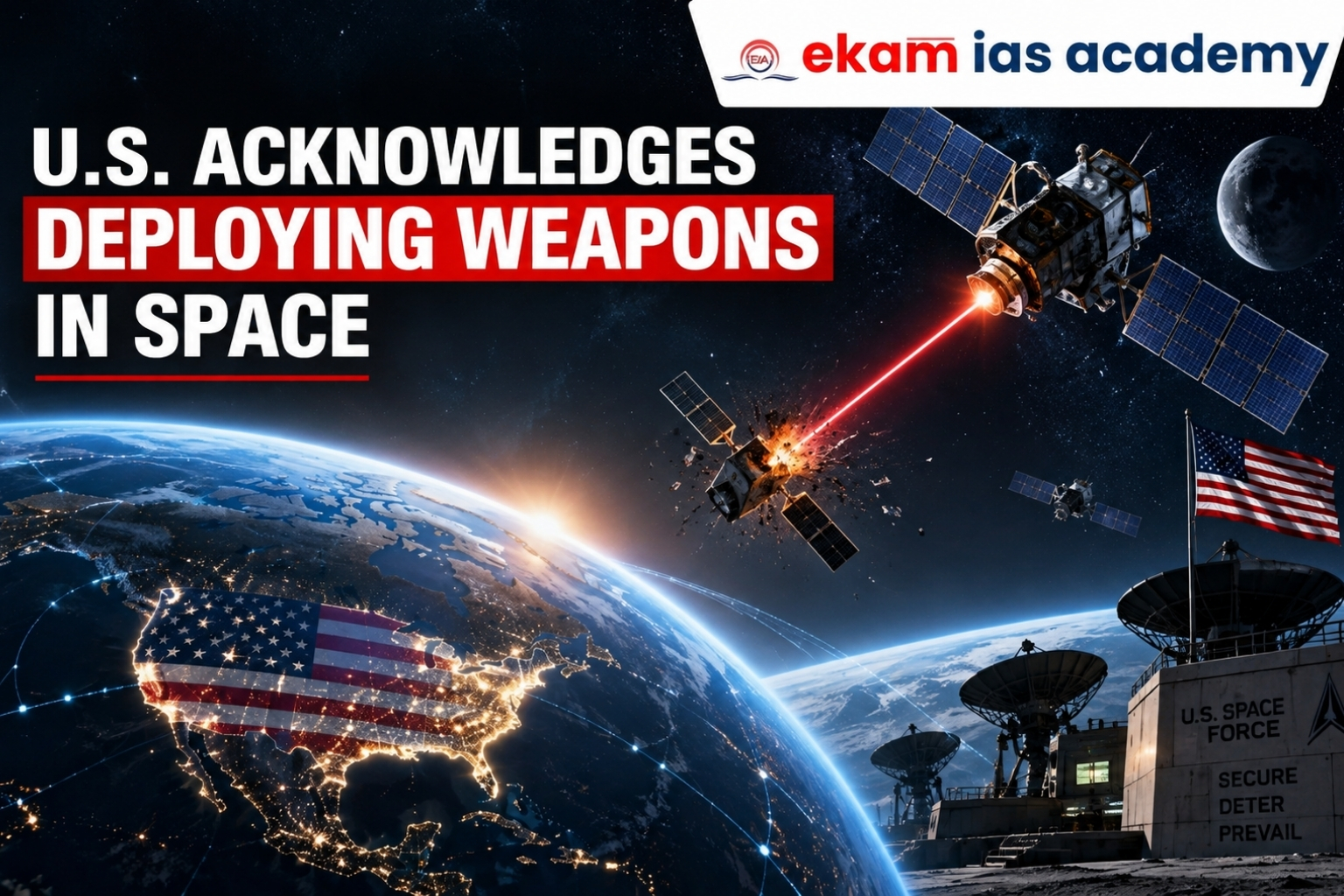
The United States has publicly acknowledged the deployment of active U.S. Weapons in Space, marking the first official admission by any country regarding the placement of U.S. Space Weapons in space.
What is Weaponisation of Space?
- Space Weaponisation refers to the deployment or use of weapons in outer space for military purposes.
- It involves capabilities to destroy or disable satellites, space stations, or other space-based assets.
- Space-Based Weapons may also be used to target terrestrial military infrastructure.
- Cyberattacks and electronic warfare systems can disrupt satellite communications, navigation, and surveillance networks.
- Such capabilities have become increasingly important in modern warfare due to reliance on satellite-based services, increasing concerns over Space Warfare and Space Security and Arms Race.
Major Forms of Space Weapons
- Anti-Satellite (ASAT) Weapons: Designed to destroy or disable satellites operating in orbit. Demonstrated by the United States, Russia, China, and India through successful ASAT tests.
- Space-Based Strike Systems: Weapons stationed in orbit capable of targeting assets on Earth or in space.
- Electronic and Cyber Warfare: Jamming satellite signals can disrupt military communications and navigation systems.
- The growing role of the U.S. Space Force reflects the increasing importance of Militarisation of Outer Space and space security.
Legal Framework Governing Space
- Outer Space Treaty (1967): Serves as the cornerstone of international space law. Prohibits the placement of nuclear weapons and other weapons of mass destruction (WMDs) in outer space.
- Existing Gaps: The treaty does not prohibit conventional weapons in space. No explicit restrictions exist on anti-satellite weapons or earth-to-space weapons, highlighting concerns regarding Weapons in Space and International Law.
- Artemis Accords: A voluntary framework led by the United States and NASA. India is among the signatories.
Implications of Space Weaponisation
- Increases the risk of an arms race among major powers.
- Creates security dilemmas in the Indo-Pacific and beyond.
- ASAT tests generate dangerous space debris, threatening civilian and commercial satellites.
- Raises concerns over the safety of critical services such as navigation, communication, weather forecasting, and disaster management.
Impact on India
- India’s communication, navigation, defence, and remote-sensing capabilities increasingly depend on satellites.
- Growing Militarisation of Outer Space necessitates enhanced space situational awareness and satellite protection measures.
- Strengthens the importance of institutions such as Defence Space Agency (DSA) and ISRO’s space security initiatives.
- Requires active participation in shaping future global norms on responsible space behaviour.
Way Forward
- Develop a comprehensive international treaty regulating conventional weapons in space.
- Strengthen transparency and confidence-building measures among space-faring nations.
- Promote global norms against destructive ASAT testing.
- Enhance international cooperation through the UN Committee on the Peaceful Uses of Outer Space (COPUOS).
- Encourage responsible and sustainable use of outer space resources.
Conclusion
Strengthening global governance mechanisms and ensuring the peaceful use of outer space will be essential to prevent an arms race beyond Earth and preserve space as a shared global commons. Understanding Space Security UPSC, Space Weaponisation UPSC, and the Outer Space Treaty UPSC perspective is important for analysing emerging challenges in international security.