
India has retained its 131st position among 145 countries in the World Economic Forum’s (WEF) Global Gender Gap Index 2026. The Global Gender Gap Report 2026 highlights India’s continuing challenges in Gender Equality in India and women’s participation in economic and political spheres.
Key Highlights
- India’s overall gender parity score stands at 64.5%, below the global average of 69.2%.
- Iceland, Finland, and Norway retained the top three positions globally.
- India has improved its gender parity by 4.3 percentage points since 2006, mainly due to gains in educational attainment.
- The WEF estimates that achieving full global gender parity could take approximately 120 years at the current pace.
- The Global Gender Gap Report 2026 highlights continuing disparities in economic participation and political empowerment.
India's Performance Across Indicators
- Educational Attainment: India recorded a strong parity score of 96.6%, with near-equal enrolment levels across educational stages.
- Health and Survival: The score improved to 95.6%, reflecting gradual progress in health outcomes.
- Economic Participation and Opportunity: Parity remains low at 41.2%, indicating limited workforce participation and leadership representation for women.
- Political Empowerment: India ranked relatively better, placing 67th globally with a parity score of 24.5%.
Major Challenges
- Low female labour-force participation.
- Underrepresentation of women in senior management and decision-making positions.
- Persistent wage gaps and unequal economic opportunities.
- Gender disparities in political and corporate leadership.
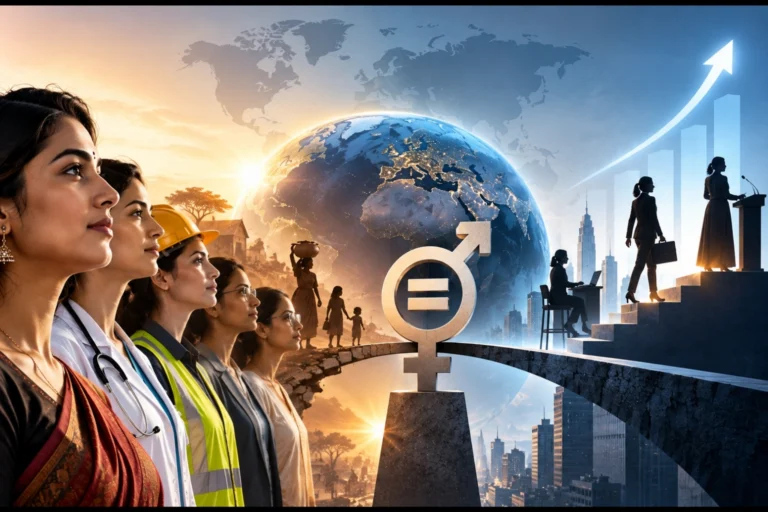
- The Gender Gap in India 2026 remains significant despite progress in education and health.
Way Forward
- Increase women’s participation in the workforce through skill development and employment incentives.
- Promote gender-sensitive workplace policies and equal pay.
- Strengthen implementation of schemes such as Beti Bachao Beti Padhao, Mission Shakti, and women-led entrepreneurship initiatives.
- Enhance women’s representation in governance and leadership roles.
- Strengthen policies aimed at improving Women’s Economic Participation India.
- Promote greater Women’s Political Empowerment India at different levels of governance.
Conclusion
India has made notable progress in education and health, but significant gaps persist in economic and political empowerment. Bridging these disparities is essential for achieving inclusive growth, social justice, and the objectives of Sustainable Development Goal (SDG)-5: Gender Equality. The India Gender Gap Index 2026 therefore remains important for understanding the Gender Gap in India 2026, Gender Equality Index 2026, and India’s progress towards Gender Equality UPSC objectives.