
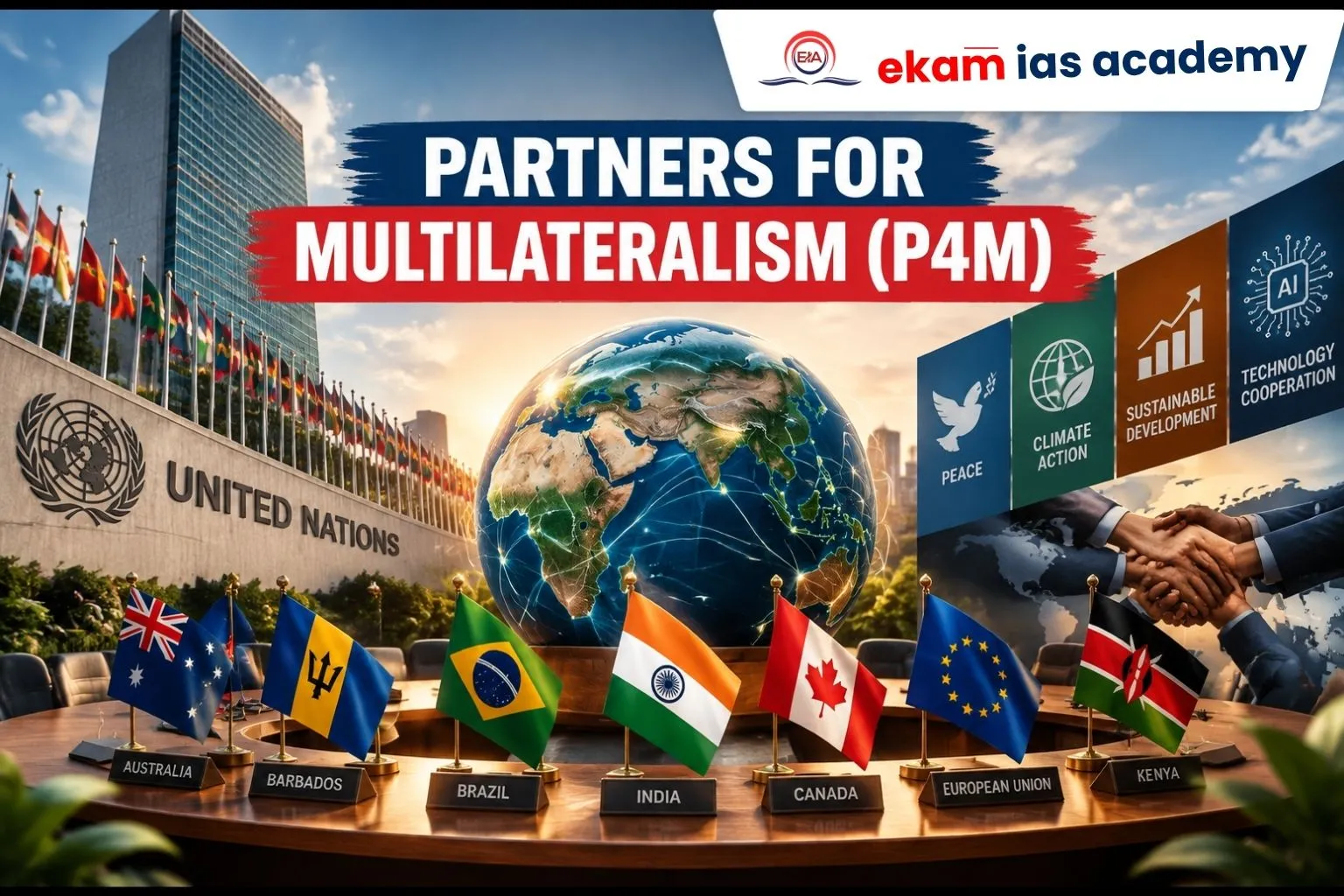
Partners for Multilateralism (P4M) was launched on 21 September 2026 during the 81st UN General Assembly. The Partners for Multilateralism P4M initiative represents a new approach towards strengthening multilateralism and global governance through cooperation among diverse countries.
What is P4M?
- Partners for Multilateralism (P4M) is an open and flexible diplomatic platform, rather than a military alliance or treaty-based organisation.
- The P4M Initiative brings together India, Australia, Barbados, Brazil, Canada, the EU and Kenya to promote P4M Multilateralism, international law, peace and inclusive prosperity.
- It seeks to bring countries from different regions and political systems together for:
- o Dialogue and coalition-building.
- o Practical cooperation on global challenges.
- o Strengthening the Rules Based International Order.
- Its declaration reaffirms sovereign equality, territorial integrity, peaceful settlement of disputes and prohibition of force.
Why is P4M Needed?
- Changing global power structure: Institutions created after World War II do not fully reflect today’s economic and political realities.
- Geopolitical fragmentation: Conflicts, protectionism, economic coercion and strategic rivalry are weakening international cooperation.
- Transnational challenges: Climate change, pandemics, AI, cyber risks and supply-chain disruptions cannot be managed by individual countries alone.
- Weakening global trust: Countries increasingly seek reforms that make international institutions more representative, transparent and effective.
- The UN itself is pursuing institutional reform through the UN80 Initiative, which aims to make the UN system more efficient, coherent and responsive.
Major Areas of Cooperation
- Reform of Multilateral Institutions: Promotes more representative, inclusive and effective global governance and stronger international institutions worldwide.
- Peace and International Law: Promotes peaceful dispute settlement, UN Charter compliance, humanitarian law, and fundamental freedoms.
- Economic Cooperation: Promotes diversified supply chains, predictable trade, and reforms in international financial architecture.
- Emerging Technologies: Encourages international cooperation on AI, digital transformation, cybersecurity, and emerging technology risks.
Significance for India
- Voice of Global South: India can highlight concerns relating to development finance, food and energy security, technology access and climate equity.
- Reformed multilateralism: The Partners for Multilateralism India platform supports India’s long-standing demand for more representative global institutions, including UN Security Council reform.
- Strategic autonomy: P4M provides India another platform for cooperation without requiring membership in a rigid strategic bloc.
- Bridge-building role: India’s participation alongside countries from different regions can support its role as a bridge between developed and developing economies.
- The India and Multilateralism approach through platforms like P4M reflects India’s emphasis on inclusive global governance.
Challenges
- Different national interests: Members may have different positions on conflicts, trade, technology and major-power relations.
- Implementation gap: A flexible platform may generate political commitments without strong mechanisms for implementation.
- Forum proliferation: Overlapping international groupings can create duplication and dilute attention.
- Consensus difficulties: Greater diversity among participants can make common positions harder to achieve.
Way Forward
- Keep P4M open, inclusive and representative rather than turning it into another exclusive bloc.
- Convert broad declarations into specific projects on health, climate, AI, trade and supply chain resilience.
- Give greater space to developing-country priorities, especially development finance and technology access.
- Coordinate with existing institutions such as the UN, G20 and regional organisations to avoid duplication.
- Strengthen P4M Global Governance efforts by focusing on practical cooperation and institutional reforms.
Conclusion
Partners for Multilateralism UPSC relevance lies in understanding how new diplomatic platforms can support global cooperation. P4M can help translate the idea of reformed multilateralism into practical cooperation suited to an increasingly interconnected and multipolar world.
P4M Alliance, Multilateralism UPSC, India Global Governance UPSC and Partners for Multilateralism UPSC are important areas for understanding India’s evolving role in international relations.