
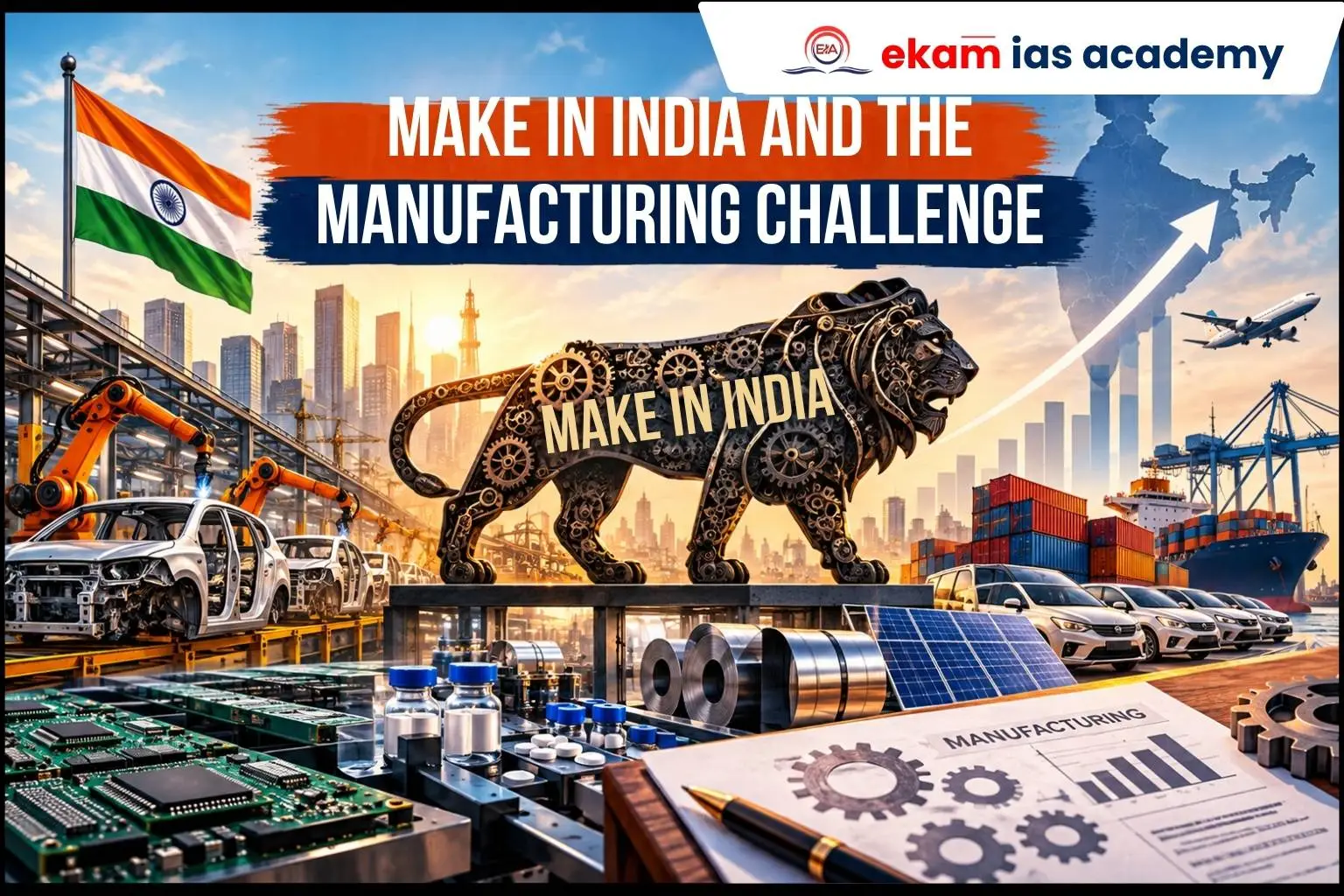
As Make in India completes 12 years on September 25, 2026, its impact on manufacturing growth, investment, employment and exports is being assessed.
Make in India
- Make in India was launched in 2014, with the aim of making India a global hub for manufacturing, innovation and investment.
- Make in India 2026 continues this focus, while Make in India 2.0 now covers 27 sectors, including 15 manufacturing sectors.
- Major supporting measures include PLI schemes, PM GatiShakti, National Single Window System, FDI reforms, industrial corridors and logistics reforms.
- The Make in India Initiative has therefore combined policy support, infrastructure development and investment facilitation to strengthen the Indian Manufacturing Sector.
Performance
- Manufacturing Growth: Revised national accounts show manufacturing GVA grew at 10.88% annually from 2022-23 to 2025-26 period, reflecting the progress of Make in India Manufacturing.
- Investment: PLI schemes attracted more than ₹2.40 lakh crore investment by March 2026, supporting manufacturing capacity expansion and strengthening the Manufacturing Sector in India.
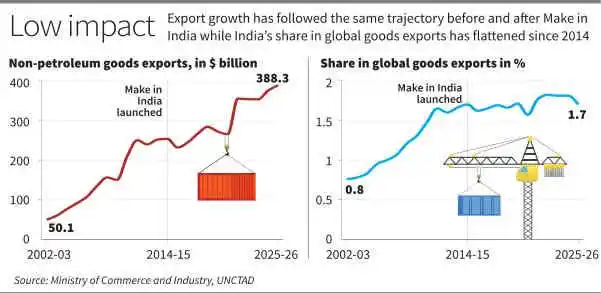
- Exports: Non-petroleum goods exports have expanded considerably since 2014, but India’s merchandise export share remains modest.
- Employment: Manufacturing can generate large-scale semi-skilled and skilled employment, but remains an underdeveloped employment engine nationally. Make in India and Employment therefore remains an important policy challenge.
Sectoral Success of PLI
- PLI has produced visible gains in electronics, pharmaceuticals, automobiles, solar modules and specialty steel.
- By March 2026, PLI-supported sectors reported over ₹22.66 lakh crore production/sales and ₹15.20 lakh crore exports.
- Electronics illustrates the transformation: mobile-phone production has expanded sharply, while domestic manufacturing now meets most domestic demand.
- However, benefits remain concentrated in selected industries rather than spreading uniformly across the manufacturing ecosystem.
Challenges
- Low manufacturing intensity: Manufacturing has not yet achieved the scale required to become a dominant growth and employment driver, highlighting the broader Make in India and Manufacturing Challenge.
- Investment gap: Weak private investment in new productive capacity can restrict long-term industrial expansion. Strengthening Make in India and FDI remains important for sustained industrial growth.
- MSME constraints: Smaller firms face difficulties related to finance, technology, infrastructure and market access.
- Global competition: India competes with established manufacturing hubs on cost, logistics, skills and supply-chain efficiency, making India Manufacturing Competitiveness a key concern.
Way Forward
- Shift from incentive-led manufacturing towards productivity, innovation and technology-intensive production.
- Integrate MSMEs with large firms and global supply chains through technology, credit and quality-support programmes.
- Improve logistics, industrial infrastructure, power reliability and ease of doing business.
- Encourage deeper domestic value addition in electronics, semiconductors, machinery, chemicals and green technologies.
Conclusion
Make in India has created important manufacturing capabilities, but sustained private investment, employment and global value-chain integration are essential for converting sectoral gains into broad-based industrial transformation.
For Manufacturing Sector UPSC and Make in India UPSC, the key issue is how India can move from policy-supported manufacturing growth towards globally competitive, employment-intensive and technology-driven industrialisation