
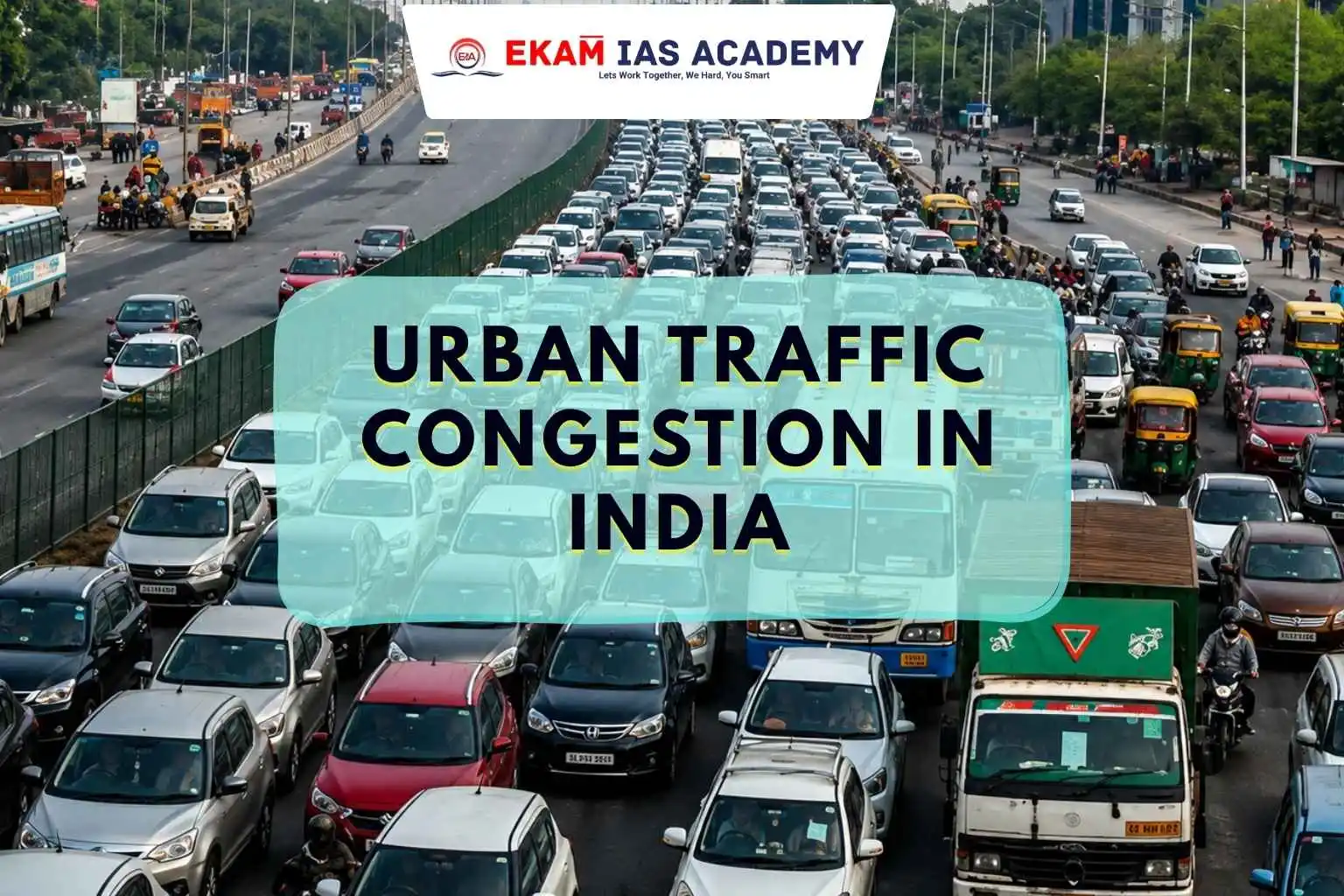
Rapid urbanisation and rising vehicle ownership have turned urban traffic congestion into a major economic, environmental, and governance challenge in India. Recent data shows that major cities are losing more than half of their free-flow traffic speed during peak hours, highlighting the need for integrated urban mobility planning, efficient public transport, and smart traffic management systems. This topic is important for aspirants preparing for GS3 Economy through Best IAS Coaching in Hyderabad.
Speed Decline in Metros
- Delhi: Speed drops from 46 km/h to 19 km/h; congestion persists throughout the day.
- Hyderabad & Mumbai: Speeds fall from 40 km/h to 15 km/h; midday recovery in Hyderabad but not in Mumbai.
- Bengaluru: 38 km/h to 13 km/h, showing sustained congestion with minimal fluctuation.
- Kolkata: 29 km/h to 10 km/h, among the lowest in Tier‑1 cities.
- Tier‑2 cities also face similar declines, affecting productivity and daily life.
Congestion Patterns
- Delhi: Continuous congestion with little relief.
- Hyderabad: Some midday recovery, but peak hours remain problematic.
- Bengaluru: Consistently congested, reflecting poor road capacity and high vehicle density.
- Heatmaps show travel time reliability is weak, impacting commuters, logistics, and emergency services.
Connectivity and Urban Design
- Network design matters more than road length.
- Example: A 7.5 km trip covers 65% of Delhi’s area but only 59% in Kolkata.
- Delhi: Yamuna crossings force longer detours.
- Bengaluru: Whitefield and Basavanagudi routes increase travel distance due to poor connectivity.
- WRI India stresses that better urban planning and multimodal integration can reduce detours.
Broader Implications
- Economic Loss: Billions lost annually due to wasted fuel, delays, and reduced productivity.
- Environmental Impact: Higher emissions worsen air quality; transport sector contributes ~13% of India’s CO₂ emissions.
- Public Health: Stress, respiratory illnesses, and reduced quality of life.
- Urban Planning: Need for metro expansion, bus rapid transit, cycling infrastructure, and smart traffic management.
- Global Comparison: Singapore and Tokyo manage congestion better through integrated public transport, congestion pricing, and strict vehicle ownership rules.
Challenges
- Rapid Urbanisation & Vehicle Growth: India’s urban population is 475 million (2025) and projected to add 416 million more by 2050. Cities contribute 63% of GDP, expected to rise to 75% by 2030.
- Inadequate Public Transport: Metro systems cover only a fraction of urban areas. Bus rapid transit (BRT) projects face delays and poor integration.
- Poor Road Design & Connectivity: Delhi’s Yamuna crossings force long detours. Bengaluru’s Whitefield suffers from poor connectivity, increasing travel distances. Road networks expand in length but not in efficiency.
- Environmental & Health Costs: Transport contributes ~13% of India’s CO₂ emissions. Congestion increases particulate matter, worsening respiratory diseases.
- Weak Traffic Management: Reliance on fixed‑timing signals and manual enforcement. Limited real‑time data integration compared to global benchmarks.
Way Forward
- Integrated Public Transport: Expand metro and suburban rail Strengthen bus fleets with GPS tracking and dedicated lanes.
- Smart Traffic Systems: AI‑powered Adaptive Traffic Control reduced waiting time by 33% in Bengaluru. Advanced Traffic Management Systems (ATMS) show 28–48% reduction in travel times and up to 73% fall in accident fatalities.
- Policy & Governance: Implement congestion pricing (Singapore model). Encourage electric vehicles under FAME scheme to reduce emissions. Align Comprehensive Mobility Plans (CMPs) with city master plans for holistic growth.
- Financing & PPP Models: Public‑Private Partnerships for metro, BRT, and ATMS deployment. Explore innovative financing like land value capture and green bonds.
Conclusion
Traffic congestion in India is a multi‑dimensional urban crisis impacting economy, environment, and public health demanding integrated transport planning and sustainable mobility solutions.