
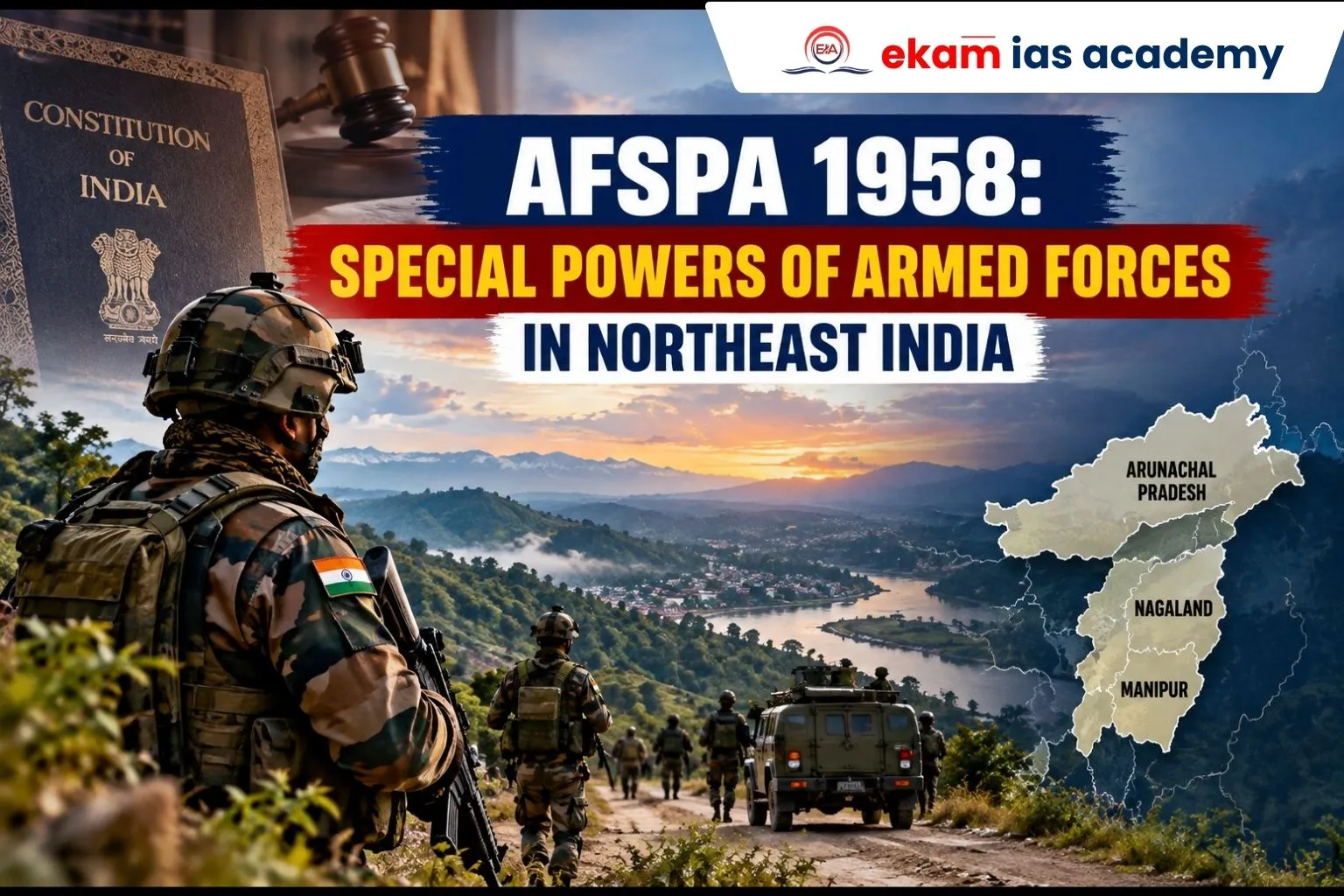
The Union Home Ministry has extended the Armed Forces Special Powers Act 1958 (AFSPA 1958) in specified areas of Manipur, Nagaland and Arunachal Pradesh for another six months from October 1, 2026, following a review of the security situation.
What is AFSPA?
- Enacted in 1958, AFSPA 1958 provides special operational powers to the armed forces in areas facing serious insurgency or internal-security challenges.
- Its constitutional context is linked to the Union’s responsibility under Article 355 to protect States against external aggression and internal disturbance.
- Jammu and Kashmir is governed by a separate AFSPA law of 1990.
- The Armed Forces Special Powers Act Northeast India remains relevant to security and governance in specified areas of the region.
What is a ‘Disturbed Area’?
- Under Section 3, the Governor of a State, Administrator of a Union Territory or Central Government may declare an area “disturbed” when armed forces are considered necessary to aid civil power.
- Such notification activates the special powers provided by the Act.
- These notified regions are commonly referred to as AFSPA Disturbed Areas or AFSPA Specified Areas.
Major Powers under AFSPA
- Use of force: Authorised personnel may, after due warning and subject to statutory conditions, use force even to the extent of causing death against specified violations involving prohibited assemblies or weapons.
- Arrest: A person suspected of committing certain cognisable offences may be arrested without a warrant.
- Search: Premises may be entered and searched without a warrant for specified purposes.
- Destruction: Certain arms dumps, fortified positions or shelters used by armed groups may be destroyed.
- Legal protection: Under Section 6, prosecution or other legal proceedings for acts done or purportedly done under AFSPA require previous sanction of the Central Government.
- These provisions form the core of AFSPA Powers and Provisions.
Why is AFSPA Considered Necessary?
- Provides security forces operational flexibility in areas affected by insurgency and armed violence.
- Supports civil administration where ordinary policing capacity may be inadequate.
- Helps secure strategically sensitive and border regions.
- The government links the shrinking geographical application of AFSPA to improvements in security. In June 2026, it stated that roughly 80% of the Northeast was outside AFSPA coverage.
- AFSPA in Northeast India remains particularly significant in the context of AFSPA Manipur, AFSPA Nagaland and AFSPA Arunachal Pradesh.
Key Concerns
- Fundamental rights: Wide powers of arrest, search and use of force create concerns regarding Articles 14 and 21.
- Accountability: Prior sanction for prosecution has generated debate over effective remedies for alleged excesses.
- Federalism: Both Union and State authorities can declare disturbed areas, making Centre-State coordination important.
- Public trust: Long-term application may create alienation if extraordinary security arrangements become normalised.
- Duration: Continued application should reflect periodic, evidence-based assessment of local security conditions.
- These concerns form the broader AFSPA and Civil Liberties and AFSPA and Human Rights debate.
Way Forward
- Review disturbed-area notifications regularly using objective security indicators.
- Ensure strict adherence to proportionality, operational safeguards and judicial directions.
- Strengthen local police, intelligence and civilian administration so extraordinary measures become less necessary.
- Ensure credible investigation of alleged human-rights violations.
- Complement security operations with peace agreements, development, employment and political dialogue. Government data point to peace accords and declining insurgency alongside the reduction of AFSPA areas in the Northeast.
Conclusion
AFSPA should remain an exceptional security instrument, with its use continuously tested against necessity, accountability, constitutional rights and the goal of restoring normal civilian governance.
The topic is important for AFSPA Act 1958 UPSC, AFSPA Current Affairs, and Internal Security UPSC preparation.