
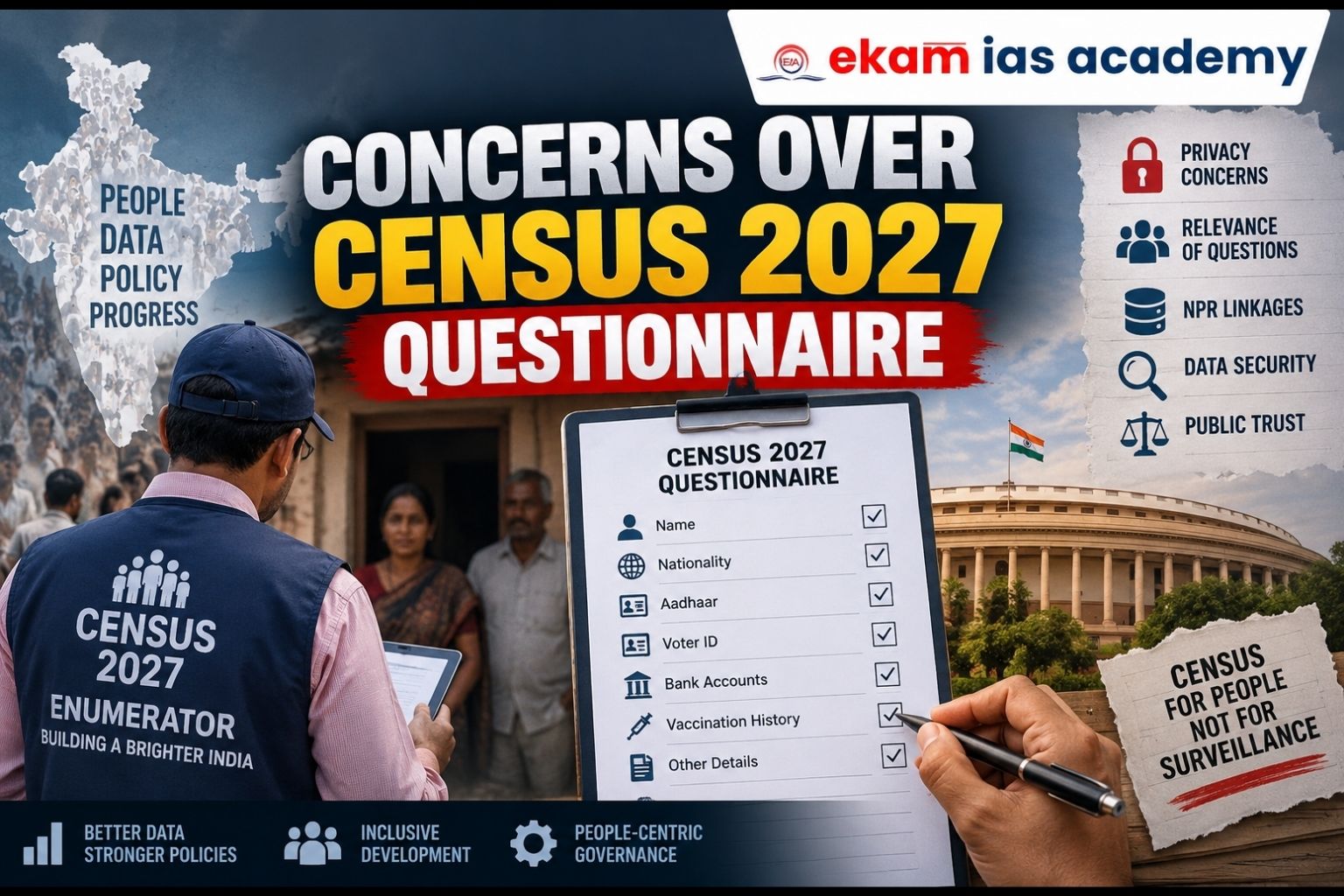
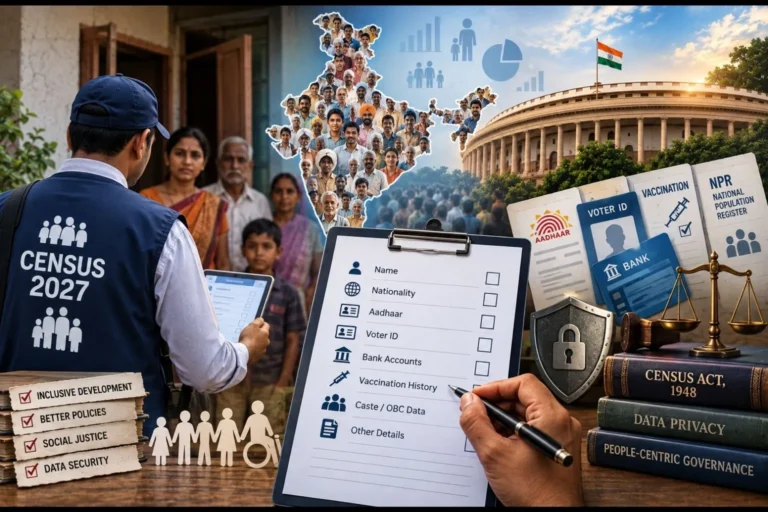
The Central government has notified 40 questions for the population enumeration phase of the Census 2027, including details such as nationality, Aadhaar, voter ID, bank accounts, and vaccination history. This has raised concerns about confidentiality, relevance, and digression from statistical objectives. The debate around the Census 2027 Questionnaire, privacy, and the role of the Census of India UPSC framework has gained importance among policymakers and citizens.
Census in India
- Purpose of Census: As per the UN definition, a census is meant to collect demographic, economic, and social data at the smallest geographic level for policy and planning. The Census India exercise provides crucial data for governance, resource allocation, and welfare planning.
- Legal Framework: Conducted under the Census Act, 1948, which ensures confidentiality of individual information, aligned with the UN Fundamental Principles of Official Statistics.
- Traditional Practice: Earlier censuses avoided personal identifiers like names, Aadhaar, voter ID, or passport numbers, focusing only on statistical data relevant for governance.
- Confidentiality Principle: Individual data collected is strictly confidential and used exclusively for statistical purposes, not for surveillance or administrative targeting.
Census 2027 Questionnaire
- Data Quality Concerns: Overloaded questionnaires with irrelevant personal details risk casual or inaccurate responses, undermining the reliability of statistical data. The expanded Census 2027 Questions may affect the quality of responses collected during enumeration.
- Trust Deficit: Citizens may hesitate to share sensitive identifiers like Aadhaar, voter ID, or passport numbers, creating Census 2027 Privacy Concerns and eroding confidence in confidentiality mechanisms.
- Policy Misalignment: Instead of aiding planning, inclusion of non-statistical questions dilutes focus on core areas such as housing, health, education, and employment.
- Federal Concerns: States may resist deploying staff for NPR-linked data collection, citing lack of legal mandate, creating friction between Centre and States. The relationship between Census and NPR remains a major concern in discussions surrounding the National Population Register India framework.
Challenges
- Confidentiality Risks: Collecting Aadhaar, voter ID, and passport numbers may compromise privacy and violate statistical principles.
- Relevance of Questions: Data on COVID-19 vaccination or multiple bank accounts adds little statistical value and raises questions about the relevance of certain Census 2027 Questionnaire components.
- Operational Burden: Enumerators may struggle to collect complex personal details, leading to errors and respondent fatigue.
- Overlap with NPR: Questions on nationality, parents’ names, and permanent address resemble National Population Register (NPR) requirements, raising fears of indirect NRC linkage. This has intensified debates around Census 2027 India, Census 2027 Caste Census, and Caste Census in India.
- Institutional Households: Hostels, old-age homes, and prisons may find it impossible to provide such personal identifiers.
Way Forward
- Limit Questions to Statistical Needs: Focus on demographic and socio-economic indicators, including reliable information required for planning and welfare policies.
- Ensure Transparency: Any NPR-related data collection must be legislated separately, not embedded in Census. Clear procedures are necessary for handling issues related to Census 2027 OBC Data and Census 2027 Caste Data.
- Strengthen Confidentiality: Reaffirm that individual identifiers will not be stored or shared.
- Simplify Questionnaire: Reduce descriptive questions to avoid respondent fatigue and enumerator overload.
Conclusion
The Census 2027 is India’s most vital statistical exercise. Diluting its credibility with irrelevant or intrusive questions risks undermining both data quality and public trust. A transparent, legally sound, and statistically focused approach is essential to preserve the Census as a tool for policy and planning, not surveillance.
The discussions around Census 2027 India, Census 2027 Questionnaire, Census 2027 Privacy Concerns, and Census 2027 UPSC highlight the need to balance data requirements with privacy safeguards and constitutional values.