

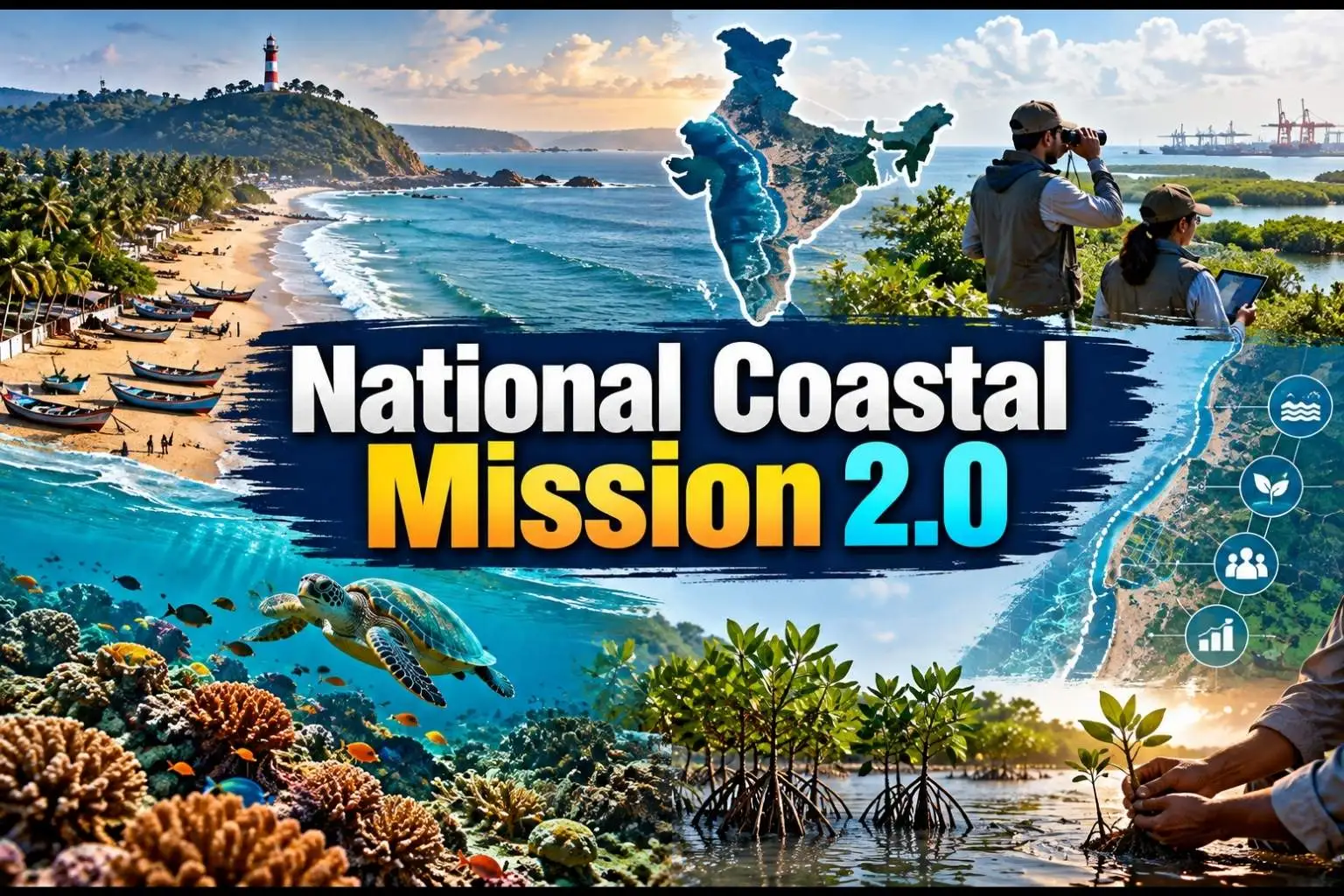
The Union Environment Minister has launched the implementation guidelines for National Coastal Mission 2.0 in New Delhi. The National Coastal Mission 2.0 2026 framework focuses on climate resilience, ecosystem conservation and sustainable coastal development.
About NCM 2.0
- National Coastal Mission 2.0 (NCM 2.0) is a Central Sector Scheme under the Ministry of Environment, Forest and Climate Change (MoEFCC).
- NCM 2.0 India has an outlay of ₹767 crore, with implementation extending up to 2030-31.
- National Coastal Mission India covers nine coastal States—Gujarat, Maharashtra, Goa, Karnataka, Kerala, Tamil Nadu, Andhra Pradesh, Odisha and West Bengal—and four coastal UTs.
- It builds upon the earlier National Coastal Mission and promotes Centre-State-stakeholder coordination for Coastal Zone Management India.
- The mission supports Coastal Ecosystem Conservation and sustainable management of India’s coastal resources.
Key Focus Areas
- Climate resilience: Undertake vulnerability assessments and adaptation measures against sea-level rise, erosion and extreme weather, strengthening Coastal Resilience India.
- Ecosystem conservation: Restore and protect mangroves, coral reefs, wetlands and other marine habitats, supporting Coastal Biodiversity India and Marine Ecosystem Conservation India.
- Scientific planning: Develop Integrated Coastal Zone Management Plans (ICZMPs) and Coastal Marine Spatial Plans for balanced use of coastal resources.
- Pollution control: Prevent and reduce pollution entering coastal and territorial waters.
- Livelihood security: Promote diversified, climate-resilient livelihoods, sustainable tourism and community participation.
- Blue Economy: Facilitate environmentally sustainable coastal infrastructure and economic activities, strengthening the Blue Economy India framework.
- Governance: Strengthen research, capacity-building, monitoring and convergence with existing government programmes, including broader Coastal Regulation Zone India governance.

Significance
- The Mission links ecological security with economic development, particularly for climate-vulnerable coastal communities.
- Coastal Conservation India under NCM 2.0 can strengthen ecosystem protection while supporting climate adaptation and sustainable livelihoods.
- The National Centre for Sustainable Coastal Management (NCSCM) will be a major implementation partner, supporting science-based coastal management.
- The mission is important for Coastal Conservation UPSC, particularly in the context of National Coastal Mission UPSC, climate resilience and the Blue Economy India.
Conclusion
NCM 2.0 can make India’s coastline a model where ecosystem conservation, climate resilience and the Blue Economy advance together, strengthening Coastal Climate Change India responses and sustainable coastal development.