

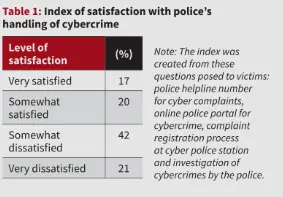
The Status of Policing in India Report 2026 finds widespread dissatisfaction among surveyed Cybercrime Cases India victims with police handling. The findings highlight concerns around Cybercrime Policing in India, Cybercrime Reporting in India, investigation and the Cybercrime Reporting and Justice Gap.
Key Findings
- The Lokniti-CSDS–Common Cause study reports 63% dissatisfaction with complaint handling, highlighting challenges in Cybercrime Reporting in India.
- Satisfaction falls from 50% for helplines to 43% during investigations, indicating declining confidence after initial contact in Cybercrime Investigation India.
- 26% of women, compared with 18% of men, report being very dissatisfied.
- Five or more police visits were reported by 38% of rural victims, against 19% of urban victims.
- These are survey findings; they should not be treated as administrative counts covering every victim.
Governance Concerns
- Access versus outcomes: Easier Cybercrime Reporting in India does not automatically ensure timely investigation or recovery.
- Unequal burdens: Repeated visits impose travel costs and lost wages, especially on rural households.
- Gender sensitivity: Privacy concerns and insensitive responses can worsen victims’ distress.
- Technical complexity: Fraudsters exploit multiple bank accounts, digital platforms and jurisdictions, requiring coordinated Cybercrime Police India and Cybercrime Law Enforcement India responses.
Existing Institutional Framework
- Indian Cyber Crime Coordination Centre (I4C): Under the Ministry of Home Affairs, coordinates national responses to Cybercrime in India.
- National Cyber Crime Reporting Portal: The National Cyber Crime Reporting Portal accepts complaints, including offences against women and children, supporting Cybercrime Reporting Portal India.
- Helpline 1930 and CFCFRMS: Enable quick financial-fraud reporting and coordinated efforts to prevent stolen funds moving further.
- Police and public order are State subjects: States lead investigations while the Centre supports coordination and capacity, making inter-State cooperation important for Cybercrime Investigation India.
Reform Priorities
- Provide complaint acknowledgements, tracking numbers and regular progress updates to reduce the Cybercrime Reporting and Justice Gap.
- Train personnel in digital evidence, financial tracing and respectful communication to strengthen Cybercrime and Digital Evidence capabilities.
- Strengthen cooperation with banks, platforms and police across States to address Cyber Crime Investigation Challenges.
- Offer local-language assistance, confidential reporting and support for rural complainants.
- For example, prompt reporting of an investment scam should trigger rapid transaction tracing and strengthen Cybercrime Police India response.
Conclusion
Effective Cybercrime Policing in India must turn accessible reporting into timely action, fair treatment and accountable justice. Strengthening Cybercrime Law Enforcement India, digital evidence capabilities and institutional coordination is essential to address Cybercrime and Justice in India.