


Namami Gange Programme
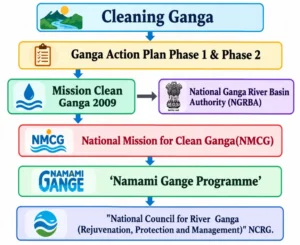
The Namami Gange Programme is adopting different wastewater treatment technologies to address pollution across the Ganga basin. The Namami Gange Programme India initiative focuses on Ganga River Rejuvenation through technological innovation and improved pollution management.
About Namami Gange Programme
- Launched: 2014 by the Government of India.
- Objective: Reduce pollution, conserve biodiversity and restore the ecological health of River Ganga through the Namami Gange Mission and Ganga Conservation Programme.
- Implementing agency: National Mission for Clean Ganga (NMCG), under the Ministry of Jal Shakti.
- Major components: Sewage treatment, industrial pollution control, river cleaning, afforestation, biodiversity protection and public participation under the Clean Ganga Mission.
Why Are Different Technologies Needed?
- Large cities: Require centralised sewage treatment plants (STPs) connected through sewer networks.
- Villages: Need smaller, decentralised systems where underground sewerage is unavailable.
- Hilly regions: Require compact treatment facilities suitable for difficult terrain and cold weather.
- Crowded cities: Need technologies that occupy less land and consume less energy, supporting Wastewater Treatment in India.
Important Wastewater Treatment Technologies
- Activated Sludge Process: Uses microorganisms to break down organic pollutants in sewage.
- Sequential Batch Reactor (SBR): Treats wastewater through different stages in a single tank.
- Food Chain Reactor (FCR): Combines microorganisms, artificial surfaces and plant roots for biological treatment.
- Electrocoagulation: Uses electricity to separate pollutants from wastewater; suitable for certain difficult locations.
- Constructed Wetlands: Use plants, soil and microorganisms to naturally filter wastewater.
- NEREDA Technology: Uses compact bacterial granules for efficient treatment with reduced space requirements.
- Soil Biotechnology: Uses soil, beneficial microorganisms and natural filtration processes to clean wastewater.
- These technologies contribute to Namami Gange Innovation, particularly in improving Sewage Treatment Plants Ganga projects.
Resource Recovery and Circular Economy
- Biogas: Sewage sludge can produce renewable energy through anaerobic digestion.
- Example: Dinapur STP in Varanasi uses biogas-based electricity to meet a substantial share of its energy needs.
- Solar power: Reduces dependence on conventional electricity.
- Treated-water reuse: Supports irrigation and industrial activities, reducing freshwater consumption.
- Sludge management: Properly processed sludge can support safe resource recovery.
- Resource recovery supports sustainable River Basin Management India and strengthens the circular-economy approach to Ganga River Pollution Control.
Challenges
- Environmental benefits: Reduced river pollution improves water quality and aquatic biodiversity, strengthening the objectives of River Rejuvenation in India.
- Economic benefits: Energy recovery and suitable decentralised systems can reduce operating costs.
- Public health: Better sanitation reduces exposure to contaminated water.
- Challenges: Inadequate sewer connections, industrial discharge, maintenance costs and weak monitoring can limit results.
Conclusion
Sustainable Ganga rejuvenation requires innovative technology, effective pollution control and continuous community participation—not merely the construction of sewage treatment plants. The Namami Gange Programme, National Mission for Clean Ganga, Namami Gange Innovation, Ganga River Rejuvenation, Namami Gange UPSC and Environment and Ecology UPSC perspectives highlight the importance of integrated and sustainable approaches to restoring India’s rivers.