
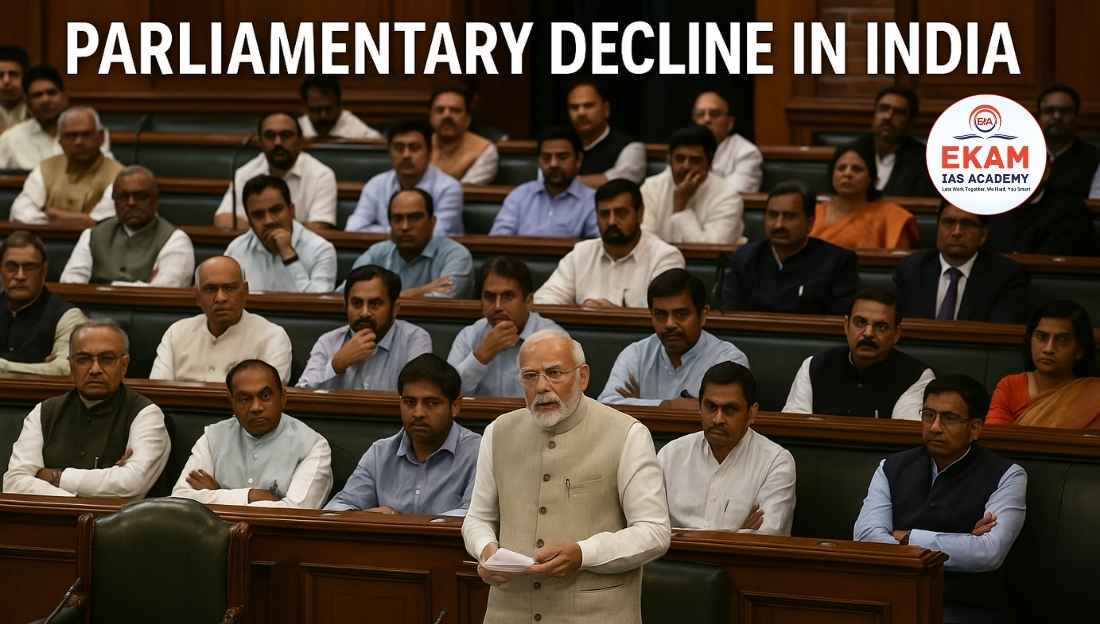
The Winter Session of Parliament has begun amid possible deadlock over the Special Intensive Revision (SIR) of electoral rolls. Concerns are growing about falling productivity, weak deliberation, and rising executive control over the legislature.
Declining Health of Parliament
- Frequent disruptions: Monsoon Session 2024 – Lok Sabha worked only 29% of scheduled time, Rajya Sabha 34%.
- Question Hour weakened: LS completed 23%, RS only 6% of allotted time.
- Bills passed with little debate:
- Online Gaming Bill – cleared in one day with 6 minutes (LS) and 23 minutes (RS).
- Merchant Shipping Bill – 20 minutes (LS), 10 minutes (RS).
- Skewed priorities: Half of LS time spent on Operation Sindoor.
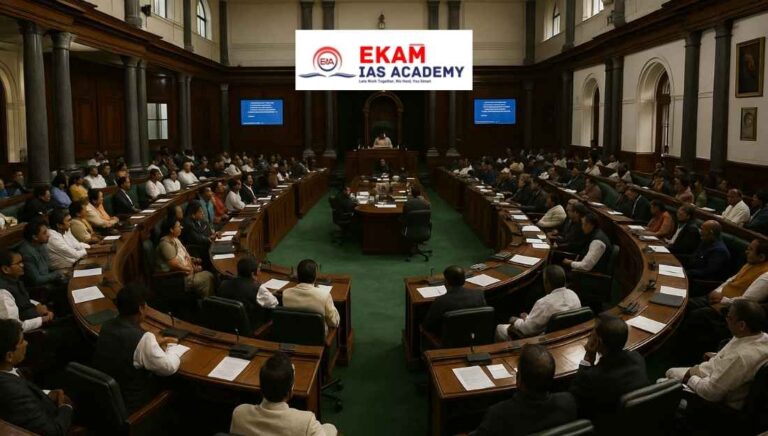
Numbers Indicate Structural Decline
- Short-term variation: Budget Sessions 2023–24 had high productivity (111% LS, 112% RS), but Winter Session 2024 dropped sharply (52% LS, 39% RS).
- 17th Lok Sabha (2019–24): LS worked 88% of scheduled time, RS 73%. Fewest sittings since 1952 (Covid impact). No Deputy Speaker – continued into 18th Lok Sabha.
- Historical trend: 1952–70: Avg. 121 sittings/year. Since 2000: Avg. 68 sittings/year. 17th LS: Only 55 sittings/year.
- Committee scrutiny weakened: Referral of Bills fell from 60% (14th–15th LS) to ~20% (16th–17th LS).
Importance of Parliamentary Proceedings
Ensuring Accountability of the Executive
- Parliament holds the government responsible through Question Hour, Zero Hour, and debates.
- Example: Questions raised during the Coal Allocation Scam (2012) exposed irregularities and forced government response.
Law-Making and Policy Deliberation
- Parliamentary proceedings allow discussion before passing laws, ensuring diverse viewpoints.
- Example: The Right to Information Act, 2005 was debated extensively, strengthening transparency in governance.
Representation of Citizens’ Voices
- MPs bring regional and social concerns into national debate, making Parliament the “voice of the people.”
- Example: Discussions on farmers’ issues during the 2020 farm laws debate reflected grassroots concerns.
Safeguarding Democracy and Constitutional Values
- Parliamentary proceedings uphold democratic norms by checking executive dominance and protecting rights.
- Example: The Emergency (1975–77)
Comparative Perspective
- Westminster model (UK): PM’s Questions, strong committee oversight, mandatory testimony by ministers.
- India’s divergence: Decline in accountability, reversal of Westminster spirit.
Challenges and Way Forward
- Dialogue mechanisms: Regular communication between PM, LoP, and House leaders.
- Mandatory sittings: At least 120 days/year to ensure debate.
- Strengthen committees: Referral of major Bills must be compulsory.
- Deputy Speaker election: Enforce Article 93 convention.
- Revive Question Hour/Zero Hour: Ensure accountability sessions function fully.
- Institutionalise PM’s Question Hour: Weekly accountability of executive before Parliament.
PARLIAMENTARY SESSIONS
Articles in the Constitution
- Article 85 – Sessions of Parliament
- President summons each House of Parliament.
- Six months must not elapse between two sessions.
- Provides for prorogation and dissolution of Lok Sabha.
- Article 86 – Right of President to Address and Send Messages
- President can address either House or both Houses together.
- Can send messages to Parliament, which must be considered.
- Article 87 – Special Address by the President
- At the first session after each general election and at the first session of every year, the President addresses both Houses.
- This is called the President’s Address.
- Article 88 – Rights of Ministers and Attorney General
- Ministers and Attorney General can participate in parliamentary proceedings, though they may not vote unless they are members.
Types of Parliamentary Sessions
- Budget Session (Feb–May): Longest, focused on financial business.
- Monsoon Session (July–Aug): Legislative business and discussions.
- Winter Session (Nov–Dec): Shorter, often politically significant.
Conclusion
The decline of Parliament is structural, not episodic, weakening its constitutional role as the nation’s forum of accountability. Urgent reforms are needed to restore deliberation, strengthen oversight, and uphold the spirit of democracy envisioned by the Constitution.
This topic is available in detail on our main website.