
The Armed Conflict Location and Event Data (ACLED) organisation has released its Global Conflict Trends Report 2025, revealing an alarming rise in political violence worldwide. The report highlights that nearly one in six people globally were exposed to conflict, with a sharp escalation in violence involving state forces and civilians—a critical issue for aspirants analysing global governance and security through platforms such as a UPSC Academy in Hyderabad.
About the ACLED Report
ACLED is an independent global organisation that systematically collects, verifies, and analyses data on political violence and protest events across the world.
Its 2025 report offers evidence-based insights into:
- Intensity and spread of conflicts
- Role of state and non-state actors
- Impact on civilian populations
Such data-driven assessments are frequently used in GS-II and Essay answers at the Best IAS Academy in Hyderabad.
Scale of Global Conflict in 2025
- Around 831 million people, nearly 10% of the global population, were affected by conflict.
- This means one in six people worldwide faced exposure to violence or insecurity.
- Nearly 2 lakh violent incidents were recorded globally, almost double compared to four years ago.
Features of Conflict in 2025
- Conflicts showed less restraint and higher brutality.
- Armed groups increasingly ignored civilian safety.
- Nearly three-fourths of violent events involved state forces, indicating growing state participation in violence.
Regional Conflict Trends
- Europe witnessed the sharpest rise in violence due to the Russia–Ukraine war.
- This conflict affected the largest number of people globally since 2022.
- West Asia saw a decline in violence due to: End of Syria’s civil war, Ceasefires in Gaza and Lebanon
- Violent incidents in the region fell by almost 50% compared to 2024.
- Reduced air strikes led to a global fall in aerial warfare.
Rising Violence Against Civilians
- Over 56,000 incidents of direct violence against civilians were recorded—the highest in five years
- State forces were responsible for 35% of civilian-targeted violence, up from 20% in 2020
- Government forces were involved in 74% of all violent events worldwide
This raises serious concerns regarding state accountability and international humanitarian law, a recurring GS-II theme discussed in IAS Coaching in Hyderabad.
Major Actors Behind Civilian Harm
- Israel and Russia accounted for most cross-border state violence against civilians.
- Myanmar’s military alone caused nearly one-third of state-led violence against its own civilians.
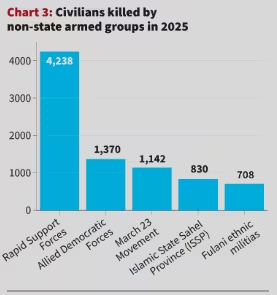
- Non-state actors caused around 60% of civilian deaths overall.
Role of Non-State Armed Groups
- Sudan’s Rapid Support Forces (RSF) killed over 4,200 civilians in 2025.
- Other major groups included: Allied Democratic Forces (ADF), M23 rebel group in Africa
- Many deaths are likely underreported.
Changing Nature of Warfare
- Increased use of commercial drones by armed groups.
- Nearly 470 non-state groups used drones in the last five years.
- Shows easy access to advanced technology and evolving conflict methods.
Conclusion
The ACLED Global Conflict Trends Report 2025 paints a troubling picture of intensifying conflicts, expanding state-led violence, and eroding civilian protection mechanisms. It underscores the urgent need for stronger international conflict prevention frameworks, accountability of state actors, and reinforced humanitarian safeguards.
For UPSC aspirants preparing International Relations and Security issues through institutions like the Best IAS Academy in Hyderabad, this report provides crucial data and analytical depth for both Mains answers and essays.
This topic is available in detail on our main website.