
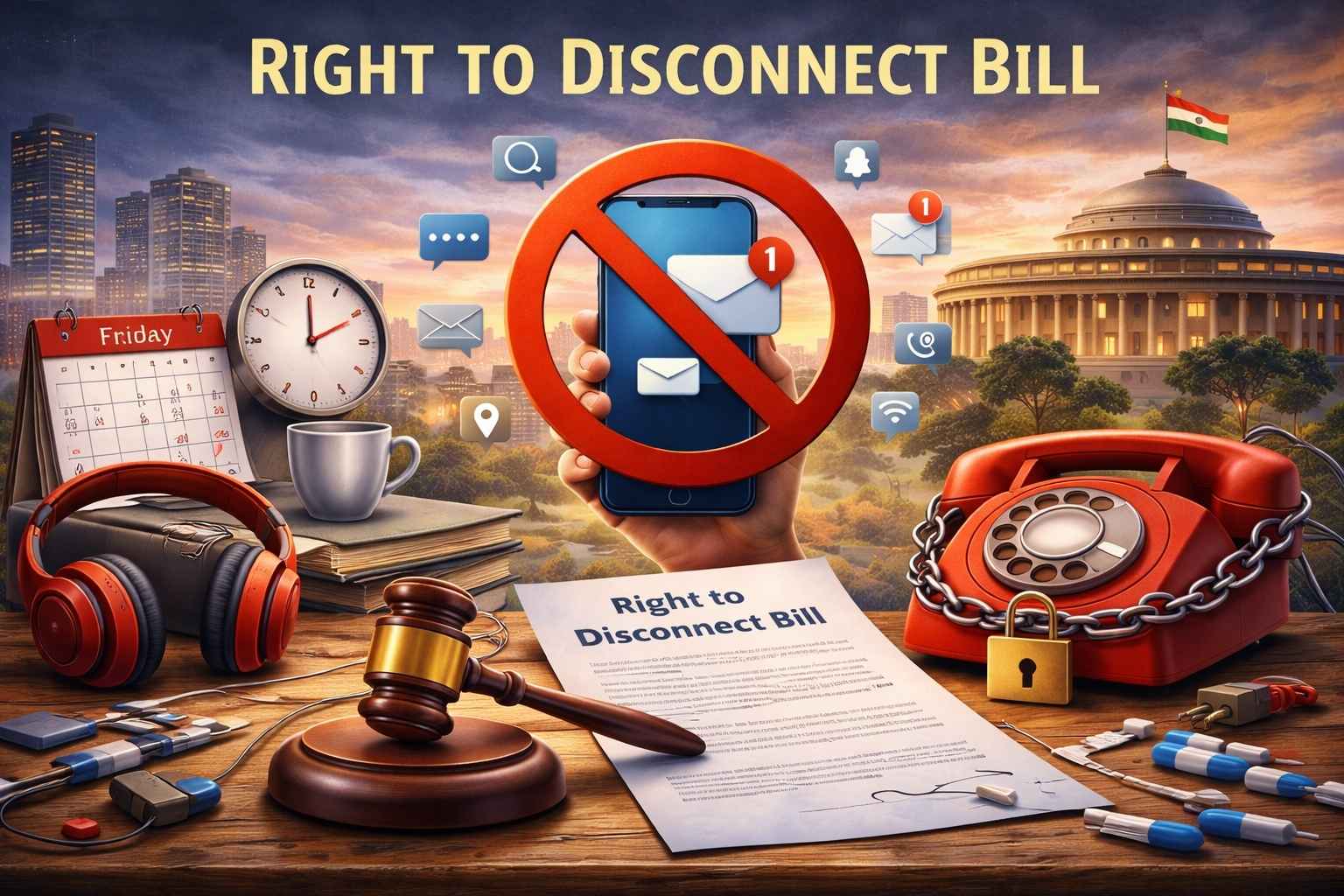
The Right to Disconnect Bill was recently introduced as a private member’s bill in Parliament, aiming to protect employees from work-related digital communication beyond office hours. The issue has gained attention in policy discussions and is increasingly analysed in governance and social justice modules for aspirants preparing through UPSC coaching in Hyderabad.
Background
- Introduced amid India’s labour law reforms under four consolidated labour codes.
- Seeks to regulate after-hours work communication in the digital age.
- Reflects the need to rethink labour laws in a tech-driven work environment, a theme relevant to contemporary GS Paper II and III debates at the Best IAS Academy in Hyderabad.
Key Provisions
- Grants employees the right to ignore work-related calls, emails, or messages after official working hours.
- Aims to reduce stress and improve work-life balance.
- Does not clearly define what constitutes “work” in a digital context.
Legal Ambiguities
- The Bill does not align with the Occupational Safety, Health and Working Conditions Code, 2020.
- Fails to clarify whether digital engagement after hours qualifies as “work” under current labour laws.
- Operates more as a behavioural guideline than a legally enforceable labour standard.
Global Comparisons
- European Union: Defines work based on employer control, including standby and on-call time.
- France: Uses collective bargaining to integrate digital communication into work-rest schedules.
- Germany: Enforces strict rules on working hours and rest periods.
- These examples show how other countries treat availability under employer control as working time.
Constitutional Angle
- The Bill hints at a link with Article 21 (Right to Life and Personal Liberty), which includes the right to personal autonomy.
- However, it does not explicitly establish this connection or explain how the right is protected constitutionally.
Concerns and Way Forward
- It remains unclear whether the right is a mandatory labour standard or one that can be modified through contracts.
- Effective implementation requires integration with existing labour codes.
- Clear legal recognition of digital labour and its status is essential.
- The Bill initiates a wider national debate on digital rights, workplace autonomy, and employee well-being—an evolving issue frequently discussed in policy analysis sessions at Top UPSC Coaching in Hyderabad.
Conclusion
The Right to Disconnect Bill highlights the growing clash between digital work and personal autonomy. Its gaps show the need to integrate digital labour into India’s legal framework to truly protect workers’ rights.
This topic is available in detail on our main website.