
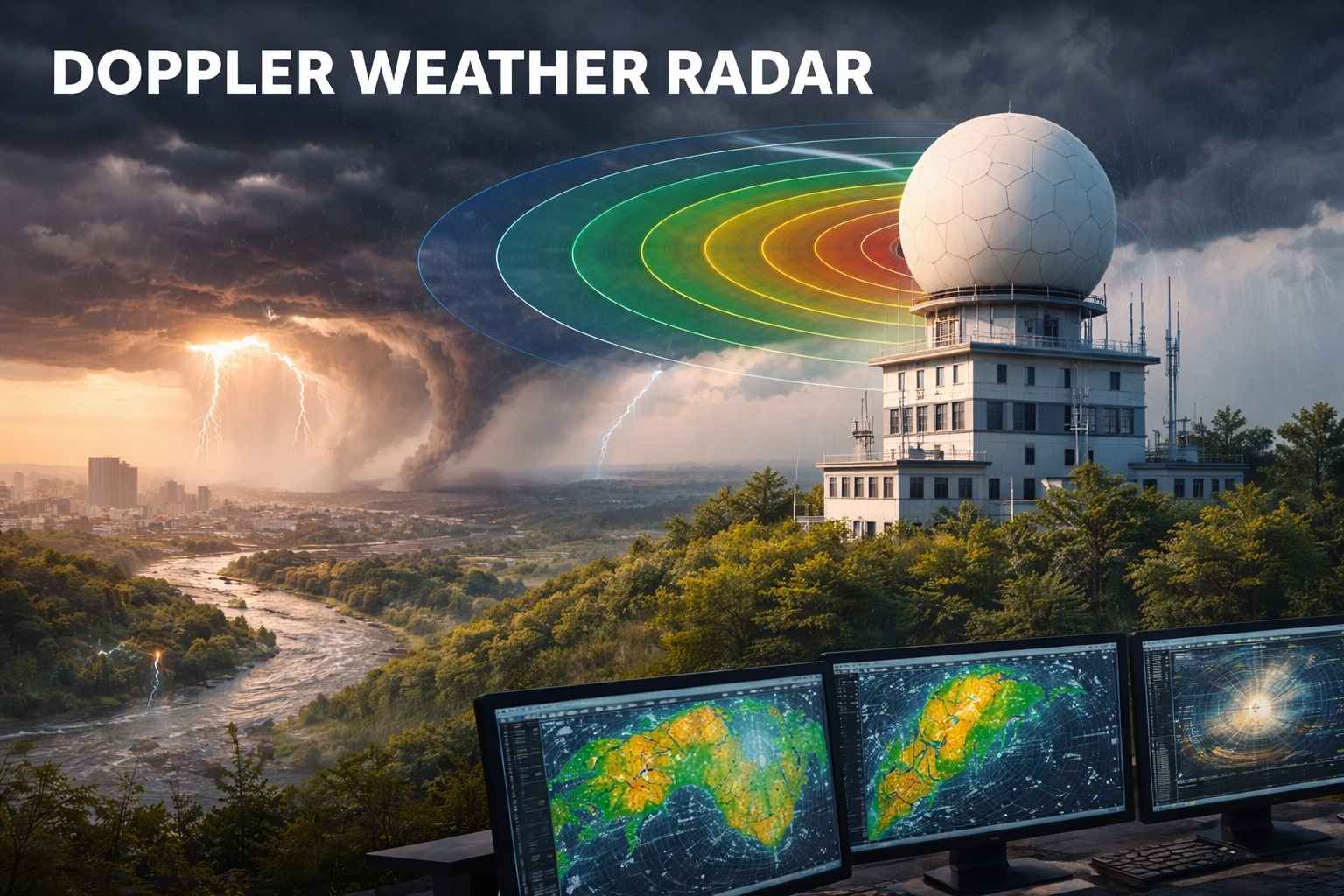
The Minister of State for Earth Sciences recently announced that India currently operates 47 Doppler Weather Radars (DWRs) to monitor atmospheric conditions and improve forecasting accuracy. Such developments in weather technology are an important part of geography and disaster-management discussions for aspirants preparing through UPSC coaching in Hyderabad.
Doppler Weather Radar
- A Doppler radar is a specialized system that applies the Doppler effect to measure both the velocity and position of distant objects.
- Unlike conventional radars, it can detect not only where a target is located but also how it is moving, making it crucial for weather observation.
Working of Doppler Weather Radars
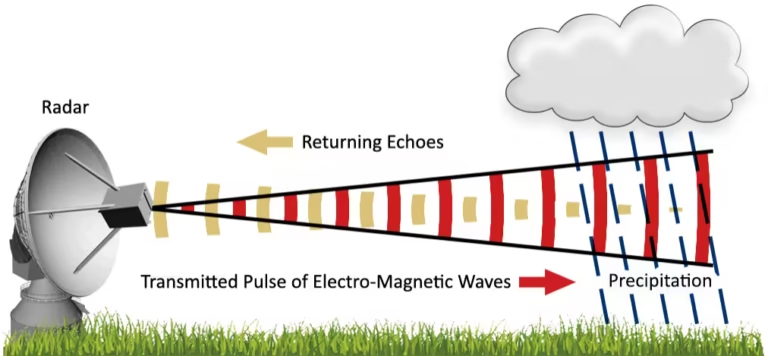
- The radar antenna emits radio waves into the atmosphere.
- When these waves encounter raindrops or other particles, the energy scatters, with part of it returning to the radar.
- The size of the object determines the strength of the reflected signal.
- By calculating the time taken for the signal to return, meteorologists can identify precipitation, its distance, and movement.
- This process enables real-time visualisation of rainfall patterns and continuous tracking of storm systems, a concept regularly explained in physical geography classes at the Best IAS Academy in Hyderabad.
Types of Radar Bands
- S-band: Suitable for long-range weather surveillance.
- C-band: Commonly used for cyclone monitoring.
- X-band: Effective for detecting thunderstorms and lightning. These frequency bands are widely deployed by the India Meteorological Department (IMD).
Applications
- Coverage extends up to 500 km, allowing monitoring of large weather systems.
- Helps track cloud bands, rainfall intensity, and storm movement.
- Plays a vital role in cyclone prediction, flood warnings, and disaster preparedness, making it highly relevant for GS Paper I and III preparation at Top UPSC Coaching in Hyderabad.
This topic is available in detail on our main website.