

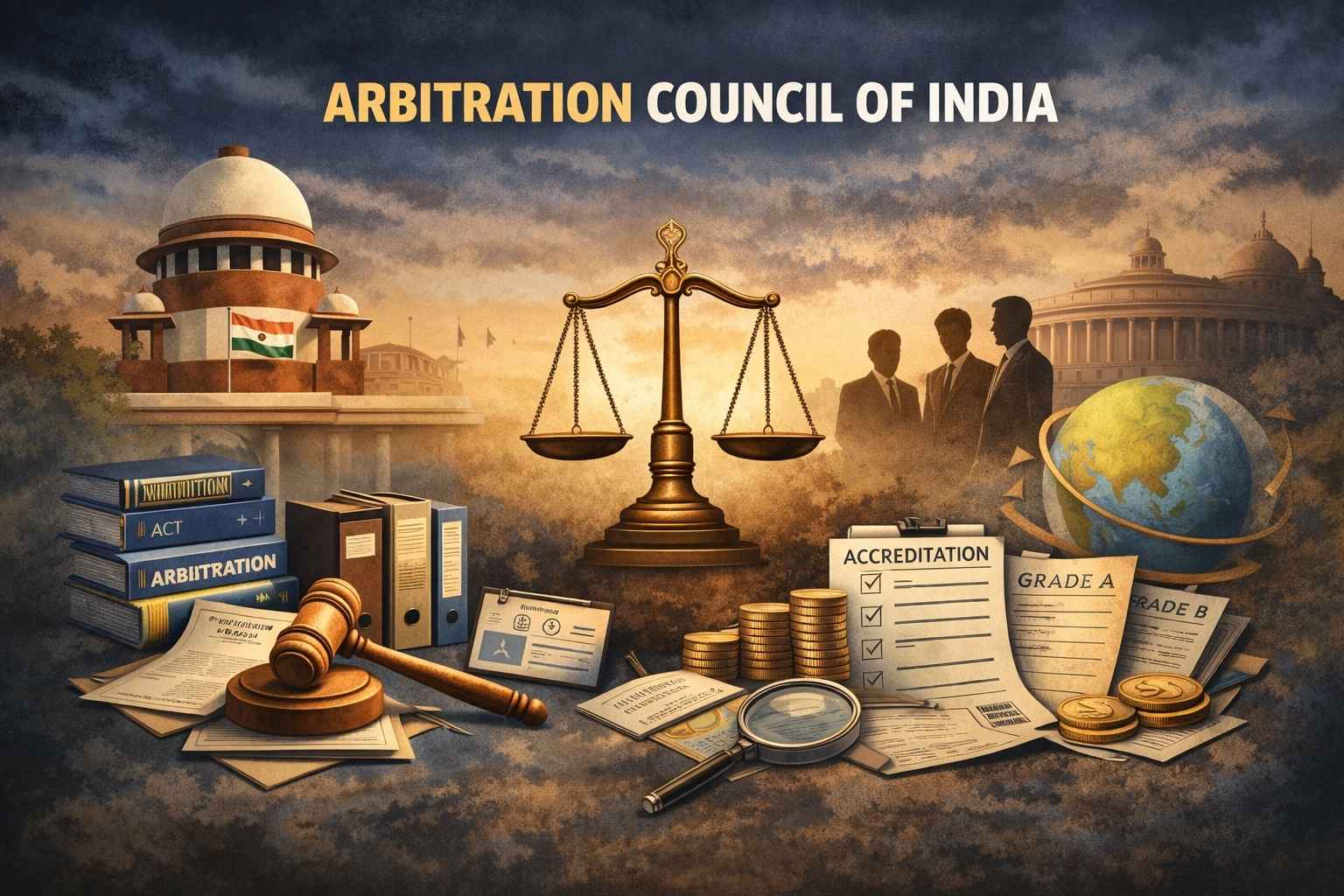
Nearly six years after the 2019 amendment to the Arbitration and Conciliation Act, the Union government has not yet set up the Arbitration Council of India (ACI). Its absence has slowed reforms in India’s arbitration system and global competitiveness—an issue often discussed in governance and economy modules of IAS coaching in Hyderabad.
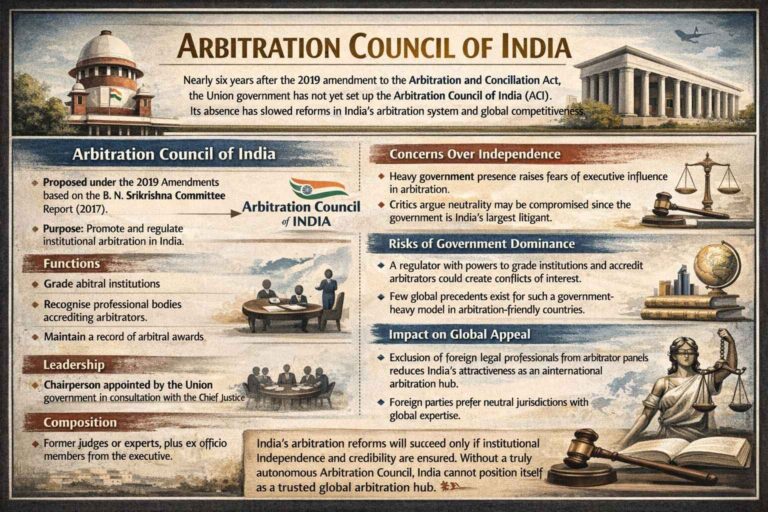
Arbitration Council of India
- Proposed under the 2019 amendments based on the B. N. Srikrishna Committee Report (2017).
- Purpose: Promote and regulate institutional arbitration in India.
- Functions: Grade arbitral institutions. Recognise professional bodies accrediting arbitrators. Maintain a record of arbitral awards.
- Leadership: Chairperson to be appointed by the Union government in consultation with the Chief Justice of India.
- Composition: Former judges or experts, plus ex officio members from the executive.
Concerns Over Independence
- Heavy government presence raises fears of executive influence in arbitration.
- Critics argue neutrality may be compromised since the government is India’s largest litigant Hyderabad IAS coaching.
Risks of Government Dominance
- A regulator with powers to grade institutions and accredit arbitrators could create conflicts of interest.
- Few global precedents exist for such a government-heavy model in arbitration-friendly countries.
Accreditation Model Issues
- Inspired by Singapore and Hong Kong but differs in design.
- Those countries rely on a single strong arbitral institution, not a regulator.
- Allowing unlimited accreditation may dilute standards, increase costs, and burden administration.
Impact on Global Appeal
- Exclusion of foreign legal professionals from arbitrator panels reduces India’s attractiveness as an international arbitration hub.
- Foreign parties may prefer neutral jurisdictions offering global expertise—an issue relevant for GS-III and essay papers for aspirants enrolled in UPSC coaching in Hyderabad.
Way Forward
- Ad hoc arbitration dominates due to distrust in domestic institutions.
- To build credibility, India must: Ensure independence of arbitral bodies. Strengthen governance and transparency.
- Only then can Indian centres compete with global hubs like Singapore and London.
Draft Arbitration Reform Bill, 2024
Key Proposals:
- Redefine arbitral institutions (broader definition, not limited to court designation).
- Transfer certain powers from courts to institutions (extend timelines, reduce fees, replace arbitrators).
- Limit courts’ interim relief powers to two stages: before arbitration begins and after award.
- Amend Section 9(2): 90-day rule clock to start from filing of interim application.
- Introduce emergency arbitration (Section 9-A) for quick remedies before tribunal formation.
Conclusion:
India’s arbitration reforms will succeed only if institutional independence and credibility are ensured. Without a truly autonomous Arbitration Council, India cannot position itself as a trusted global arbitration hub.
This topic is available in detail on our main website.