

The Delhi High Court recognised unpaid domestic labour as a valid economic contribution within marriage, reframing marriage as a partnership — a constitutional and social justice issue often discussed in UPSC coaching in Hyderabad while analysing gender justice and legal reforms in India.
Homemaking as Economic Contribution
• Recognition of Unpaid Labour: Household management, childcare, and relocation support are treated as economic inputs that sustain the earning spouse’s productivity.
• Partnership Model: Marriage is defined as an economic partnership where contributions may differ but remain equally valuable.
• Legal Entitlement: Moves domestic work from moral appreciation to enforceable legal recognition.
• Enabling Function: Homemaker’s labour facilitates continuity of the earning spouse’s career, including overseas employment.
Educational Qualification vs Maintenance Claim
• Capacity vs Actual Income: Courts must distinguish between theoretical earning ability and proven income.
• Burden of Proof: Denial of maintenance requires evidence of stable taxable income.
• Judicial Clarification: Degrees or employability potential cannot be grounds to refuse maintenance.
Re-entry Barriers After Career Breaks
• Career Disruption: Recognises difficulties in rejoining the workforce after caregiving breaks.
• Gendered Labour Market: Acknowledges structural challenges faced by women in employment continuity.
• Realistic Assessment: Maintenance must be based on present income, not hypothetical opportunities.
• Preventive Safeguard: Protects spouses from being penalised for prioritising household responsibilities.
Scope of Maintenance under Section 125 CrPC & PWDVA
• Social Justice Mandate: Ensures financial support for wives unable to maintain themselves.
• Interim Relief: Provides monetary assistance during proceedings.
• Fairness Mechanism: Treats maintenance as equitable adjustment within marital partnership.
• Rejects Dependency Narrative: Homemaking is not voluntary withdrawal but an economic role.
Judicial Trend
• Kerala HC (Kannan Nair v. Kamala Amma): Recognised homemaking as financial contribution in property disputes.
• Delhi HC (Saurjan Saha v. Rumpa Saha): Rejected demand for proof of negative income.
• Doctrinal Evolution: Strengthens gender-sensitive interpretation of maintenance laws.
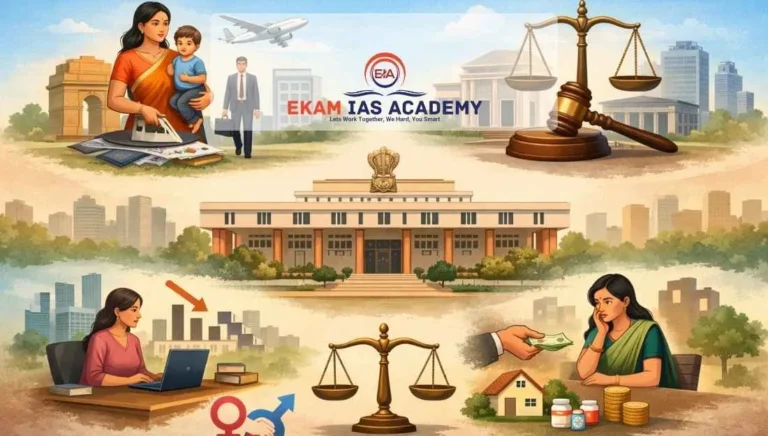
Gender Justice Dimension
• Structural Inequality: Women disproportionately perform unpaid domestic labour.
• Economic Invisibility: Household work excluded from GDP despite enabling workforce participation.
• Substantive Equality: Recognition advances Article 14-based equality beyond formal neutrality.
• Corrective Role of Judiciary: Counters patriarchal assumptions equating worth with paid employment — an issue frequently analysed in IAS coaching in Hyderabad while discussing constitutional rights and gender justice.
• Welfare Responsibility: Maintenance law ensures dignity and security for non-earning spouses.
Conclusion
The Delhi HC ruling separates earning potential from actual income, reinforces marriage as a partnership, and strengthens substantive equality under constitutional guarantees of dignity and fairness — themes widely covered in UPSC online coaching for GS2 Polity and governance preparation.
This topic is available in detail on our main website.