

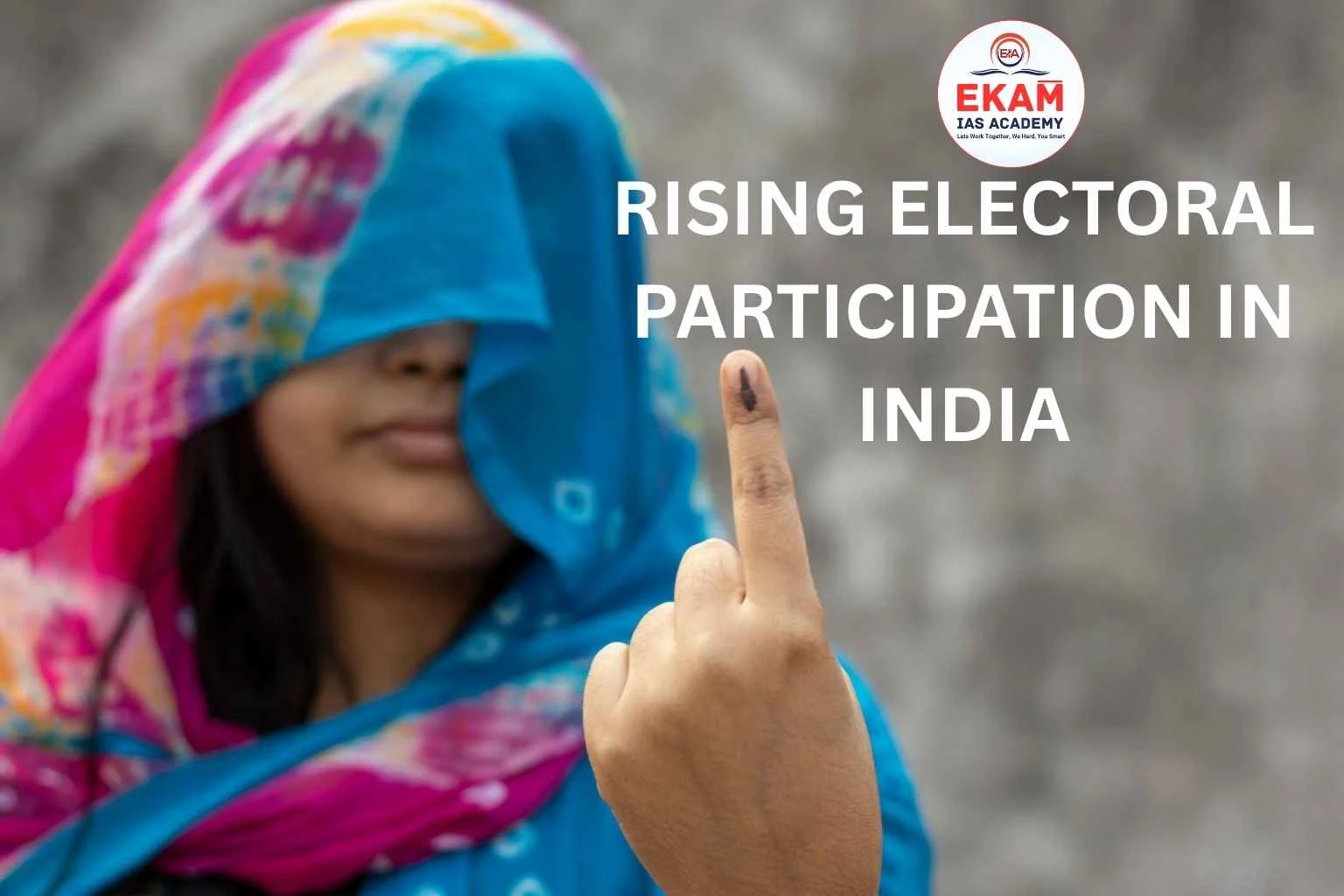
Recent data shows that voter turnout has steadily increased across most Indian States over the past decade, indicating a deeper and long term trend of electoral engagement rather than a sudden surge linked to recent roll revisions. This polity topic is important for aspirants preparing through IAS coaching in Hyderabad, UPSC coaching in Hyderabad, and UPSC online coaching.
Broad Pattern of Rising Turnout
• Across Regions: Growth visible in diverse States with different political contexts.
• Examples:
• Gujarat: 59.77% (2007) → 64.84% (2022).
• Uttar Pradesh: 45.96% → 61.08%.
• Goa: 70.51% → 81.89%.
• Manipur: 86.73% → 90.28%.
• Other States: Karnataka, Madhya Pradesh, Rajasthan, Chhattisgarh all show upward trends.
Exceptions to the Trend
• Decline: Punjab (76.04% → 72.15%), Haryana (72.37% → 67.89%).
• Stability/Decline: Meghalaya, Mizoram, Nagaland, Tripura.
• Lesson: Turnout growth is not automatic; shaped by local politics, competition, and administration.
High Turnout States Maintaining Growth
• Arunachal Pradesh: 79.45% (2009) → 86.89% (2024).
• Puducherry: 86.19% (2011) → 89.85% (2026).
• Kerala: 75.26% → 78.27%.
• Tamil Nadu: 78.29% → 85.15%.
• West Bengal: 84.72% → 92.47% (2026).
• Insight: Even States with already high participation show further increases.
Long Term Trend Across Cycles
• Andhra Pradesh: 72.72% (2009) → 81.79% (2024).
• Odisha: 65.35% → 74.79%.
• Jharkhand: 57.03% → 67.66%.
• Bihar: 52.73% (2010) → 67.67% (2025).
• Message: Participation has broadened steadily across India, not just in isolated cases.
Role of Special Intensive Revision (SIR)
• SIR recalibrates voter rolls, sometimes raising turnout percentages.
• Effect is additive, not foundational — turnout was already rising before SIR.
• Important to distinguish between denominator effects and genuine mobilisation.
Significance of Rising Participation
• Reflects stronger political engagement and mobilisation by parties/institutions.
• Indicates changing voter attitudes and awareness of electoral importance.
• Strengthens democratic legitimacy by expanding participation base.
• Exceptions highlight need to study local variations rather than assume uniformity.
Conclusion
While roll revisions may amplify percentages, the broader story is one of expanding participation and stronger electoral mobilisation, though exceptions remind us that turnout depends on local political dynamics.
For aspirants preparing through IAS coaching and civils coaching in Hyderabad, this topic is highly relevant for GS2 Polity, especially electoral reforms and democratic participation.
This topic is available in detail on our main website.
One thought on “Rising Electoral Participation In India”