
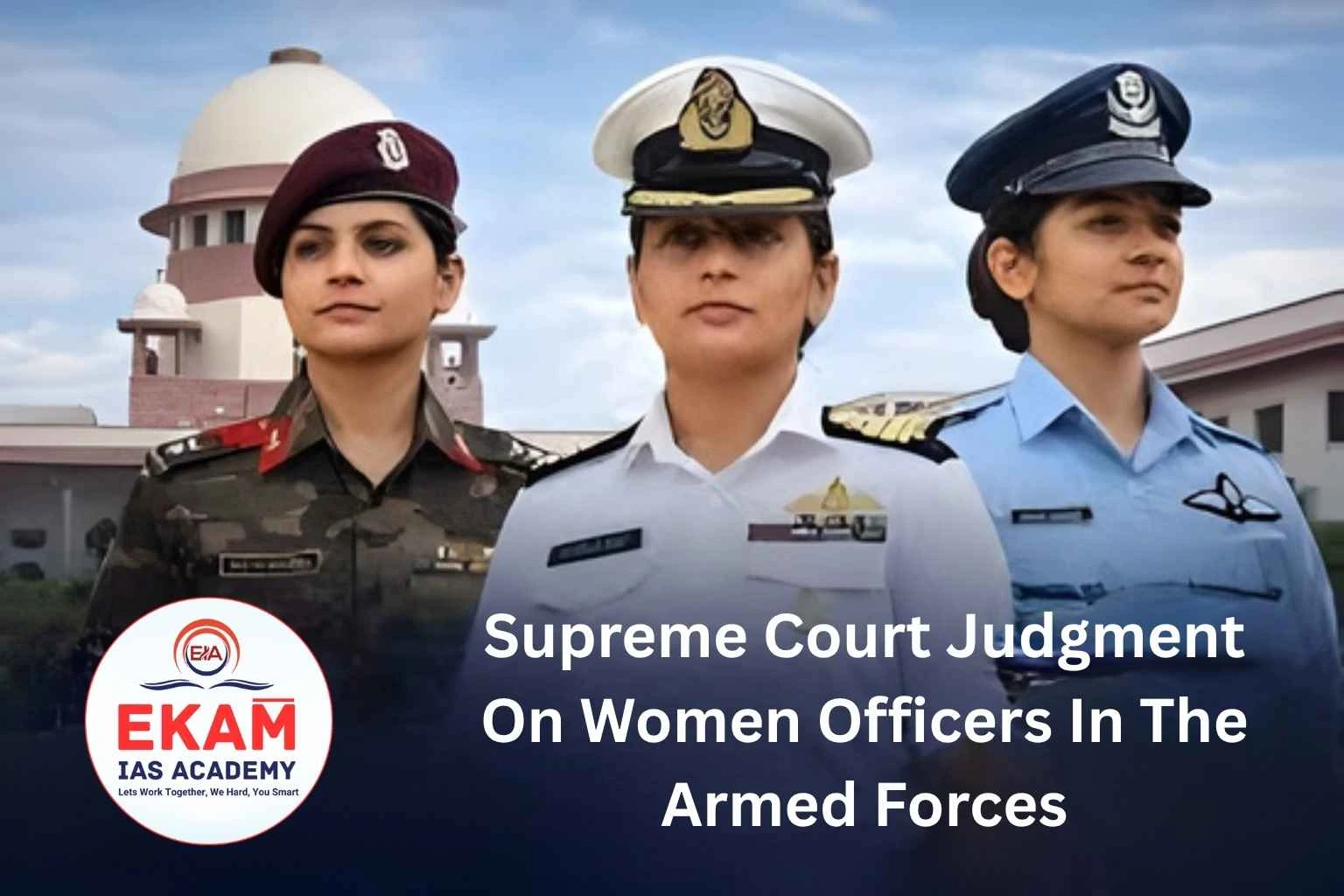
The Supreme Court upheld permanent commission and pensionary benefits for women officers in the Army, Air Force, and Navy, flagging systemic bias and unequal opportunities faced by them. Such governance and constitutional developments are important for aspirants preparing through IAS coaching in Hyderabad, UPSC online coaching, and other civil services preparation programs.
Background
• Women officers under Short Service Commission (SSC) were historically denied permanent commission (PC).
• Their Annual Confidential Reports (ACRs) were graded casually, limiting career progression.
• Supreme Court interventions over the years have gradually expanded women’s rights in the Armed Forces.
Understanding such legal developments is essential for students preparing through UPSC coaching in Hyderabad and Hyderabad IAS coaching institutes, where polity and constitutional issues are key parts of the UPSC syllabus.
Observations of the Court
• Systemic Bias: Women officers were presumed to have no long-term career, leading to lower grading in ACRs.
• Unequal Playing Field: Male SSC officers received higher grades as they were eligible for PC, unlike women.
• Career Hindrances: Women were not recommended for career-enhancing courses, resulting in diminished service profiles.
• Constitutional Obligation: Inclusion of women SSC officers in PC consideration is not discretionary but mandated by equality principles under Articles 14 and 15.
• Vacancy Cap Not Absolute: Court held that annual caps on PC vacancies are neither sacrosanct nor immutable.
These judicial observations are frequently analysed in IAS coaching and civils coaching in Hyderabad, helping aspirants develop strong analytical answers for GS Paper 2.
Importance of the Judgment
• Gender Equality: Reinforces equal opportunity and dignity for women officers.
• Military Inclusion: Recognises women’s role in long-term service and leadership.
• Pensionary Benefits: Ensures financial security and parity with male counterparts.
• Institutional Reform: Calls out structural discrimination in Armed Forces evaluation systems.
Such governance insights are widely discussed in UPSC online coaching and structured UPSC coaching in Hyderabad programs.
Constitutional & Legal Basis
• Article 14: Equality before law.
• Article 15(1): Prohibition of discrimination on grounds of sex.
• Article 15(3): Allows special provisions for women.
• Article 16: Equality of opportunity in public employment.
• Past Precedent: Supreme Court’s 2020 judgment (Babita Punia case) upheld PC for women in the Army.
These constitutional principles are core topics covered in Hyderabad IAS coaching programs for UPSC preparation.
Women in Indian Armed Forces (2026)
• Total Women Officers: ~11,000 across Army, Navy, and Air Force.
Recent Milestones
• First batches of women cadets graduated from the National Defence Academy (NDA) in 2025.
• Women now serve as fighter pilots, warship commanders, and at Lieutenant General rank.
• Permanent Commission: Supreme Court rulings (2020, 2025) upheld women’s right to permanent commission and pensionary benefits.
• Combat Roles: Women inducted into combat aviation (Air Force fighter pilots since 2016) and expanding into artillery and command positions.
Such developments are often discussed in IAS coaching and civils coaching in Hyderabad, especially for answer enrichment in UPSC Mains.
Conclusion
The Supreme Court’s ruling marks a landmark step in gender justice. It strengthens constitutional guarantees of equality and sets a precedent for institutional reforms in defence services. For aspirants preparing through IAS coaching in Hyderabad, UPSC coaching in Hyderabad, and UPSC online coaching, such topics are crucial for mastering polity and governance sections in UPSC.
This topic is available in detail on our main website.